
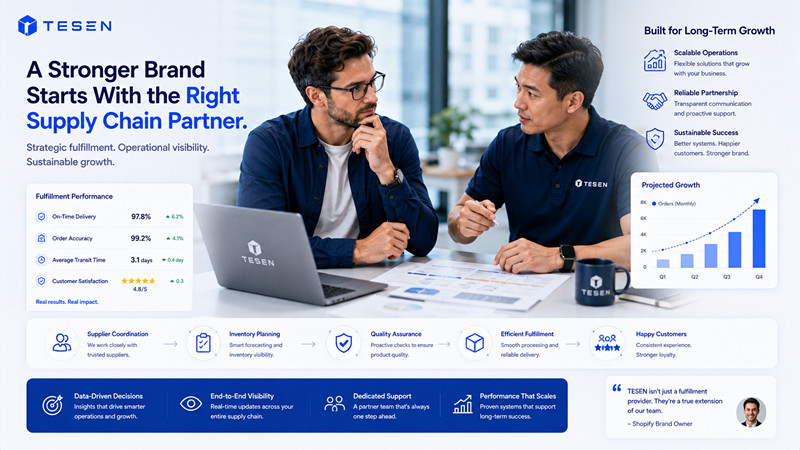
When an ecommerce business first launches, choosing a fulfillment partner often seems straightforward.
The primary concerns are usually:
At this stage, fulfillment is viewed mainly as a logistics function.
However, as Shopify brands grow, the role of a fulfillment partner changes dramatically.
Fulfillment becomes closely connected to customer experience, inventory management, operational efficiency, and long-term business growth.
For scaling brands, choosing a reliable fulfillment partner is no longer simply about moving parcels.
It is about building a stable operational foundation.
During the early stages of an ecommerce business, occasional fulfillment issues may have only a limited impact.
A delayed shipment or inventory discrepancy might affect only a handful of customers.
As order volume increases, however, those same issues begin affecting dozens or even hundreds of orders.
Operational complexity grows rapidly.
Brands must coordinate:
Without reliable fulfillment processes, operational pressure increases quickly.
Many growing ecommerce brands improve their marketing performance while leaving fulfillment operations unchanged.
Initially, sales increase.
Soon afterward, operational challenges begin to appear.
Common issues include:
The business continues growing.
But operational stability begins weakening behind the scenes.
At TESEN, we've seen this pattern repeatedly.
One ecommerce brand selling across Europe experienced rapid sales growth after several successful marketing campaigns.
Order volume increased significantly.
However, the company's fulfillment processes remained largely unchanged.
Within weeks, new operational challenges emerged:
After improving fulfillment planning, inventory coordination, and operational workflows, the business regained control over its growth.
The company learned that sustainable scaling depends on reliable fulfillment systems—not simply higher sales.
As businesses grow, the role of a fulfillment partner extends far beyond shipping.
Reliable partners help brands improve visibility, consistency, and operational control.
Key capabilities include:
Helping brands maintain accurate inventory and reduce stockouts.
Working closely with suppliers to improve replenishment and production planning.
Maintaining consistent processing workflows as order volume increases.
Providing predictable delivery timelines and tracking visibility.
Giving brands clear insights into inventory, orders, and fulfillment performance.
As businesses scale, price becomes only one factor in the decision-making process.
Leading brands increasingly evaluate partners based on:
| Selection Criteria | Why It Matters |
|---|---|
| Operational reliability | Reduces fulfillment disruptions |
| Inventory visibility | Improves planning and forecasting |
| Tracking consistency | Enhances customer experience |
| Supplier coordination | Prevents inventory shortages |
| Scalability | Supports long-term growth |
A fulfillment partner should grow with the business—not become a bottleneck.
The right fulfillment partner does more than ship orders.
They help create:
These capabilities become increasingly valuable as order volume grows.
For Shopify brands in 2026, fulfillment is no longer simply a logistics service.
It is a strategic business function.
As businesses scale, reliable fulfillment partners help brands maintain operational stability while continuing to grow.
The strongest fulfillment strategy is not simply finding the lowest shipping cost.
It is choosing a partner capable of supporting sustainable growth through consistent operations, inventory visibility, supplier coordination, and reliable fulfillment performance.
Because long-term ecommerce success is built on operational reliability.
As order volume increases, fulfillment affects inventory management, customer experience, supplier coordination, and operational efficiency. A reliable partner helps manage this growing complexity.
If you experience frequent shipping delays, inventory inaccuracies, poor communication, or your current provider struggles to support increasing order volumes, it may be time to evaluate other options.
Look for inventory visibility, reliable order processing, supplier coordination, tracking consistency, operational reporting, and the ability to scale with your business.
Yes. Many fulfillment partners support inventory synchronization, stock reporting, demand forecasting, and supplier coordination to help brands avoid stock shortages and overselling.
Consistent processing, accurate inventory, reliable tracking, and predictable delivery timelines reduce customer uncertainty and improve satisfaction.
Not always. Lower shipping costs can be outweighed by higher operational costs caused by fulfillment errors, delayed processing, and inconsistent service.
TESEN is a China-based fulfillment and supply chain partner helping Shopify and ecommerce brands with product sourcing, supplier coordination, quality control, inventory management, warehousing, order fulfillment, private labeling, and global shipping solutions.
Source Your Products and Start Dropshipping
 IPv6 network supported