
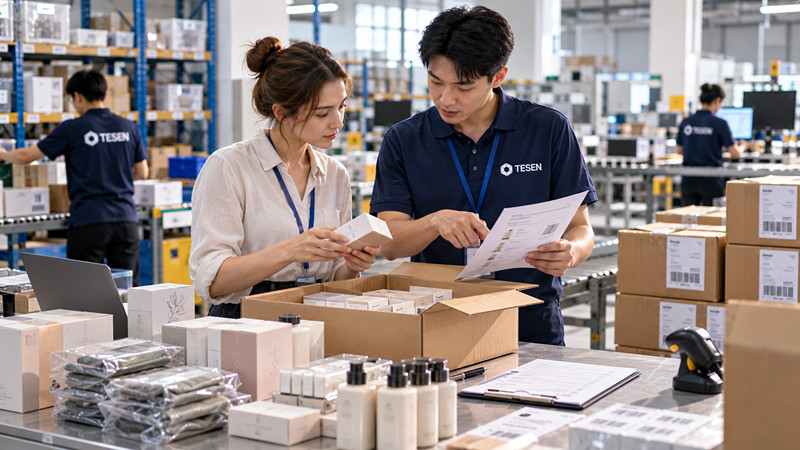
Choosing a third-party logistics (3PL) provider in China can seem straightforward.
You need a warehouse to receive products, store inventory, pick and pack orders, and ship parcels to customers.
So you request quotations from several China 3PL companies and compare storage fees, handling charges, and international shipping rates.
But for a Shopify or DTC brand sourcing products from Chinese suppliers, those numbers only tell part of the story.
Your fulfillment partner may need to coordinate multiple suppliers, verify incoming inventory, manage product quality issues, prepare custom packaging, synchronize Shopify orders, and resolve fulfillment exceptions.
A provider offering the lowest pick-and-pack fee may not be the best operational fit.
The right China 3PL should connect your suppliers, inventory, ecommerce orders, and international fulfillment—not simply provide warehouse space.
This guide explains how to evaluate a China 3PL, which questions to ask, and how to compare providers based on the actual requirements of your ecommerce business.
A China 3PL is a third-party logistics provider that manages outsourced logistics operations from China.
For ecommerce brands, these services may include:
Inventory receiving and warehousing
SKU identification and stock management
Order picking and packing
Custom packaging and kitting
International parcel fulfillment
Shipment tracking and order updates
Some China 3PL providers also offer supplier coordination, product sourcing, quality control, and other preparation services.
However, capabilities differ significantly between providers.
A traditional warehouse may focus on storage and dispatch.
An ecommerce-focused China fulfillment provider may support the broader operational process connecting Chinese suppliers with customer orders.
For Shopify and DTC brands, that distinction matters.
Before comparing warehouse rates, examine how your products reach the fulfillment operation.
Ask:
Where are your products manufactured?
How many suppliers are involved?
How frequently do suppliers deliver inventory?
Do products and packaging come from different factories?
Do you need help communicating with suppliers?
Consider a Shopify brand working with four Chinese suppliers.
| Supplier | Product or material |
|---|---|
| Supplier A | Main product |
| Supplier B | Accessories |
| Supplier C | Custom packaging |
| Supplier D | Printed inserts |
All four suppliers support the same customer-order operation.
A suitable China 3PL should have a clear receiving process for identifying which products belong to which SKU and supplier shipment.
It should also be able to report quantity discrepancies and identify missing components.
How do you identify incoming deliveries from different suppliers?
Can suppliers ship directly to your warehouse?
How do you verify quantities against expected shipments?
Can you receive packaging and accessories separately?
How are discrepancies reported?
Can your team communicate with suppliers when problems occur?
A warehouse that handles one large inbound shipment well may not necessarily be suitable for frequent deliveries from multiple factories.
One of the most important questions to ask a China 3PL is:
What happens after my supplier delivers inventory to your warehouse?
Supplier delivery does not automatically mean that all products are ready for customer orders.
A practical receiving workflow may include:
Supplier Delivery → Receiving → SKU Verification → Required QC → Inventory Release → Fulfillment
For example, suppose a supplier sends 500 units.
The warehouse physically receives only 480.
Or perhaps all 500 arrive, but 30 have damaged packaging.
A reliable inventory process should distinguish these situations.
The business needs to know:
How many units were expected
How many physically arrived
How many were accepted
How many require further action
How many are available for fulfillment
This is especially important when inventory is synchronized with Shopify.
If the storefront treats unavailable stock as sellable inventory, the brand may accept orders the warehouse cannot fulfill.
Many China 3PL providers advertise quality-control services.
But the more useful question is not simply whether QC is available.
It is what happens when an issue is identified.
A practical QC process should connect inspection results with inventory decisions.
| QC result | Possible inventory action |
|---|---|
| Product passes | Release for fulfillment |
| Potential issue identified | Place on hold |
| Correctable issue | Rework or repackaging |
| Product rejected | Supplier resolution or other approved action |
Consider a shipment of 200 units.
During an agreed inspection, 40 units are identified as potentially defective.
The warehouse may release 160 approved units while holding the remaining 40 for further instructions.
The brand should understand whether the provider can:
Identify affected SKUs and quantities
Supply inspection evidence
Prevent held products from entering normal fulfillment
Coordinate approved corrective work
Communicate with the supplier when necessary
Inspection without a clear next action can leave the brand managing unresolved inventory problems remotely.
A warehouse dashboard showing 500 units of a SKU is useful.
But a growing ecommerce brand may need more information.
For example:
| Inventory category | Operational meaning |
|---|---|
| Available | Eligible for new customer orders |
| Reserved | Already allocated or committed |
| Pending receiving | Awaiting verification |
| QC Hold | Not released due to inspection concerns |
| Rework | Requires approved corrective work |
| Damaged | Not suitable for normal fulfillment |
The exact inventory statuses vary by provider and system.
What matters is whether the inventory information supports real fulfillment decisions.
Can I view inventory by SKU and variant?
When is received inventory recorded?
How are stock adjustments documented?
How are damaged or held units treated?
How are inventory discrepancies reported?
How are reserved quantities handled?
For Shopify brands, also confirm which inventory quantity is synchronized with the storefront and how frequently it updates.
A visually impressive dashboard is not enough if the numbers do not accurately reflect warehouse operations.
Two brands processing 100 orders per day may have very different fulfillment requirements.
Consider the following comparison.
| Brand A | Brand B | |
|---|---|---|
| Average items per order | 1 | 3 |
| Product variants | Few | Many |
| Packaging | Standard mailer | Custom branded packaging |
| Accessories | None | Frequently included |
| Inserts | None | Required |
| Kitting | Not required | Required for selected products |
Both brands have the same daily order volume.
But Brand B requires more component handling, inventory coordination, and packing instructions.
When evaluating a China 3PL, provide:
Number of SKUs
Number of product variants
Average items per order
Daily and monthly order volume
Bundle configurations
Custom packaging requirements
Product handling instructions
Seasonal order fluctuations
Order volume indicates how many orders need to be processed. SKU and order structure determine how complex those orders are to fulfill.
A provider should be evaluated against both.
For DTC brands, kitting and packaging are not always simple add-on services.
They can affect inventory availability.
Suppose a brand sells a starter kit containing:
Product A
Accessory B
Insert C
The warehouse has:
| Component | Available quantity |
|---|---|
| Product A | 500 |
| Accessory B | 200 |
| Insert C | 800 |
If each kit requires one unit of every component, the maximum theoretical number of complete kits is 200.
Accessory B is the limiting component.
A suitable fulfillment partner should understand both the physical assembly process and the inventory requirements behind it.
Can you assemble products into finished kits?
Can finished kits have their own SKUs?
How are component quantities adjusted?
Can components also be sold individually?
Can branded boxes, pouches, and inserts be tracked?
What happens when a required component is unavailable?
Are kitting and packaging charged separately?
Brands should also clarify whether kits are assembled in advance or prepared when customer orders arrive.
These two approaches have different inventory and handling implications.
For Shopify brands, ecommerce integration is a major part of the fulfillment relationship.
A typical connected workflow is:
Shopify Order → 3PL System → Pick and Pack → Shipment → Tracking Update
However, the phrase "Shopify integration" does not guarantee that every workflow is automated.
Before selecting a China 3PL, verify what the integration actually supports.
Order synchronization
Do new Shopify orders automatically enter the fulfillment system?
Inventory synchronization
Which inventory quantities are updated, and how frequently?
Tracking synchronization
Are shipment tracking numbers and fulfillment updates sent back to Shopify?
Order changes
What happens if a customer changes an address or requests cancellation after an order has synchronized?
Multiple stores
Can the provider support more than one Shopify store under the intended account setup?
Integration failures
How are synchronization errors detected and corrected?
A practical way to evaluate integration is to test it before transferring substantial inventory.
For example, create a test order, confirm that it reaches the fulfillment system, and verify the tracking-update workflow.
Brands should also test exception scenarios where supported.
A successful basic connection does not necessarily demonstrate how the system handles operational problems.
Normal orders are only part of the fulfillment process.
Operational differences between providers often become clearer when something goes wrong.
Common exceptions include:
Supplier quantity shortages
Incorrect SKUs
Barcode mismatches
Damaged products
Missing packaging
QC issues
Inventory discrepancies
Incomplete customer addresses
Unavailable shipping routes
A useful exception-management process should clarify:
Detection → Hold or Containment → Evidence → Communication → Decision → Resolution
For example, a warehouse discovers that 50 units arrived with the wrong packaging.
The important questions are:
Who identifies the problem?
Who receives the report?
Are the affected units placed on hold?
Can the warehouse provide photos?
Who contacts the supplier?
Does the brand need to approve replacement packaging?
When can the inventory be released?
A China 3PL that can identify an issue but cannot communicate the next steps may leave the brand managing the problem remotely.
This is why exception ownership should be part of the provider-selection process.
For ecommerce brands based in Europe, North America, Australia, or the Middle East, supplier communication can become a significant operational challenge.
The supplier operates in China.
The warehouse operates in China.
But the brand's management team may be thousands of miles away.
When a supplier delivers the wrong SKU or a batch requires rework, the brand needs a clear process for resolving the issue.
Ask:
Who will be our primary account contact?
Can your team communicate with Chinese suppliers?
How are supplier issues documented?
Can you provide photos or videos when needed?
Which actions require our approval?
What communication channels are available?
How are unresolved issues escalated?
The goal is not to give the fulfillment provider unlimited authority.
It is to establish clear responsibilities.
A suitable China fulfillment partner should help reduce the communication gap between supplier operations and customer-order fulfillment.
Shipping is a critical part of China fulfillment.
But comparing one shipping rate is not enough.
A Shopify brand may sell to the United States, United Kingdom, Germany, France, Australia, Canada, and the Middle East.
Each destination can have different requirements.
When comparing China 3PL providers, evaluate:
Destination-country coverage
Available shipping services
Estimated transit windows
Tracking availability
Customs and tax arrangements
DDP or DDU options where applicable
Actual-weight and volumetric-weight calculations
Restricted-product handling
Lost-parcel and delivery-exception procedures
Instead of requesting a generic shipping rate, provide several representative orders.
For example:
| Sample order | Destination | Product profile |
|---|---|---|
| Order A | United States | Single lightweight item |
| Order B | United Kingdom | Two products in one parcel |
| Order C | Germany | Product with branded packaging |
| Order D | Australia | Larger, lightweight product |
| Order E | France | Multi-SKU order |
Ask each provider to quote the same profiles.
This makes comparisons more meaningful.
A provider may offer competitive rates for one product type or market but be less suitable for another.
The relevant question is whether its shipping network matches your actual customer geography and product characteristics.
Suppose two China 3PL providers offer:
| Provider | Pick-and-pack fee |
|---|---|
| Provider A | $0.70 per order |
| Provider B | $1.00 per order |
Provider A appears cheaper by $0.30 per order.
At 3,000 orders per month, that represents a $900 difference in basic handling fees.
But this comparison is incomplete.
Suppose Provider A requires the brand to manage more supplier discrepancies, QC coordination, packaging adjustments, and inventory exceptions.
Provider B may offer additional operational services, although those services may also carry separate charges.
The correct comparison is not simply the handling fee.
It is the total cost and operational responsibility associated with each model.
| Cost category | What to confirm |
|---|---|
| Inventory receiving | Per shipment, carton, unit, or labor time |
| Storage | Free period, volume calculation, and ongoing charges |
| Pick and pack | Base order fee and additional-item charges |
| Quality control | Inspection scope and pricing |
| Kitting | Assembly and component-handling charges |
| Custom packaging | Materials, labor, and minimum quantities |
| International shipping | Destination, weight rules, service level |
| Technology | Integration, account, or API fees |
| Returns and replacements | Processing and reshipping terms |
| Exception handling | Included services and extra charges |
Some services may be included in a provider's standard handling fee.
Others may be charged separately.
Always request a written quotation showing the assumptions behind the pricing.
The lowest quoted fee is not necessarily the lowest total fulfillment cost.
A structured scorecard can help compare providers more consistently.
The following example uses weighted criteria.
| Evaluation criterion | Suggested weight |
|---|---|
| Shopify integration and order workflow | 20% |
| Inventory accuracy and receiving | 20% |
| International shipping fit | 20% |
| Supplier coordination and QC | 15% |
| Kitting and packaging capabilities | 10% |
| Exception handling and communication | 10% |
| Pricing transparency | 5% |
| Total | 100% |
These weights are illustrative.
A single-SKU brand may place greater emphasis on shipping cost and delivery performance.
A brand managing multiple suppliers and customized product sets may prioritize receiving, QC, and kitting.
Score each provider against the same criteria and verify important capabilities through documentation, demonstrations, sample orders, or operational testing.
A scorecard helps prevent one attractive shipping quotation from dominating the entire decision.
Certain warning signs deserve closer examination.
The provider cannot explain how supplier deliveries are identified, counted, or reconciled.
The system cannot clearly distinguish available stock from unresolved or unavailable inventory.
The provider claims integration but cannot explain the order and tracking workflow.
Additional-item handling, packaging, storage, QC, or other services are not clearly defined.
The provider cannot explain what happens when products are missing, damaged, or incorrectly received.
The provider gives one delivery estimate without considering destination, product characteristics, and shipping service.
The brand cannot determine who will coordinate with Chinese factories when problems arise.
These warning signs do not automatically disqualify a provider.
But they indicate areas that require clarification before committing inventory or customer orders.
Before transferring a large quantity of inventory, consider running a controlled pilot.
A practical pilot may include:
Step 1: Select Representative SKUs
Choose products that reflect your actual fulfillment requirements.
Step 2: Arrange Supplier Delivery
Test how the provider receives and identifies incoming inventory.
Step 3: Verify Inventory Records
Compare expected quantities with recorded quantities.
Step 4: Test Packaging Requirements
Confirm that inserts, branded materials, and product combinations are handled correctly.
Step 5: Connect Shopify
Verify order synchronization and the fulfillment workflow.
Step 6: Process Sample Orders
Test representative destinations and order configurations.
Step 7: Review Tracking and Communication
Check whether tracking information and exception updates are handled as agreed.
Step 8: Evaluate Results
Review accuracy, handling time, communication, shipping performance, and actual charges.
A pilot can reveal operational issues that are difficult to identify from a quotation alone.
TESEN is a China-based Ecommerce Supply Chain & Fulfillment Partner for Shopify and DTC brands.
Our core focus is ecommerce fulfillment, supported by China sourcing, supplier management, quality control, inventory planning and storage, custom packaging, and international shipping.
For brands sourcing products from China, TESEN can support an integrated operational workflow connecting:
Chinese Suppliers → Inventory Receiving → QC Where Required → Inventory Management → Custom Packaging / Kitting → Shopify Fulfillment → International Shipping
Depending on the brand's requirements, TESEN supports services such as:
Receiving products from Chinese suppliers
Product sourcing and supplier coordination
Agreed quality-control services
Inventory storage and management
Custom packaging and kitting
Shopify order integration
Order picking and packing
International ecommerce shipping
Brands can also work with their own suppliers and arrange delivery to TESEN's China-side fulfillment operations.
Not every business needs every service.
A brand selling one standard product has different requirements from a DTC business managing dozens of SKUs, several suppliers, and custom product sets.
The objective is to establish a fulfillment process that matches the actual business model.
If your brand sources products from China and needs help with inventory receiving, order fulfillment, custom packaging, or international shipping, TESEN can review your operational requirements.
For a meaningful evaluation, share:
Your product categories
Number of SKUs
Average daily or monthly orders
Main destination countries
Product dimensions and weights
Supplier arrangements
Packaging and QC requirements
Shopify integration needs
These details help determine the appropriate fulfillment setup and quotation.
Learn more about TESEN: https://www.tesenscm.com
Choosing a China 3PL requires more than comparing warehouse and shipping prices.
Supplier receiving and coordination are especially important for brands sourcing from multiple Chinese factories.
Inventory should be verified and released before being treated as available for customer orders.
QC should connect inspection findings with clear inventory actions.
SKU complexity, bundles, and custom packaging affect fulfillment requirements.
Shopify integration should be evaluated through actual order and tracking workflows.
Exception management and China-side communication are important operational capabilities.
International shipping should be compared using real destination and product profiles.
Total fulfillment cost includes more than basic pick-and-pack charges.
A structured scorecard and controlled pilot can help brands evaluate providers before scaling.
Evaluate supplier receiving, inventory management, quality-control options, Shopify integration, order processing, packaging, international shipping, exception handling, and communication. The most suitable provider depends on your products, markets, and operating requirements.
A China 3PL generally focuses on outsourced inventory storage, order fulfillment, and logistics operations. A dropshipping agent may focus more heavily on sourcing products and fulfilling individual orders. However, services overlap, and some providers combine sourcing, supplier coordination, inventory management, and ecommerce fulfillment.
Many providers can, but brands should verify how supplier deliveries are identified, quantities are checked, and inventory discrepancies are handled. Multi-supplier receiving is particularly important for brands using separate product and packaging suppliers.
Not every business requires Shopify integration, but it can be valuable for Shopify brands processing recurring orders. Confirm whether orders synchronize automatically, inventory updates are supported, and tracking information is returned to Shopify.
Costs vary according to receiving, storage, order volume, SKU complexity, packaging, QC, kitting, destination countries, and shipping methods. Request a quotation based on representative products and orders rather than relying on one advertised handling rate.
Some providers support branded packaging, inserts, gift sets, and pre-assembled kits. Confirm any minimum quantities, preparation charges, component inventory requirements, and handling procedures.
Use the same product weights, dimensions, destinations, and service requirements for each provider. Compare estimated transit times, tracking, customs arrangements, volumetric-weight rules, and exception procedures alongside the price.
A controlled pilot is often useful. Test supplier receiving, inventory accuracy, packaging, Shopify synchronization, sample order fulfillment, tracking, and communication before scaling to larger inventory quantities.
Choosing a China 3PL should begin with the operating requirements of your ecommerce brand.
A warehouse location and a low shipping quotation do not tell you how well a provider can manage supplier deliveries, inventory availability, product preparation, Shopify orders, and fulfillment exceptions.
The more useful question is:
Can this China 3PL reliably connect our suppliers, inventory, and customer orders?
For Shopify and DTC brands sourcing from China, the right fulfillment partner should support the operational path from supplier delivery to international customer fulfillment.
That is a stronger basis for selecting a China 3PL than choosing the lowest pick-and-pack fee alone.
TESEN is a China-based Ecommerce Supply Chain & Fulfillment Partner for Shopify and DTC brands.
Our core focus is ecommerce fulfillment, supported by product sourcing, supplier management, quality control, inventory planning and storage, custom packaging, and international shipping.
We help ecommerce brands coordinate China-side supplier operations with inventory management and Shopify fulfillment, supporting international customer orders through an integrated supply-chain approach.
Source Your Products and Start Dropshipping
 IPv6 network supported