
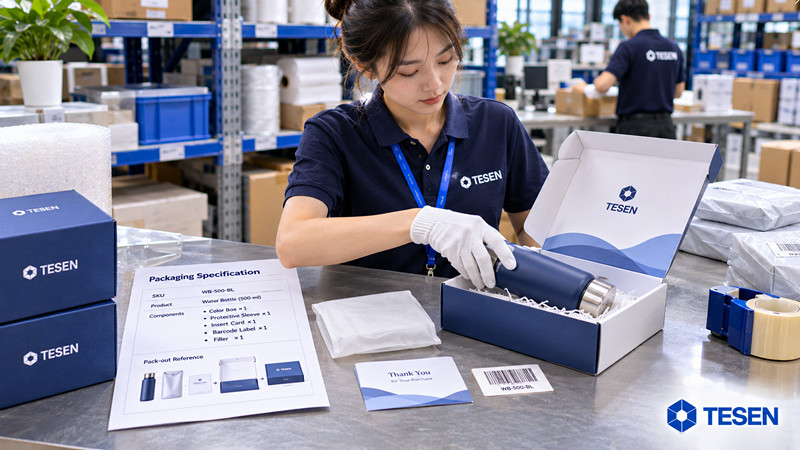
Custom packaging can make an ecommerce brand more recognizable. A branded box, product pouch, printed insert, or carefully assembled gift set can create a more consistent customer experience.
But designing attractive packaging is only the beginning.
Once packaging materials reach a fulfillment warehouse, the operational questions become more specific.
Which SKUs should use each box? How many inserts belong in an order? What happens when a customer purchases multiple units? How should packaging materials be tracked? And what should the warehouse do when a branded component is unavailable?
For Shopify and DTC brands, these questions matter because custom packaging must work consistently across hundreds or thousands of individual customer orders.
Successful custom packaging fulfillment depends on more than packaging design. It requires accurate specifications, inventory control, and repeatable pack-out instructions.
This guide explains how to turn branded packaging requirements into practical warehouse processes.
Custom packaging in ecommerce fulfillment refers to the use of brand-specific packaging materials and packing instructions when preparing customer orders.
Depending on the product and brand requirements, it may include:
Branded boxes, mailers, or pouches
Custom printed tissue paper or wrapping
Product-specific protective materials
Thank-you cards and promotional inserts
Private-label stickers and product labels
Gift packaging and multi-product sets
Market-specific inserts or instructions
A fulfillment partner may receive these materials from the brand's packaging supplier or coordinate their sourcing as part of a broader service arrangement.
However, simply having branded materials available in the warehouse does not guarantee that they will be used correctly.
The warehouse also needs to understand which materials belong to which products and how each order should be assembled.
That is where packaging specifications become important.
A packaging design describes how a box, pouch, or other material should be manufactured.
It typically includes dimensions, materials, colors, printing requirements, and logo placement.
A fulfillment specification explains how those materials should be used when processing orders.
Consider a skincare brand selling three products:
A facial serum
An eye cream
A skincare gift set containing both products
The brand may use the same visual identity across all three products, but each order could require a different packaging configuration.
The serum might use a protective sleeve and a small branded box.
The eye cream might use a pouch.
The gift set might require a larger presentation box, an insert card, and additional protective material.
A packaging design file does not necessarily communicate these differences.
A useful fulfillment specification should answer:
Which product or SKU uses the packaging?
What components are required?
How many units of each component should be included?
Where should labels and inserts be placed?
What protective materials are necessary?
Which packaging version is currently approved?
These details turn a design concept into a repeatable fulfillment instruction.
As an ecommerce brand expands its product catalog, packaging requirements often become more complicated.
A warehouse may handle different product sizes, variants, bundles, gift configurations, and destination markets.
Without clearly defined rules, packaging decisions can become dependent on individual warehouse operators.
A simple SKU-to-packaging matrix can reduce that ambiguity.
| Product or Order Type | Packaging Configuration |
|---|---|
| SKU A — Facial Serum | Branded Box A + Protective Sleeve |
| SKU B — Eye Cream | Branded Pouch B |
| SKU C — Skincare Gift Set | Gift Box C + Insert Card |
| SKU A — France Orders | Box A + Approved French Insert |
The objective is not to create unnecessary administrative work.
It is to make the correct packaging configuration identifiable when an order reaches the fulfillment stage.
For brands selling through Shopify, product and variant identifiers should be sufficiently clear for the fulfillment team to apply the agreed packaging rules.
Where packaging requirements depend on promotions, destinations, or other conditions, those rules may need to be communicated separately from the standard product information.
Ecommerce brands usually pay close attention to product inventory.
They monitor available stock, replenishment requirements, and the number of units that can be sold.
Packaging inventory is sometimes overlooked.
But branded packaging materials can become a fulfillment constraint even when sufficient product inventory is available.
Consider a brand with the following stock:
| Inventory Item | Available Quantity |
|---|---|
| Product A | 1,000 units |
| Branded Box A | 300 units |
| Insert Card | 600 units |
| Protective Sleeve | 800 units |
If every order requires one product, one box, one insert, and one protective sleeve, the warehouse has enough materials for only 300 complete orders under that packaging configuration.
The brand still has 1,000 products in stock.
However, without an approved alternative, the packaging materials support only 300 orders.
This distinction is important for inventory planning.
Brands should identify which packaging components are essential to fulfillment and monitor them accordingly.
Product-specific branded boxes, printed inserts, and custom pouches may require more detailed inventory control than generic tape or standard packing materials.
Replenishment decisions should consider:
Current packaging inventory
Average component consumption per order
Expected promotional demand
Supplier production lead times
Transportation and receiving time
Minimum order quantities
Approved safety stock
Packaging shortages should be identified before they interrupt customer orders, not after the warehouse runs out of materials.
One of the most common sources of confusion is how many packaging components an order requires.
Suppose a customer purchases three units of the same product.
Should the warehouse use three protective pouches?
Should it include three thank-you cards or only one?
Can all three products fit into a single outer mailer?
The answer depends on the brand's approved packaging requirements.
A practical specification should distinguish between three types of consumption rules.
Materials required for each individual product.
For example, one protective sleeve per skincare bottle.
Materials included once for the entire customer order.
For example, one thank-you card per parcel.
Materials used only when specific conditions apply.
These might include gift wrapping, destination-specific instructions, promotional inserts, or additional protective materials.
| Packaging Component | Consumption Rule |
|---|---|
| Protective Sleeve | One per product |
| Thank-You Card | One per order |
| Gift Insert | One per eligible gift order |
| Outer Mailer | Based on packed order dimensions |
| Market-Specific Insert | Based on approved destination requirements |
These rules affect both packing accuracy and packaging inventory consumption.
Without them, the warehouse may have the correct materials but use incorrect quantities.
A pack-out instruction is a documented sequence explaining how products and packaging components should be assembled before shipment.
For a product requiring branded packaging, the instructions might be:
Verify the product SKU and quantity.
Check the product against the agreed quality requirements.
Place the product inside the specified protective pouch.
Include the approved branded insert.
Place the components inside the designated box.
Apply the required label in the approved position.
Seal the packaging according to the specification.
Add the appropriate outer shipping protection if required.
This is more actionable than simply telling the warehouse to use branded packaging.
Pack-out instructions can also include reference photos, packaging samples, or diagrams when visual details matter.
For example, a brand may require a label to be placed on the bottom of a box rather than across its logo.
That requirement should be documented rather than left to operator interpretation.
The goal of a pack-out standard is consistent execution across different orders and warehouse operators.
Custom packaging and kitting are closely related, but they are not identical.
Custom packaging determines how an order should be presented and protected.
Kitting involves combining multiple products or components into a defined set.
Consider a Shopify brand selling a skincare gift bundle containing a serum, an eye cream, and a facial tool.
The fulfillment operation may use one of two approaches.
The components are assembled into a finished set before customer orders arrive.
The completed kit may then be managed as a separate inventory unit.
The individual products remain in inventory until an order is received.
The warehouse then picks the required components and assembles the bundle according to the approved instructions.
Both approaches can support branded packaging, but their inventory and labor requirements differ.
A brand should confirm which model its fulfillment partner will use before launching a bundle.
The decision can affect inventory availability, assembly workload, packaging consumption, and the way orders are processed.
Packaging requirements often change as brands grow.
A company might introduce a new logo, update a box size, replace an insert card, or improve protective packaging.
The challenge is not only producing the new materials.
It is ensuring that the warehouse uses the correct version at the correct time.
Imagine that Packaging Version A is already in stock when the brand introduces Version B.
Several questions need to be resolved:
When should Version B become active?
Can the remaining Version A materials still be used?
Which SKUs are affected?
Should existing orders use the old or new version?
Who approves the change?
How will warehouse staff receive the updated instructions?
A simple version-control record can help.
| Field | Example |
|---|---|
| Packaging Code | BOX-A-V2 |
| Applicable SKU | SKU A |
| Status | Approved |
| Activation Condition | After warehouse confirmation |
| Previous Version | BOX-A-V1 |
| Old Stock Handling | Follow approved phase-out instructions |
A packaging update should not depend on whether an operator happens to see the latest message in an email or chat.
The approved instructions need to be communicated clearly before the new version is used.
What happens when a branded box or pouch runs out?
The warehouse might have an alternative material available, but using it without approval could create problems.
An alternative pouch may not provide the same protection.
A different box may affect shipping dimensions.
A missing insert could change the customer experience or omit required product information.
Brands should establish substitution rules before shortages occur.
For example:
If Branded Pouch A is unavailable:
Use Approved Pouch B only if the brand has authorized it for the relevant SKU.
Otherwise, hold the affected order.
Notify the designated contact for approval.
Do not substitute unapproved materials.
The correct procedure depends on the product and brand requirements.
For some orders, an approved neutral package may be acceptable.
For others, packaging is an essential part of the product presentation or compliance requirements.
A fulfillment partner should follow the agreed rules rather than make assumptions.
When preparing to work with an ecommerce fulfillment provider, brands can reduce setup problems by preparing a packaging specification sheet.
The following information provides a practical starting point.
| Information | What to Provide |
|---|---|
| Product Identification | SKU and variant details |
| Packaging Components | Box, pouch, insert, label, protective material |
| Packaging Dimensions | Length, width, height, and relevant specifications |
| Component Quantities | Per-unit, per-order, or conditional usage |
| Packing Sequence | Approved pack-out steps |
| Label Placement | Position and label requirements |
| Packaging Version | Current approved version |
| Inventory Source | Who supplies each packaging component |
| Substitution Policy | Approved alternatives or hold instructions |
| Approval Contact | Person responsible for changes and exceptions |
For more complicated products, the specification may also include reference photographs, assembly videos, or a sample pack-out.
Brands do not necessarily need sophisticated software to manage these requirements.
A small operation may use a controlled spreadsheet and written standard operating procedures.
As the number of SKUs and packaging configurations increases, more structured records may become necessary.
What matters is that the warehouse has access to accurate, approved instructions.
Custom packaging can influence fulfillment costs in several ways.
The branded materials themselves are only one part of the calculation.
Depending on the configuration, additional costs may arise from:
Packaging material procurement
Inventory receiving and storage
Extra packing or assembly steps
Kitting requirements
Protective materials
Larger parcel dimensions
Packaging changes and rework
Special labeling or inserts
For example, a rigid gift box may improve presentation but increase the packed dimensions of an order.
That can affect international shipping charges, particularly when volumetric weight is relevant.
Similarly, a multi-component gift set may require more handling than a standard single-product order.
A useful custom packaging quotation should therefore consider the actual pack-out configuration, not just the purchase price of the branded box.
Brands should provide packaging samples or confirmed specifications when requesting a fulfillment quotation.
TESEN is a China-based Ecommerce Supply Chain Partner for Shopify and DTC brands, with ecommerce fulfillment as its core service.
For brands sourcing products and packaging from China, custom packaging may involve several suppliers.
One manufacturer produces the product.
Another supplies branded boxes or pouches.
A printing company produces inserts or labels.
The fulfillment warehouse then needs to receive the materials and apply the approved packaging requirements to individual customer orders.
TESEN supports this broader workflow through services including:
Product sourcing and supplier coordination
Receiving products and packaging materials into the China warehouse
Inventory storage and management
Quality control according to agreed requirements
Custom packaging and labeling
Kitting and order preparation
Ecommerce order fulfillment and international shipping
The specific packaging process depends on the products, materials, order volume, and agreed operating instructions.
For Shopify brands, TESEN can also support order synchronization and tracking updates through its integration workflow.
Packaging configurations and special instructions should be confirmed during onboarding so the warehouse understands how each eligible order needs to be handled.
The objective is to connect branded packaging requirements with reliable fulfillment execution rather than treat packaging as an isolated design service.
Before selecting a fulfillment partner, ecommerce brands should ask:
Can you receive packaging materials from different suppliers?
How do you identify the correct packaging for each SKU?
Can you handle product-specific inserts, labels, and protective materials?
How are branded packaging materials stored and monitored?
Can you support both standard orders and bundled products?
How are packaging instructions documented?
What happens when packaging specifications change?
How do you handle missing or unavailable packaging materials?
Which packaging activities involve additional handling costs?
How do you investigate and correct recurring packing errors?
These questions help distinguish basic branded packing capabilities from a more structured custom packaging fulfillment operation.
Custom packaging can improve how customers experience an ecommerce brand, but successful execution requires more than attractive materials.
The warehouse must understand which packaging belongs to each SKU, how much of each component is required, how orders should be assembled, and what to do when requirements change.
For growing Shopify and DTC brands, packaging specifications should therefore be treated as part of fulfillment operations.
A practical approach connects five elements:
SKU Identification → Packaging Rules → Component Inventory → Pack-Out Instructions → Order Fulfillment
When those elements are clearly defined, branded packaging becomes easier to manage consistently as order volume and product complexity increase.
For brands sourcing products from China, working with a fulfillment partner that can coordinate packaging, inventory, and order processing may reduce the operational gaps between suppliers and warehouse execution.
Custom packaging fulfillment is the process of preparing ecommerce orders using brand-specific packaging materials and approved packing instructions. It may include branded boxes, pouches, inserts, labels, protective materials, and gift packaging.
Packaging specifications describe the materials, quantities, dimensions, labeling requirements, and assembly instructions needed to pack products consistently. They connect packaging design with warehouse execution.
Many fulfillment providers can receive and use packaging supplied by a brand or its manufacturers. However, the available options, storage requirements, handling fees, and minimum quantities should be confirmed with the provider.
Yes, particularly when the materials are essential to completing customer orders. Monitoring branded boxes, pouches, inserts, and labels helps identify potential shortages before they disrupt fulfillment.
Custom packaging focuses on the presentation and protection of an order. Kitting combines multiple products or components into a defined set. A kit may also require custom packaging, but the inventory and assembly processes are different.
Packaging can affect shipping costs through additional material weight, parcel dimensions, and protective requirements. Larger boxes may increase volumetric weight, while complex configurations may require additional packing labor.
TESEN supports custom packaging, labeling, inventory storage, kitting, and ecommerce order fulfillment from China. The appropriate process and quotation depend on the product specifications, packaging requirements, and order volume.
TESEN is a China-based Ecommerce Supply Chain Partner for Shopify and DTC brands.
Our core focus is ecommerce fulfillment, supported by product sourcing, supplier management, quality control, inventory management, custom packaging, and international shipping.
By connecting supplier coordination with warehouse execution, TESEN helps ecommerce brands manage the operational requirements behind consistent order fulfillment.
Source Your Products and Start Dropshipping
 IPv6 network supported