
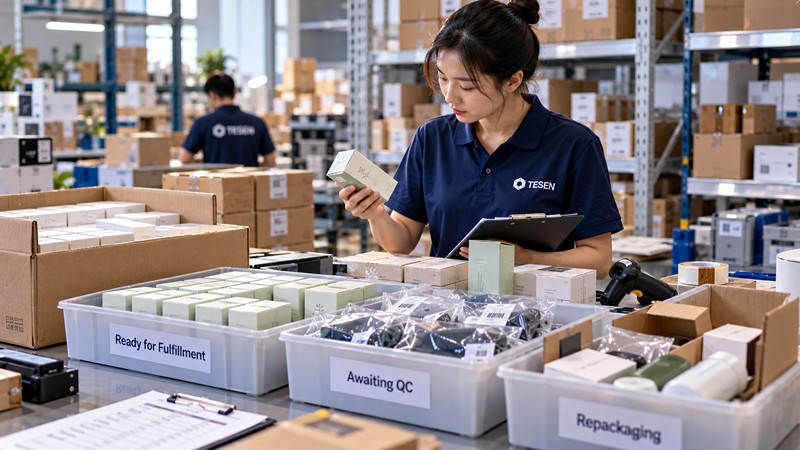
A Shopify brand checks its warehouse inventory and sees 500 units in stock.
It is tempting to assume that all 500 units are ready for customer orders.
But inside the fulfillment operation, those numbers may be very different.
Some products may have arrived but are still awaiting receiving verification. Others may be pending quality control, reserved for existing orders, held because of quality concerns, or waiting for repackaging.
The warehouse may physically contain 500 units, while only 430 are currently available for new customer orders.
For a growing ecommerce brand, this difference can affect inventory accuracy, Shopify order processing, replenishment decisions, and customer experience.
The most important inventory number is not always how much stock exists in the warehouse. It is how much inventory can actually be released for fulfillment.
Understanding fulfillment-ready inventory helps brands avoid accepting orders against stock that cannot yet be shipped.
Fulfillment-ready inventory is stock that has completed the required operational steps and is currently eligible to be allocated to customer orders.
Depending on the product and fulfillment workflow, those steps may include:
Inventory receiving and quantity verification
SKU identification
Required quality-control checks
Labeling or packaging preparation
Inventory status confirmation
Release from operational holds
Confirmation that the stock is not already allocated elsewhere
A product can physically exist in a warehouse without meeting these requirements.
This is why ecommerce brands should distinguish between three important inventory concepts.
Physical Inventory
The total number of units physically present in the warehouse.
Fulfillment-Ready Inventory
Units that have completed the necessary operational checks and can be used for fulfillment, subject to any existing allocations.
Available-to-Fulfill Inventory
Fulfillment-ready units that remain available for allocation to new customer orders after applicable reservations and commitments.
These quantities are related, but they are not interchangeable.
Consider a Shopify brand with 500 units of one SKU physically stored in its fulfillment center.
The inventory is divided into the following mutually exclusive categories.
| Inventory status | Units | Available for new orders? |
|---|---|---|
| Available and unallocated | 430 | Yes |
| Pending QC | 30 | No |
| Reserved for existing commitments | 20 | No |
| QC Hold | 10 | No |
| Rework Required | 5 | No |
| Damaged | 5 | No |
| Total Physical Inventory | 500 |
The warehouse physically contains 500 units.
However, only 430 units are available for allocation to new customer orders.
The remaining 70 units have not disappeared.
They are simply unavailable for different operational reasons.
In this example:
Physical Inventory = 500 units
Available-to-Fulfill Inventory = 430 units
Unavailable or Committed Inventory = 70 units
The categories must be defined consistently to avoid counting the same unit more than once.
For example, if reserved inventory is already excluded from an available quantity, it should not be deducted again.
This distinction is essential when inventory data is shared between a fulfillment operation and an ecommerce storefront.
A single stock number does not explain whether products can be used for customer orders.
Inventory status provides the operational context behind that number.
Common inventory statuses include:
The products have physically arrived at the fulfillment center.
However, receiving verification, SKU identification, or other required procedures may still be incomplete.
The inventory has arrived but is waiting for an agreed inspection or quality-control process.
It should not be released until the required checks are completed.
The units have completed the required operational steps and are eligible for allocation to customer orders.
The inventory is physically present and may be in good condition, but it has already been committed to an existing order or another designated purpose.
A potential or confirmed quality issue prevents the inventory from being released for normal fulfillment.
The product may become usable after approved corrective work, such as relabeling, repackaging, or replacing a missing insert.
The inventory is physically present but is not suitable for normal customer fulfillment.
Different warehouse systems may use different terminology.
The objective is not to create as many status labels as possible.
It is to understand what can happen next to each inventory unit.
Inventory readiness begins with the receiving process.
Suppose a supplier sends 1,000 units to a China fulfillment center.
The cartons arrive on Monday.
The supplier confirms delivery.
From a purchasing perspective, the goods have reached the warehouse.
But the fulfillment operation may still need to:
Identify the supplier shipment.
Verify carton and product quantities.
Match products to the correct SKUs.
Check product variants and labels.
Record the received inventory.
Complete any agreed quality-control checks.
Carry out required preparation.
Release approved units for fulfillment.
Until these steps are completed, some or all of the shipment may remain unavailable for new orders.
The important distinction is:
Inventory Received ≠ Inventory Released for Fulfillment
This becomes particularly relevant when brands work with multiple suppliers or receive frequent replenishment shipments.
A supplier delivery confirmation should not automatically be treated as confirmation that all products are ready for customer orders.
Inventory accuracy matters because customer orders are accepted before warehouse staff physically pick the products.
Imagine a Shopify store displays 100 units as available.
Inside the warehouse, however, the inventory status is:
| Inventory status | Units |
|---|---|
| Available | 80 |
| QC Hold | 10 |
| Rework Required | 5 |
| Damaged | 5 |
| Physical Total | 100 |
Only 80 units are currently eligible for normal fulfillment.
If the store continues accepting orders based on all 100 physical units, the brand may accept more orders than the warehouse can fulfill.
The resulting workflow can become:
Customer Order → Inventory Allocation → Warehouse Processing → Stock Cannot Be Released → Order Delay
The problem may not be missing inventory.
It may be that the ecommerce system and warehouse operation are using different definitions of available stock.
For Shopify brands, the important operational requirement is to ensure that the inventory quantity used for selling reflects the stock actually eligible for order allocation.
The exact synchronization and reservation behavior depends on the Shopify configuration, fulfillment integration, and inventory-management system.
A practical inventory workflow should distinguish physical warehouse records from the quantity made available for new customer orders.
For example, a fulfillment operation may maintain:
Physical quantity
Pending or unverified quantity
Quality-held quantity
Rework quantity
Reserved quantity
Available quantity
The storefront should not treat all these categories as equally sellable.
Instead, the inventory integration should use an agreed availability definition.
Brands should clarify the following questions with their fulfillment partner:
Which inventory quantity is synchronized?
Is it physical stock, available stock, or another system-defined quantity?
When does newly received inventory become available?
Does availability change when cartons arrive, when receiving is completed, or after required QC and preparation?
How are existing orders reserved?
Does the system deduct committed stock before making inventory available to new orders?
What happens when inventory is placed on hold?
Is the unavailable quantity excluded from new-order allocation?
How are inventory corrections communicated?
If receiving identifies a shortage or QC identifies defective units, how is the available quantity updated?
These questions help prevent discrepancies between warehouse operations and customer-facing inventory.
Quality control is often viewed as a process for identifying defects.
But from a fulfillment perspective, QC also determines what happens to inventory next.
A simple operational decision structure may be:
QC Passed → Release to Available Inventory
Issue Identified → QC Hold
Correctable Issue → Rework Required
Rejected Product → Supplier Resolution or Other Approved Disposition
The inspection result should lead to an inventory decision.
For example, suppose 200 units arrive from a supplier.
During an agreed inspection, 40 units are identified as potentially defective.
The warehouse may classify:
160 units as approved and available
40 units as QC Hold
The physical inventory remains 200 units.
But only 160 units can be released for normal fulfillment at that stage.
The remaining 40 units require further action.
That action may involve additional inspection, supplier confirmation, rework, replacement, or rejection.
The purpose of a QC Hold is not simply to record a quality problem.
It is to prevent unresolved inventory from entering customer orders.
Not every inventory issue requires products to be rejected.
Some problems can be corrected.
Examples include:
Incorrect labels
Missing inserts
Damaged outer packaging
Packaging replacement
Approved repacking
Other agreed corrective work
These units may move through the following workflow:
Received → Inspection → Rework Required → Rework Completed → Verification → Available
The important point is that inventory should not become available before the necessary corrective work is completed and accepted.
If the inventory system only distinguishes between "in stock" and "out of stock," this process becomes difficult to represent accurately.
A more useful inventory model reflects the product's operational condition and next required action.
Quality problems are not the only reason inventory may be unavailable.
Some inventory is intentionally reserved.
Suppose a brand has 300 fulfillment-ready units of one SKU.
It allocates:
| Inventory commitment | Units |
|---|---|
| Existing customer orders | 50 |
| Replacement orders | 20 |
| Upcoming promotion | 30 |
| Available for new orders | 200 |
| Total | 300 |
All 300 units may be physically usable.
However, only 200 units remain available for new orders if the reservations are enforced.
This is an allocation issue, not a quality issue.
The distinction matters because reserved inventory should not be interpreted as missing or defective.
It is inventory that has already been committed to another operational purpose.
For brands selling bundles, fulfillment readiness becomes more complex.
Imagine a Shopify store sells a gift set containing:
Product A
Product B
One branded pouch
The available component inventory is:
| Component | Available quantity |
|---|---|
| Product A | 500 |
| Product B | 300 |
| Branded Pouch | 120 |
Assuming each gift set requires one unit of each component, the warehouse can currently prepare a maximum of 120 complete sets.
The branded pouch is the limiting component.
If 20 pouches are already reserved and the displayed 120 units have not yet accounted for that reservation, only 100 pouches remain available for new gift-set orders.
The important quantity is not the stock level of the main product.
It is the number of complete customer orders that can be prepared using all required components.
This is why fulfillment-ready inventory must sometimes be evaluated at the order or bundle level rather than at the individual SKU level.
For many DTC brands, custom packaging is part of the product experience.
A brand may require:
Branded boxes
Pouches
Printed inserts
Product sleeves
Stickers
Protective materials
If those materials are mandatory for the order, their availability can affect fulfillment readiness.
Consider a brand with 1,000 approved products in stock.
However, only 250 required branded boxes remain.
If each order requires one branded box and no alternative packaging is authorized, the operation can prepare only 250 complete orders using that packaging configuration.
The brand may have enough products to sell.
But it does not have enough required packaging to fulfill every potential order.
Packaging should therefore be considered when planning inventory replenishment and customer-order availability.
Inventory status can also affect reorder timing.
Suppose a brand physically holds 600 units of one SKU.
At a sales rate of 100 units per week, that appears to represent six weeks of stock.
But the actual inventory status is:
450 units available
100 units on hold
50 units requiring rework
Only 450 units can currently support new orders.
At the same sales rate, that represents approximately 4.5 weeks of immediately available stock.
The difference may change when replenishment needs to begin.
A practical inventory review should therefore consider:
Available-to-fulfill quantity
Existing reservations
Incoming inventory
Inventory awaiting QC or rework
Expected sales velocity
Supplier production lead time
Expected receiving and preparation time
Held or rework inventory should not be assumed to become available until there is a reliable release plan.
The goal is to base replenishment decisions on stock that can realistically support customer orders.
Clear inventory status allows operational problems to be identified before they reach customer orders.
Without accurate status information, a typical exception may follow this pattern:
Order Received → Warehouse Attempts Picking → Inventory Problem Discovered → Order Delayed
With better inventory controls, the process can become:
Inventory Issue Identified → Stock Placed on Hold → Unavailable Quantity Excluded → Brand Decides Next Action
The second workflow moves the decision earlier.
It does not eliminate every fulfillment exception.
However, it can reduce the likelihood that known inventory problems repeatedly become customer-order delays.
For growing ecommerce brands, this is an important connection between inventory management and fulfillment reliability.
Brands do not necessarily need dozens of inventory classifications.
A useful process should answer five operational questions.
Confirm that the shipment has reached the fulfillment center and has been identified.
Verify quantities, SKUs, and required shipment information.
Determine whether QC, labeling, repacking, or other preparation is necessary.
Confirm which units are approved for normal fulfillment and which remain on hold.
Account for existing order allocations and other reservations before determining the quantity available for new customer orders.
A simple workflow is:
Supplier Delivery → Receiving → Verification / QC → Inventory Disposition → Release → Order Allocation → Fulfillment
This process helps separate physical ownership of inventory from operational readiness.
Consider a hypothetical Shopify apparel brand.
A supplier delivers 1,000 units to its fulfillment center.
After receiving and the agreed checks, the inventory is classified as follows:
| Inventory status | Units |
|---|---|
| Available for new orders | 900 |
| Reserved for replacement orders | 20 |
| Rework Required | 30 |
| QC Hold | 20 |
| Damaged | 10 |
| Pending additional verification | 20 |
| Total Physical Inventory | 1,000 |
The warehouse physically holds 1,000 units.
However, only 900 units are currently available for new customer orders.
The other 100 units are either committed or not yet eligible for normal fulfillment.
The brand should not automatically use the full 1,000 units when planning a promotion or evaluating immediate order capacity.
Instead, it should consider:
Available inventory: 900 units
Potential future availability: Some held or pending units may become usable after the required actions.
Unavailable inventory: Damaged or rejected units may require separate disposition.
This provides a more accurate foundation for Shopify inventory availability and replenishment planning.
TESEN is a China-based Ecommerce Supply Chain & Fulfillment Partner for Shopify and DTC brands.
Our core focus is ecommerce fulfillment, supported by supplier management, quality control, inventory planning and storage, custom packaging, and international shipping.
For brands sourcing from China, inventory management is the operational connection between supplier deliveries and customer orders.
Depending on the agreed service scope, that process can include:
Receiving inventory from Chinese suppliers
Identifying products and SKUs
Verifying received quantities
Performing agreed quality-control checks
Coordinating inventory holds or corrective actions
Managing available inventory
Supporting custom packaging and kitting
Processing Shopify fulfillment orders
Preparing international shipments
The objective is not simply to record how many products are inside a warehouse.
It is to help ensure that inventory used for customer orders has completed the required preparation and is available for fulfillment.
Brands should confirm the specific inventory-status, reservation, and synchronization capabilities applicable to their fulfillment setup.
Physical warehouse inventory and available-to-fulfill inventory are not the same.
Received inventory may require verification, QC, or preparation before release.
QC Hold, Rework Required, Reserved, and Damaged inventory should not be treated as freely available stock.
Inventory categories must be defined consistently to prevent double counting.
Shopify inventory availability should reflect the stock eligible for new customer orders.
Reserved inventory may be physically usable but already committed elsewhere.
Bundles and custom packaging create additional inventory dependencies.
Replenishment planning should consider fulfillment-ready stock rather than only physical quantity.
Accurate inventory status can help identify problems before they become customer-order exceptions.
A reliable fulfillment operation should connect receiving, inventory disposition, order allocation, and shipping.
Fulfillment-ready inventory is stock that has completed the required receiving, inspection, preparation, and release steps and is eligible for customer-order fulfillment. The quantity available for new orders must also account for existing reservations and commitments.
This can happen when the storefront's available quantity does not reflect warehouse holds, pending inspection, rework, damage, or reservations. The brand should verify which inventory quantity is synchronized and how unavailable stock is excluded.
Not necessarily. Products may require quantity verification, SKU identification, system recording, QC, labeling, or other preparation. Availability depends on the agreed receiving and release process.
Inventory with unresolved quality concerns should be separated from normal available stock. Depending on the issue and agreed instructions, the next action may involve additional inspection, rework, supplier confirmation, replacement, or rejection.
Reserved inventory may be fully usable but already committed to existing orders or another purpose. Other unavailable inventory may be awaiting inspection, held for quality reasons, damaged, or requiring corrective work. Both categories can reduce stock available for new orders.
Yes. If a customer order requires a specific branded box, pouch, or insert, the absence of that component may prevent the complete order from being prepared unless the brand authorizes an alternative.
Brands should calculate stock coverage using inventory that can realistically support customer orders. They should also consider incoming inventory, held stock, supplier lead times, sales velocity, and expected receiving or preparation time.
Ask how inventory is received, when stock becomes available, how QC holds and rework are recorded, how reservations are handled, which quantities synchronize with Shopify, and how inventory discrepancies are reported.
Inventory should not be understood as a single warehouse quantity.
A fulfillment center may physically hold 500 units while only 430 are available for new customer orders.
The difference may come from receiving, quality control, reservations, damage, rework, or required packaging components.
For Shopify and DTC brands, the most useful inventory question is not simply:
How many units do we have?
It is:
How many units can we actually fulfill right now, and what is preventing the remaining inventory from becoming available?
That distinction connects inventory visibility with real ecommerce fulfillment capability.
TESEN is a China-based Ecommerce Supply Chain & Fulfillment Partner for Shopify and DTC brands.
Our core focus is ecommerce fulfillment, supported by product sourcing, supplier management, quality control, inventory planning and storage, custom packaging, and international shipping.
We help ecommerce brands connect China-side supplier deliveries and inventory preparation with Shopify order fulfillment, supporting more coordinated inventory and customer-order operations.
Source Your Products and Start Dropshipping
 IPv6 network supported