Many Shopify founders dream about reaching 100 orders per day.
In the early stages of building an ecommerce business, success often seems straightforward:
Generate more traffic
Improve conversion rates
Increase advertising performance
But as many growing brands discover, the biggest challenges often begin after sales start accelerating.
At TESEN, we've worked with Shopify brands at different stages of growth, and one pattern appears repeatedly:
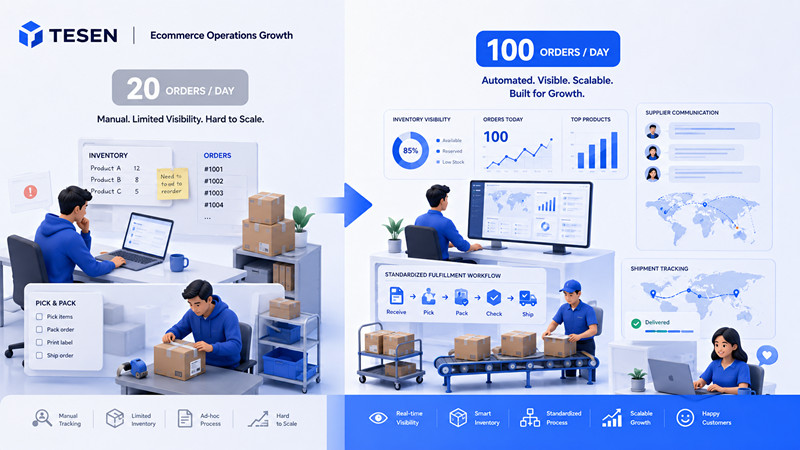
The operational requirements of a business processing 20 orders per day are completely different from those processing 100 orders per day.
Scaling is no longer just a marketing challenge.
It becomes an operational challenge.
When a Shopify store processes around 20 orders per day, many operational tasks can still be managed manually.
Inventory checks are relatively simple.
Customer inquiries remain manageable.
Occasional fulfillment mistakes can usually be corrected without significantly affecting the business.
However, once daily orders increase to 100 or more, every operational process becomes more demanding.
Founders must manage:
Larger inventory volumes
More product variants
More supplier coordination
Higher customer expectations
Greater fulfillment complexity
Without scalable systems, operational pressure grows quickly.
| 20 Orders Per Day | 100 Orders Per Day |
|---|---|
| Manual inventory tracking is manageable | Real-time inventory visibility becomes essential |
| Customer support remains relatively simple | Support workload increases significantly |
| Occasional fulfillment mistakes have limited impact | Small errors affect many more customers |
| Basic workflows are often sufficient | Standardized operational processes become critical |
| Marketing drives most business growth | Operations become equally important for continued growth |
This transition explains why many brands struggle even while sales continue increasing.
Many businesses successfully scale their advertising campaigns but continue relying on the same operational processes they used during the early stages.
Unfortunately, those systems rarely scale at the same pace as sales.
At TESEN, we've seen brands encounter challenges such as:
Inventory discrepancies
Delayed fulfillment
Increasing customer support tickets
Tracking-related complaints
Supplier communication delays
These problems are rarely caused by strong demand itself.
They occur because operational systems have not evolved alongside business growth.
One Shopify brand selling throughout Europe experienced rapid growth after several successful marketing campaigns.
Sales increased significantly within a short period.
However, inventory management and fulfillment workflows remained largely unchanged.
Within weeks, the operations team began experiencing:
Stock discrepancies across multiple SKUs
Increased customer support requests
Delayed order processing
Reduced customer satisfaction
The company realized that marketing was no longer the primary challenge.
Operations had become the limiting factor.
After improving inventory visibility, fulfillment workflows, and supplier coordination, the business regained operational control and continued scaling with greater confidence.
Successful Shopify brands rarely wait until operational problems become serious.
Instead, they prepare their systems before growth creates additional complexity.
Areas that deserve attention include:
Real-time inventory data helps prevent stock shortages and overselling.
Consistent operating procedures improve processing accuracy and efficiency.
Strong communication with suppliers supports reliable replenishment and production planning.
Reliable tracking helps reduce customer uncertainty and support requests.
Performance dashboards allow founders to identify bottlenecks before they impact customers.
Many founders believe sustainable growth depends primarily on acquiring more customers.
In reality, growth also depends on whether operations can support increasing demand.
Brands with scalable operational systems are better positioned to:
Deliver consistently
Maintain customer satisfaction
Reduce fulfillment errors
Improve inventory planning
Scale with confidence
Operational readiness becomes a competitive advantage as order volume increases.
For Shopify brands in 2026, the journey from 20 to 100 orders per day is about much more than increasing sales.
It requires building systems capable of supporting long-term growth.
Inventory visibility, fulfillment consistency, supplier coordination, and operational reporting all become essential as businesses scale.
The strongest ecommerce brands don't simply generate more orders.
They build operational systems that allow them to grow sustainably.
Because successful scaling is powered by both strong marketing and strong operations.
Operational requirements change significantly as Shopify brands scale.
Manual workflows become increasingly difficult to manage beyond 100 orders per day.
Inventory visibility and fulfillment consistency become critical growth factors.
Supplier coordination and standardized workflows improve operational efficiency.
Marketing generates growth, but scalable operations sustain it.
Operational readiness helps brands continue growing with confidence.
Inventory management, fulfillment consistency, customer support workload, and operational visibility typically become much more important as order volume increases.
Many businesses continue using manual processes that worked during the early stages. Without scalable operational systems, inventory, fulfillment, and customer support challenges become more frequent.
A reliable fulfillment partner helps improve inventory visibility, fulfillment consistency, supplier coordination, shipment tracking, and operational reporting, allowing brands to scale more efficiently.
It's best to improve operational systems before problems appear. If your order volume is growing steadily, reviewing inventory planning and fulfillment workflows early can prevent future bottlenecks.
Focus on inventory visibility, fulfillment workflows, supplier communication, shipment tracking, operational reporting, and scalable processes that can support increasing order volume.
Marketing creates demand, but long-term growth depends on whether your operational systems can consistently fulfill that demand while maintaining customer satisfaction.
TESEN is a China-based fulfillment and supply chain partner helping Shopify and ecommerce brands scale through product sourcing, supplier coordination, inventory planning, quality control, warehousing, order fulfillment, private labeling, and global shipping solutions. By improving operational visibility and fulfillment consistency, TESEN helps growing brands build the systems needed for sustainable ecommerce growth.
Source Your Products and Start Dropshipping
 IPv6 network supported