
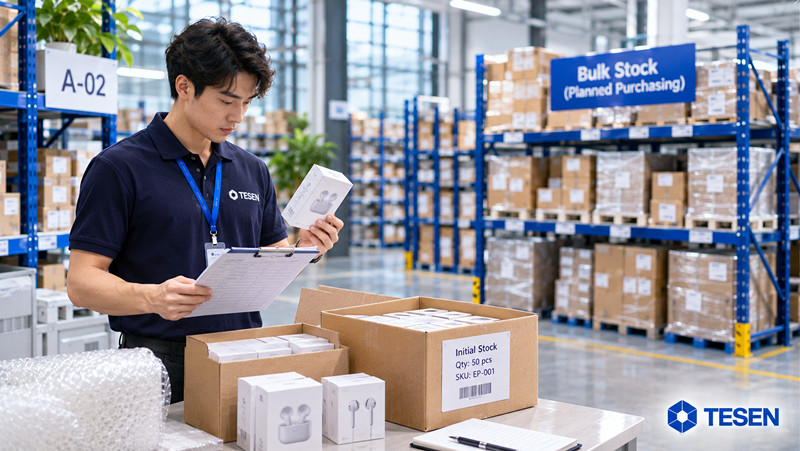
A dropshipping product starts generating consistent sales.
At first, the store purchases each unit from its supplier after a customer places an order. The model is flexible, and the brand does not need to commit much capital to inventory.
Then order volume begins to grow.
Five orders per day become ten. Ten become twenty. The supplier continues processing individual purchases, while the brand begins wondering whether buying products in bulk would make more sense.
The supplier offers a lower unit price for an order of 500 or 1,000 units.
But should the brand accept?
A product that sells well today is not necessarily a product that will sell at the same rate for the next three months.
For growing Shopify and DTC brands, the first bulk purchase is more than a sourcing decision. It changes when the business spends money, how inventory is managed, and how customer orders are fulfilled.
The right time to buy products in bulk is when demand becomes predictable enough to justify the inventory commitment—not simply when a supplier offers a discount.
This guide explains when to move from order-based dropshipping to stocked fulfillment, how to estimate an initial purchase quantity, and what to confirm with a China fulfillment partner before placing the first bulk order.
Traditional order-based dropshipping and stocked fulfillment operate on different purchasing timelines.
In an order-based model, the workflow generally follows this sequence:
Customer Order → Supplier Purchase → Product Preparation → Fulfillment
The brand purchases the product after customer demand has appeared.
This helps limit the financial risk of holding unsold inventory, but each order may depend on the supplier's availability and processing schedule.
In a stocked fulfillment model, the sequence changes:
Demand Forecast → Bulk Purchase → Warehouse Receiving → Customer Order → Fulfillment
The brand purchases products before receiving the corresponding customer orders.
That change can provide several operational advantages:
Products are already available at the fulfillment warehouse.
Repeated supplier purchases may be reduced.
Quality checks can be arranged before customer orders arrive.
Custom packaging materials can be prepared in advance.
Orders can be picked and packed without waiting for a new supplier purchase.
However, the brand now owns the inventory.
If sales slow, cash remains tied up in products that have not yet been sold.
The transition should therefore be evaluated as a change in both purchasing economics and inventory risk.
A winning product is not automatically ready for a large inventory commitment.
Imagine a product sells 300 units in one week after a successful social media campaign.
The result is encouraging, but it does not prove that the product will continue selling at the same rate.
Demand may have been influenced by a temporary promotion, seasonal interest, or an unusually successful advertising campaign.
Before buying inventory in advance, brands should examine several indicators.
Are orders arriving regularly, or are most sales concentrated in a few unusually strong days?
A product selling steadily over several weeks provides a different level of evidence from one that experiences a brief spike.
Can the brand continue generating orders at an acceptable customer acquisition cost?
Strong sales supported by unsustainable advertising expenditure may not justify a substantial inventory purchase.
Which sizes, colors, or product variants are actually selling?
A product family may perform well overall while certain variants remain slow-moving.
Bulk purchasing decisions should be made at the SKU level whenever possible.
For products that customers buy repeatedly, reorder patterns can provide additional evidence of demand stability.
However, repeat purchasing is not equally relevant to every product category.
Does the product continue selling when a particular promotion ends?
The more dependent demand is on one short-term event, the more cautious the brand should be about purchasing large quantities.
The goal is not to eliminate demand uncertainty. It is to establish enough evidence that an advance inventory purchase is commercially reasonable.
Suppliers often encourage larger purchases by offering lower unit prices.
For example, consider the following illustrative pricing:
| Purchasing Model | Product Cost per Unit |
|---|---|
| Small individual purchases | $8.00 |
| Larger bulk purchase | $7.20 |
| Potential unit saving | $0.80 |
A bulk purchase of 500 units would create a potential product-cost saving of $400 compared with purchasing the same quantity at $8.00 per unit.
But that is not necessarily a $400 improvement in profit.
Bulk inventory may introduce additional costs, including:
Warehouse receiving
Inventory storage
Quality inspection
Packaging preparation
Inventory financing
Unsold or obsolete stock
Additional handling or stock adjustments
On the other hand, stocked fulfillment may reduce repeated purchasing work and supplier-related preparation delays.
The correct comparison is not simply:
Small-Order Product Price vs. Bulk Product Price
It is:
Total Cost of Order-Based Sourcing vs. Total Cost of Stocked Fulfillment
A lower product price is valuable only when the operational benefits and expected sales justify the additional inventory commitment.
There is no universal first-order quantity.
The appropriate amount depends on sales velocity, supplier lead time, demand variability, minimum order quantities, available working capital, and the next replenishment plan.
A useful starting point is to estimate how quickly the product sells and how long replacement stock will take to arrive.
Use representative sales data rather than the strongest-performing day.
Suppose a product averages 10 units per day under reasonably stable selling conditions.
That is a planning assumption, not a guarantee that future demand will remain at 10 units.
Supplier lead time should include more than production.
Depending on the arrangement, it may involve:
Supplier production or stock preparation
Domestic delivery to the fulfillment warehouse
Warehouse receiving
Agreed quality checks
Labeling or other preparation
Suppose the total replenishment lead time is 15 days.
Expected demand during that period is:
10 units per day × 15 days = 150 units
This suggests the brand may need approximately 150 units to cover expected demand during replenishment once an ongoing stocked-inventory operation is established.
However, it does not mean the first order should automatically be 150 units.
The first purchase should be connected to a clear decision about when the brand will review inventory and place another order.
Consider this illustrative scenario:
| Planning Variable | Example |
|---|---|
| Average daily sales | 10 units |
| Replenishment lead time | 15 days |
| Planned review period | 20 days |
| Expected sales during review period | 200 units |
| Expected demand during replenishment | 150 units |
The 200-unit and 150-unit figures should not automatically be added together.
They describe time periods that may overlap, depending on when the next purchase order is placed.
For example, if a brand begins with 200 units, sells 10 per day, and waits until day 20 to reorder, its inventory may be exhausted before a 15-day replenishment arrives.
The brand must therefore model when the next order will be placed and how much inventory will remain when replacement stock arrives.
The brand should also consider:
How much daily sales fluctuate
Whether the supplier sometimes delivers late
Whether quality issues could make some units unavailable
How much cash can be committed without affecting other operations
How quickly the product could become outdated or lose demand
A controlled initial batch may be preferable to a much larger purchase made only to obtain a lower unit price.
The first bulk order should be large enough to support the planned fulfillment and replenishment cycle, but not so large that it creates unnecessary financial exposure.
The first inventory batch serves two purposes.
First, it provides stock for customer orders.
Second, it tests whether inventory-based fulfillment is commercially and operationally suitable for the product.
A controlled batch allows the brand to evaluate several important questions.
The product may have sold well before the purchase, but sales should continue to be monitored after inventory arrives.
Products from a larger production batch may require agreed quality checks before being released for fulfillment.
Having products available in stock can remove the need to wait for individual supplier purchases.
The actual improvement depends on the fulfillment process.
Stocked products and branded packaging materials can be prepared according to approved specifications.
The brand can compare actual sourcing, storage, handling, and fulfillment costs with its previous order-based model.
The first batch should generate information that helps improve future purchasing decisions.
It should not be treated solely as an opportunity to maximize supplier discounts.
For products with stable demand, holding inventory at a China fulfillment warehouse can change how orders are processed.
When inventory is already available, customer orders do not need to wait for a separate purchase from the supplier.
This can improve fulfillment readiness.
A batch can be inspected according to agreed requirements before units are allocated to individual customer orders.
The inspection scope should reflect the product, risks, and service agreement.
Branded boxes, labels, inserts, and other materials can be coordinated with stocked products.
This can make it easier to follow repeatable packing instructions.
Products held in inventory may be assembled into approved sets in advance or combined when orders arrive.
The appropriate process depends on how the brand manages its SKUs and bundle configurations.
Once products are stocked, the brand can begin planning replenishment around observed sales and supplier lead times rather than repeatedly purchasing each unit after an order.
These benefits are especially relevant to Shopify brands whose products have moved beyond the testing stage.
However, stocked fulfillment still requires accurate receiving, inventory records, and operational coordination.
Buying products in bulk does not automatically make fulfillment more reliable unless the warehouse can manage the inventory correctly.
Inventory ownership introduces responsibilities that are less significant in a purely order-based purchasing model.
Demand may decline before the purchased quantity sells through.
Cash spent on inventory is unavailable for advertising, product development, or other business activities until the stock generates revenue.
A brand may update product specifications or packaging while older versions remain in the warehouse.
Recorded stock must be reconciled with the quantities physically received, stored, and shipped.
Reordering too late can create stockouts. Reordering too early can create excess inventory.
A supplier's MOQ may exceed the quantity the brand can reasonably sell during its planning period.
Brands should understand these risks before placing their first substantial purchase.
A lower unit cost does not compensate for inventory that remains unsold indefinitely.
Yes. A growing Shopify brand does not necessarily need to move its entire product catalog into bulk inventory at once.
Different SKUs may justify different purchasing and fulfillment models.
For example:
| Product Situation | Purchasing Model to Evaluate |
|---|---|
| New product with unproven demand | Order-based sourcing |
| Product showing early consistent sales | Small-batch inventory |
| Established bestseller | Planned inventory purchasing |
| Slow-moving variant | Order-based sourcing or limited stock |
| Stable product with repeatable demand | Ongoing replenishment cycle |
This staged approach can help brands avoid applying the same inventory commitment to every product.
It also creates a practical transition:
Dropshipping → Small-Batch Inventory → Stable Stock → Planned Replenishment
The transition does not have to be permanent.
If demand changes, the brand can reassess purchase quantities and fulfillment arrangements.
The objective is to match inventory investment to actual SKU performance.
Before placing a first bulk order, a Shopify or DTC brand should confirm how the products will enter and move through the fulfillment operation.
Important questions include:
Can the supplier deliver inventory directly to the China warehouse?
What SKU, carton, and product identification information is required?
How will incoming quantities be checked?
What quality control services are available?
How will inventory quantities be recorded and managed?
Can branded packaging and labels be stored with the products?
What receiving, storage, and handling charges apply?
How will stocked orders be processed?
How can the brand monitor inventory availability?
What happens when inventory runs low?
Can other SKUs continue using order-based sourcing?
How will inventory replenishment be coordinated?
These questions matter because the purchasing decision and fulfillment process are connected.
A supplier may offer an attractive bulk price, but the brand still needs an operating model capable of receiving, storing, and fulfilling those products accurately.
TESEN is a China-based Ecommerce Supply Chain Partner for Shopify and DTC brands.
Our core focus is ecommerce fulfillment, supported by product sourcing, supplier management, quality control, inventory storage, custom packaging, and international shipping.
For brands sourcing products from China, the transition from order-based dropshipping to stocked fulfillment often happens gradually.
Some SKUs may continue to be purchased after customer orders arrive.
Other products may justify controlled inventory batches.
Established bestsellers may move into planned purchasing and regular warehouse replenishment.
TESEN supports the China-side operations involved in these arrangements, including:
Product sourcing and supplier coordination
Inventory receiving at the China warehouse
Quality control according to agreed requirements
Product and packaging storage
Custom packaging and labeling
Kitting and order preparation
Shopify order fulfillment
International shipping coordination
Through TESEN's Shopify integration workflow, customer orders can be synchronized for fulfillment, with tracking information returned after shipment.
The appropriate inventory quantities, packaging instructions, storage arrangements, and replenishment process should be confirmed for each project.
The objective is not to encourage brands to buy as much inventory as possible.
It is to help them build a more structured fulfillment operation when product demand supports that decision.
Before committing to inventory, review the following:
| Decision Area | Question to Answer |
|---|---|
| Demand | Has the SKU demonstrated consistent sales? |
| Marketing | Can demand be maintained at an acceptable acquisition cost? |
| Variants | Which exact SKUs justify inventory? |
| Supplier | What are the MOQ and full replenishment lead time? |
| Quantity | How much stock is required under the planned ordering schedule? |
| Financial Risk | How much cash can the brand safely commit? |
| Quality | What checks are required before fulfillment? |
| Warehouse | How will products be received, stored, and identified? |
| Packaging | Are packing requirements documented? |
| Replenishment | When will the next purchase decision be made? |
If several of these questions remain unanswered, a smaller initial commitment may be more appropriate than a large bulk purchase.
A winning dropshipping product creates an opportunity to improve purchasing and fulfillment efficiency.
But strong sales alone do not justify buying several months of inventory.
The decision should reflect demand consistency, SKU-level sales performance, supplier lead time, working capital, and the operational benefits of stocked fulfillment.
For many growing Shopify brands, the most practical transition is gradual.
Start with a controlled inventory batch.
Monitor actual sell-through and fulfillment performance.
Then establish a replenishment cycle when the product demonstrates repeatable demand.
The best time to buy inventory in bulk is when the expected operational benefits justify the financial risk of holding stock.
The goal is not simply to purchase products more cheaply.
It is to create a purchasing and fulfillment model that supports sustainable ecommerce growth.
A brand should evaluate bulk purchasing when a specific SKU shows sufficiently consistent demand, supplier purchasing delays create operational friction, and the expected benefits justify the inventory commitment.
The quantity should reflect realistic sales velocity, replenishment lead time, demand variability, supplier MOQ, available working capital, and the planned timing of the next purchase. There is no universal first-order quantity.
Usually not by itself. A temporary sales spike may not represent sustainable demand. Brands should review sales consistency, advertising performance, and SKU-level demand before making a substantial inventory commitment.
No. Bulk purchasing may reduce product unit costs and improve fulfillment readiness, but it can also introduce receiving, storage, financing, and unsold-stock costs.
Yes. Different SKUs can use different sourcing and fulfillment arrangements when the provider's operating workflow supports them.
Confirm supplier delivery arrangements, SKU identification, receiving requirements, quality control, packaging instructions, storage fees, order processing, and inventory reporting.
TESEN supports China sourcing, inventory storage, custom packaging, and ecommerce fulfillment. Brands can discuss different sourcing and inventory arrangements for individual SKUs based on their order volume and operational requirements.
TESEN is a China-based Ecommerce Supply Chain Partner for Shopify and DTC brands.
Our core service is ecommerce fulfillment, supported by product sourcing, supplier management, quality control, inventory storage, custom packaging, dropshipping, and international shipping.
We help ecommerce businesses connect China-side purchasing decisions with practical inventory and fulfillment operations as their products grow.
Source Your Products and Start Dropshipping
 IPv6 network supported