
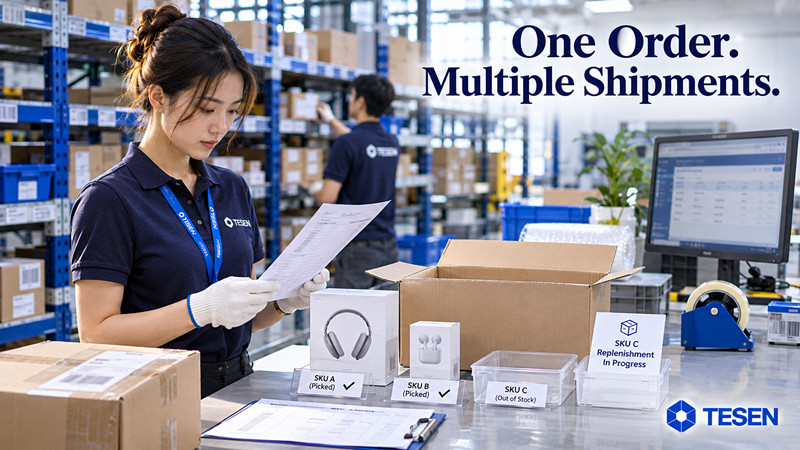
A customer places one order on a Shopify store.
The order contains three products. Two are available at the fulfillment warehouse, but the third is temporarily out of stock.
The customer has already paid for everything.
Should the warehouse hold the entire order until the missing product arrives? Or should it ship the available items first and send the remaining product later?
Both approaches can be reasonable. But each affects shipping costs, inventory allocation, order tracking, and customer expectations.
For growing Shopify and DTC brands, one customer order does not always mean one shipment.
The challenge is not simply whether a warehouse can split an order. It is whether the brand and its fulfillment partner have clear rules for deciding when to do so.
This guide explains how partial fulfillment works, when split shipping makes sense, and what brands should confirm with their fulfillment providers before these situations occur.
Partial fulfillment occurs when only some items or quantities from a customer order have been fulfilled while others remain outstanding.
For example, a customer orders:
| Product | Ordered | Shipped | Remaining |
|---|---|---|---|
| SKU A | 1 | 1 | 0 |
| SKU B | 1 | 1 | 0 |
| SKU C | 1 | 0 | 1 |
| Total | 3 | 2 | 1 |
The warehouse ships SKU A and SKU B.
SKU C remains unfulfilled until it becomes available.
The customer may eventually receive two separate parcels with different tracking numbers, even though both shipments belong to the same original Shopify order.
Shopify supports partial fulfillment workflows, but the exact steps and synchronization behavior depend on the fulfillment locations, applications, and configuration involved.
For brands using an external fulfillment provider, it is important to confirm that the warehouse process and Shopify fulfillment records remain consistent.
Split fulfillment can occur for several operational reasons.
A multi-SKU order contains available products alongside an unavailable item.
The brand must decide whether to delay the complete order or release the available stock.
A missing product may be expected from a supplier, but the actual arrival date is uncertain.
A short and reliable replenishment delay may justify holding the order. A longer or uncertain delay may justify considering partial shipment.
A brand may hold inventory in China and at one or more overseas locations.
Products from different locations may need to be dispatched separately, depending on inventory allocation and the fulfillment setup.
Not every product in an order is suitable for the same parcel or shipping service.
For example, a customer might order a wetsuit, gloves, and an unusually long spearfishing shaft.
The wetsuit and gloves may be compatible with one parcel service, while the shaft could require separate handling or a different eligible shipping method.
In this situation, splitting the order is not necessarily caused by a stock shortage.
It may be required by the physical characteristics of the products.
Some brands allow customers to purchase available products together with items scheduled for later release.
These orders require clear dispatch expectations and an agreed fulfillment policy.
Different reasons for splitting an order require different operating rules. A planned preorder should not automatically be handled like an unexpected inventory shortage.
The two main options are to hold the order until everything is ready or fulfill the available items separately.
The warehouse waits until all required products are available and compatible for consolidated shipment.
This approach may reduce shipment complexity and avoid multiple tracking events.
It may also reduce shipping costs when products can be packed together efficiently.
However, one delayed item can prevent all available products from being dispatched.
For example, if two products are ready today but the third will not arrive for eight days, holding the order delays the entire purchase.
This may conflict with the brand's promised dispatch window.
The warehouse ships available products first and keeps the remaining items pending.
This can allow customers to receive part of their purchase sooner.
It also prevents one delayed SKU from automatically blocking the other items.
However, partial fulfillment introduces additional responsibilities.
The brand may need to pay for another parcel, maintain separate tracking information, and explain why the order is arriving in multiple deliveries.
| Decision Factor | Hold Entire Order | Partial Fulfillment |
|---|---|---|
| Dispatch of available items | Delayed | Can proceed sooner |
| Shipping costs | May be lower | May increase |
| Number of parcels | Usually fewer | Often more |
| Tracking complexity | Lower | Higher |
| Customer communication | Simpler if delay is acceptable | Requires clear shipment-level updates |
| Inventory management | One release event | Outstanding items must remain visible |
| Best suited for | Short delays and compatible products | Longer delays or independent items |
Neither option is automatically better.
The appropriate decision depends on the customer's expectations, the reliability of replenishment information, and the additional fulfillment cost.
Brands should define split-shipping rules before an order becomes delayed.
Otherwise, the warehouse, customer service team, and brand owner may spend time deciding how to handle each exception.
A practical decision framework could look like this:
| Situation | Possible Fulfillment Decision |
|---|---|
| Missing SKU expected within 1–3 days | Hold if the promised dispatch window allows |
| Missing SKU expected after more than 3 days | Evaluate partial fulfillment |
| Supplier arrival date uncertain | Escalate for brand approval |
| Products require different shipping services | Evaluate separate shipments |
| Customer requests separate delivery | Review feasibility and additional costs |
| Additional shipping cost exceeds agreed limit | Obtain brand approval |
These thresholds are illustrative, not universal policies or TESEN service commitments.
For some brands, even a one-day delay may be unacceptable.
Others may prefer to wait several days to avoid additional shipping costs.
A useful policy should consider:
Promised dispatch time
Order value and margin
Expected replenishment date
Additional shipping costs
Customer delivery expectations
Product compatibility
Whether the customer has already been informed of the delay
The objective is to make split shipping a controlled business decision rather than an improvised warehouse response.
Accurate item-level fulfillment records are essential.
Suppose a customer orders three products and the warehouse ships only two.
The system should not indicate that the entire order has shipped.
The fulfillment record needs to identify the specific items and quantities that were dispatched.
For example:
Original Order: #1001
Shipment 1:
SKU A — 1 unit
SKU B — 1 unit
Tracking Number A
Remaining:
SKU C — 1 unit
Awaiting replenishment
Shipment 2, when ready:
SKU C — 1 unit
Tracking Number B
The two shipments belong to the same customer order, but they represent different physical dispatch events.
This distinction matters because a tracking number for Shipment 1 should not create the impression that SKU C has already left the warehouse.
Before relying on automated partial fulfillment, confirm:
Whether the integration supports the required item-level fulfillment workflow.
Whether the correct SKU quantities are recorded for each shipment.
Whether multiple tracking numbers can be associated with the appropriate fulfillment records.
Whether outstanding items remain visible after the first shipment.
Whether the remaining products can be fulfilled later without duplication.
Whether the customer-facing notification accurately describes what shipped.
Shopify's platform capabilities and a particular fulfillment app's capabilities are not necessarily identical.
Brands should test the actual configuration rather than assume that every external integration supports the same behavior.
When an order is split, each parcel may have a different carrier, tracking number, or dispatch date.
From the customer's perspective, these are separate deliveries.
From the brand's perspective, they remain part of one purchase.
The fulfillment workflow should preserve both relationships.
Each tracking update should correspond to the products physically included in that shipment.
If the first parcel contains SKU A and SKU B, the tracking information should not incorrectly imply that SKU C was also dispatched.
The remaining item must stay visible until it is fulfilled, canceled, or otherwise resolved through an authorized process.
Depending on the integration, multiple tracking updates may be handled automatically or through a controlled manual workflow.
The important requirement is accuracy.
A shipment confirmation should describe what actually left the warehouse, not everything the customer originally ordered.
Partial fulfillment can improve delivery timing for available products, but it may increase costs.
A second shipment may involve:
Additional parcel shipping charges
Another shipping label
Extra picking and packing work
Additional packaging materials
Separate tracking and customer service handling
Consider an illustrative example.
A customer places a $120 order containing two products.
One product is available. The other is expected to arrive in seven days.
Sending the available product immediately would add $8 in shipping and handling costs.
The brand must decide whether that expense is justified.
Holding the order avoids the additional shipment cost, but the customer waits longer.
Shipping separately may improve the delivery experience, but it reduces the order's contribution margin.
The correct choice depends on the original customer promise and the commercial value of shipping earlier.
Brands should also clarify who is responsible for the additional cost.
A fulfillment partner should not be expected to make unlimited split-shipment decisions without agreed authorization.
The contract or operating instructions should define when extra shipping charges can be approved automatically and when the brand must make the decision.
Not every multi-SKU order should be eligible for partial fulfillment.
Consider a skincare starter kit containing three products.
The customer purchases the kit because the products are intended to be used together.
If one component is unavailable, shipping the other two may not satisfy the original purchase expectations.
The same issue can occur with:
Gift sets
Preassembled kits
Promotional bundles
Products requiring shared packaging
Items sold as a complete set
Brands should distinguish between independent products and components that form one commercial product.
Items that can reasonably be delivered separately without changing what the customer purchased.
Items sold together as a defined package or set.
Products that may need to be assembled before they are ready for fulfillment.
A warehouse should not split a bundle merely because some components are physically available.
The brand needs to define whether partial fulfillment is permitted and whether any packaging or customer communication requirements apply.
Split fulfillment creates inventory responsibilities beyond the first parcel.
Suppose SKU A and SKU B have shipped while SKU C remains unavailable.
The fulfillment operation must still recognize the outstanding requirement for SKU C.
When new stock arrives, the remaining quantity should be allocated and processed according to the approved workflow.
Potential problems include:
The outstanding SKU being accidentally removed from the order
The order being marked fully fulfilled too early
Inventory being allocated twice
A remaining item being forgotten after replenishment
Duplicate shipments being created
Incorrect stock quantities after the partial shipment
These problems become more likely when a brand manages many multi-SKU orders.
A controlled process should preserve the relationship between the original order, fulfilled quantities, outstanding quantities, and inventory availability.
The objective is not only to dispatch available products.
It is to ensure that every remaining obligation is still visible and actionable.
Imagine a customer orders three products but receives only two.
The parcel arrives without an explanation.
The order notification simply says the order has shipped.
The customer may reasonably assume that the third item is missing.
This can create unnecessary support inquiries and uncertainty.
When an order is intentionally split, customer communication should explain:
Which products have shipped
Which products remain outstanding
Whether another shipment is expected
The estimated dispatch timing, if reasonably known
The tracking information for each parcel
For example:
Two items from your order have shipped. Your remaining item is awaiting replenishment and will be sent separately. We'll provide another tracking update when it ships.
This message distinguishes an intentional partial shipment from a packing error.
It also helps the customer understand why products from one order may arrive on different dates.
Brands should confirm whether notifications are generated through Shopify, another application, or their customer service workflow.
Clear communication is especially important when a split shipment was not anticipated at checkout.
A fulfillment warehouse can identify inventory shortages and shipping constraints.
However, the brand may need to decide whether additional costs and customer consequences are acceptable.
A practical responsibility framework might look like this:
| Task | Typical Responsibility |
|---|---|
| Identify unavailable SKUs | Fulfillment partner |
| Confirm expected supplier arrival | Supplier / Fulfillment partner |
| Evaluate shipment alternatives | Fulfillment partner |
| Approve additional shipping charges | Brand, unless pre-authorized |
| Decide whether to hold or split | Brand or agreed operating rule |
| Execute approved shipments | Fulfillment partner |
| Maintain fulfillment and tracking records | Fulfillment partner / Integration workflow |
| Communicate with the customer | Brand or configured notification process |
The actual division of responsibilities depends on the service agreement and technical setup.
For routine exceptions, brands may authorize predefined decisions.
For unusual or expensive situations, separate approval may still be required.
Defining these responsibilities in advance helps prevent orders from remaining on hold while different parties wait for instructions.
A fulfillment onboarding process should address how split orders will be handled.
A controlled test can reveal whether the warehouse and system workflows are consistent.
For example, create a test order containing two SKUs.
Make one SKU available and treat the other as unavailable within an appropriate test workflow.
Then verify:
The warehouse identifies the correct available and unavailable items.
The brand can approve the required fulfillment action.
Only the available item is included in the first shipment.
The remaining item stays recorded as outstanding.
Tracking information is associated with the correct shipment.
The second item can be fulfilled later without duplication.
Customer notifications accurately describe the fulfillment status.
The test should be conducted in a controlled environment or with an agreed test procedure to avoid unintended live shipments.
Not every step must be automated.
But the process should be documented, reliable, and understandable to the people responsible for handling exceptions.
TESEN is a China-based Ecommerce Supply Chain Partner for Shopify and DTC brands.
Our core focus is ecommerce fulfillment, supported by product sourcing, supplier management, quality control, inventory storage, custom packaging, and international shipping.
Multi-SKU orders can involve different suppliers, product availability dates, packaging configurations, and shipping restrictions.
TESEN supports the China-side operations needed to receive products, manage inventory, prepare orders, and coordinate international delivery.
When products within an order cannot be shipped together, the appropriate handling should be determined by:
Inventory availability
Expected supplier replenishment
Product and shipping compatibility
Additional fulfillment costs
Customer delivery expectations
Agreed brand instructions
Brands should confirm the applicable split-shipment workflow and Shopify integration behavior during onboarding, particularly where item-level fulfillment records or multiple tracking updates are required.
The objective is to keep warehouse execution, order records, and customer expectations aligned.
For Shopify brands managing more complex orders, clear fulfillment rules are as important as the ability to physically pack and ship products.
One Shopify order does not always result in one shipment.
Products may have different inventory availability, supplier arrival dates, fulfillment locations, or shipping requirements.
When that happens, brands must decide whether to hold the entire order or dispatch available items separately.
Holding an order may reduce cost and shipment complexity.
Partial fulfillment may allow available products to reach customers sooner.
Neither approach is automatically correct.
The right decision depends on inventory availability, shipping economics, customer expectations, and agreed operating rules.
Reliable partial fulfillment requires three things: accurate item-level records, clear decision ownership, and transparent customer communication.
For growing Shopify and DTC brands, these requirements should be established before split orders become a recurring operational problem.
Yes. Shopify supports fulfillment workflows where only certain items or quantities are fulfilled. The exact process depends on the fulfillment locations, applications, and configuration involved.
Yes. Orders dispatched through multiple shipments can have separate tracking information associated with the relevant fulfillment records. Brands should confirm how their specific fulfillment integration handles these updates.
Not necessarily. Holding may reduce shipping costs and complexity, while partial fulfillment may allow available products to reach customers sooner. The decision should follow the brand's agreed fulfillment policy.
It can. Multiple shipments may require additional parcel shipping, handling, labels, and packaging. The exact difference depends on product dimensions, destination, carrier pricing, and the fulfillment agreement.
It depends on how the bundle is sold and managed. A gift set or preassembled kit may need to remain together, while independent products may be suitable for separate shipments.
Responsibility for additional shipping charges depends on the agreement between the brand and fulfillment provider. Charges should be covered by predefined rules or approved before the additional shipment is arranged.
TESEN supports multi-SKU ecommerce fulfillment and international shipping coordination. Split-shipment requirements should be reviewed during onboarding to confirm the operational process, additional costs, and applicable Shopify integration capabilities.
TESEN is a China-based Ecommerce Supply Chain Partner for Shopify and DTC brands.
We support ecommerce fulfillment through integrated product sourcing, supplier management, quality control, inventory storage, custom packaging, kitting, and international shipping.
Our focus is helping ecommerce businesses manage accurate order processing and practical fulfillment operations as their product catalogs and order complexity grow.
Source Your Products and Start Dropshipping
 IPv6 network supported