
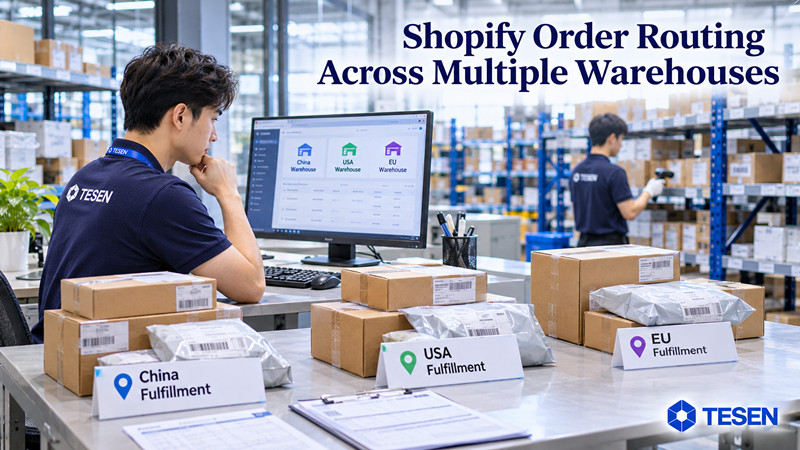
A Shopify brand starts with one fulfillment warehouse in China.
As sales grow, the brand begins stocking its bestsellers in the United States. Later, it adds an EU warehouse to serve European customers.
Now the business has three potential fulfillment locations.
A customer in California places an order for a product available in both China and the United States.
Which warehouse should fulfill it?
The US warehouse may seem like the obvious choice. But what if it has only 20 units remaining? What if the next replenishment shipment is still three weeks away? Or what if the customer orders another product available only in China?
These are order routing decisions.
Multi-location fulfillment is not only about where inventory is stored. It is about deciding which inventory should fulfill each customer order.
For Shopify and DTC brands, order routing connects warehouse locations, available stock, customer destinations, and actual fulfillment operations.
Understanding how these decisions work is essential before expanding into multiple warehouses.
Shopify order routing determines which eligible fulfillment locations should receive orders based on the store's configured routing rules.
With one fulfillment location, order allocation is relatively straightforward.
When multiple locations are available, Shopify needs to determine which location—or combination of locations—should fulfill the products in an order.
For example, a brand may operate with:
A China warehouse for product sourcing, inventory storage, and international ecommerce fulfillment.
A US warehouse for proven products with consistent American demand.
An EU warehouse for selected bestsellers sold to European customers.
Some products may be stocked in all three locations.
Others may be available only in China.
An order may also contain products that cannot all be fulfilled from the same warehouse.
Shopify's routing configuration helps determine where eligible orders should be assigned.
However, assigning an order to a location is not the same as physically fulfilling it.
The selected warehouse or fulfillment service must still receive the relevant order information, have usable inventory, and execute the shipment correctly.
Shopify documents a default order routing strategy built around three priorities:
Minimize split fulfillments.
Stay within the destination market.
Ship from the closest location.
These priorities are evaluated in sequence.
That order is important because the closest warehouse does not necessarily receive the order first.
Shopify prioritizes avoiding unnecessary splits when an eligible location can fulfill the required items together.
For example, consider an order containing three products.
| SKU | China Warehouse | US Warehouse |
|---|---|---|
| SKU A | Available | Available |
| SKU B | Available | Available |
| SKU C | Available | Unavailable |
The China warehouse can fulfill all three products.
The US warehouse can fulfill only two.
A strategy prioritizing fewer split fulfillments may favor assigning the complete order to China rather than dividing it across two warehouses.
That may reduce parcel count and order-management complexity.
However, it does not automatically guarantee the lowest shipping cost or fastest delivery.
When the earlier routing priorities permit it, Shopify's destination-market rule favors eligible locations in the customer's market.
For example, a US customer ordering a product stocked in both China and the United States may be routed to the US location.
This can support local delivery and reduce the need for an individual international shipment.
But it also means that US warehouse inventory may be consumed more quickly.
Shopify's documented closest-location rule uses geographic straight-line distance between the fulfillment location and shipping destination.
It is not a live comparison of carrier prices, actual transit times, or warehouse processing capacity.
A geographically closer warehouse is not necessarily the fastest or most economical fulfillment option.
The default routing strategy is a starting point, not a complete optimization system for every brand's shipping and inventory costs.
Merchants should verify the current rules and options available in their Shopify configuration, particularly when using external fulfillment services.
Imagine a US customer purchasing a two-product bundle.
Both products are available in China, but only one is stocked in the US warehouse.
Shipping the available item from the US and the remaining item from China could result in two parcels, two tracking numbers, and different delivery dates.
Sending both items from China could avoid the split.
Under a routing strategy that prioritizes minimizing split fulfillments, the complete-order location may be favored even though it is farther from the customer.
This creates a commercial tradeoff.
| Priority | Potential Benefit | Potential Tradeoff |
|---|---|---|
| Fewer split shipments | Less parcel and tracking complexity | Some items may ship internationally |
| Local-market fulfillment | Potentially faster local delivery | Local inventory may deplete sooner |
| Geographic proximity | Closer eligible location | Not necessarily the lowest total cost |
| Preferred warehouse | More control over stock allocation | May conflict with other routing priorities |
For some brands, minimizing parcel count is the correct priority.
For others, delivering an available item quickly may matter more.
The important point is that routing rules should reflect the brand's fulfillment objectives rather than be treated as a universal cost-saving solution.
Order routing and partial fulfillment are closely connected, but they solve different operational questions.
Order routing asks: Which location should fulfill the order?
Partial fulfillment asks: What happens when only part of the order can be shipped?
Consider a Shopify order containing three products.
SKU A and SKU B are available in the US warehouse.
SKU C is available only in China.
The brand may need to evaluate whether to:
Fulfill the complete order from China.
Split the order between the US and China.
Hold the order while inventory is transferred or replenished, if commercially appropriate.
Each option can affect shipping costs, delivery promises, and customer communication.
If an order is split, the fulfillment workflow must preserve accurate item-level records and shipment tracking.
A routing configuration alone does not guarantee that every participating warehouse or fulfillment integration can execute the selected workflow correctly.
Brands should confirm how location assignments, fulfillment requests, inventory updates, and tracking information move between Shopify and their fulfillment providers.
This is one of the most important consequences of multi-location fulfillment.
Suppose a brand stocks a bestselling SKU in two locations.
| Location | Available Stock |
|---|---|
| US Warehouse | 500 units |
| China Warehouse | 1,500 units |
| Total | 2,000 units |
The brand receives approximately 40 US orders per day for this SKU.
If eligible US orders are consistently routed to the US warehouse, its inventory will decline rapidly.
At that sales rate:
500 units ÷ 40 units per day = 12.5 days of demand.
This is an illustrative calculation before safety stock, other sales channels, returns, or changes in demand.
The China warehouse still holds 1,500 units.
But that does not mean the US warehouse can continue supporting local orders without interruption.
The inventory exists across the business, yet it is not necessarily positioned where the routing strategy expects it to be.
This distinction is critical.
Order routing determines where stock is consumed. Replenishment planning determines whether sufficient stock will remain available at that location.
Brands should monitor inventory by fulfillment location, not only total inventory across the business.
Suppose the US warehouse is the preferred location for American orders.
This may support faster delivery, but it also creates a recurring need to replenish local stock.
The brand needs answers to several operational questions:
How quickly is inventory being consumed at the US location?
How long does replenishment from China take?
When should the next transfer begin?
What stock buffer is appropriate?
What happens when US inventory becomes unavailable?
Can eligible orders be fulfilled from China instead?
How will different delivery expectations be communicated?
A useful replenishment plan should consider location-level demand, supplier lead times, international transit, customs clearance, receiving time, and inventory variability.
For example, if the US warehouse has 12.5 days of stock remaining but the expected end-to-end replenishment process takes longer, the brand may face a local stockout unless additional inventory is already on its way.
The appropriate response might involve earlier replenishment, different inventory allocation, or a controlled fallback fulfillment arrangement.
It should not depend on the assumption that inventory stored elsewhere can immediately replace local stock.
For brands operating across several markets, routing and replenishment should be reviewed together.
Not every warehouse needs to perform the same function.
For Shopify brands sourcing products from China, a China fulfillment warehouse may support several distinct activities.
Products with uncertain demand can remain closer to suppliers while the brand evaluates sales performance.
This can reduce the need to position unproven inventory across multiple overseas markets.
Low-volume products may not justify advance inventory in the United States and Europe.
Where shipping eligibility and customer expectations allow, these items can continue to be fulfilled directly from China.
China-side operations can connect purchasing, quality checks, warehouse receiving, packaging, and inventory preparation.
Eligible customer orders can be processed and shipped internationally from China under the applicable shipping arrangements.
Inventory can be prepared for agreed bulk transfers to overseas warehouses as demand develops.
Overseas locations may serve a different role by holding predictable, high-volume products for local fulfillment.
This creates a practical division of responsibilities.
China can support sourcing flexibility, long-tail inventory, international orders, and replenishment.
Overseas warehouses can support market-specific stock availability and local delivery.
The appropriate allocation depends on product demand, delivery expectations, customs requirements, and total operating costs.
Consider a Shopify brand selling 100 SKUs.
Twenty products generate most of its US sales.
Ten products have established demand in Europe.
The remaining seventy products sell irregularly across different markets.
A possible inventory strategy is:
| Product Group | Potential Fulfillment Location |
|---|---|
| Proven US bestsellers | US warehouse |
| Proven EU bestsellers | EU warehouse |
| New products | China warehouse |
| Long-tail SKUs | China warehouse |
| Inventory for overseas replenishment | China-side stock before transfer |
This approach can balance local delivery performance with inventory flexibility.
However, it introduces order routing decisions.
What happens when a US customer purchases a US-stocked bestseller and a China-only accessory in the same order?
What happens when the EU warehouse runs out of a popular variant?
Should the brand favor one complete international shipment or separate local and international deliveries?
These questions require a combination of Shopify routing configuration, inventory visibility, fulfillment partner coordination, and agreed exception-handling rules.
The brand should also verify that its actual Shopify and external fulfillment integrations can support the intended allocation and tracking workflow.
A hybrid inventory strategy is useful only when the operational systems can execute it consistently.
Not necessarily.
A warehouse can be the preferred routing location without being the least expensive option for every order.
For example, a product stocked in an EU warehouse may benefit from local delivery.
But the brand has already incurred costs to purchase, transport, import, and store that inventory.
A China warehouse may involve lower overseas inventory commitments but higher international shipping and import-related costs for individual orders.
A meaningful comparison should consider:
| Cost or Operational Factor | Questions to Ask |
|---|---|
| Product and inventory cost | How much capital is tied up in each location? |
| Warehouse handling | What are the receiving, picking, packing, and storage costs? |
| Shipping | What is the actual cost of each eligible delivery option? |
| Import charges | What duties, taxes, and customs costs apply? |
| Delivery expectations | Which option meets the customer promise? |
| Inventory ageing | Which products are at risk of becoming slow-moving stock? |
| Replenishment | How quickly and reliably can each warehouse be restocked? |
| Split shipments | Will the routing decision create additional parcels? |
Shopify's routing rules help allocate orders.
They do not replace a complete landed-cost and fulfillment-cost analysis.
For established brands, the most useful strategy is often one that combines routing rules with inventory planning and clear operational responsibilities.
Available inventory does not always mean a warehouse can process an order immediately.
A fulfillment location may have sufficient stock but be experiencing unusually high order volume.
Another warehouse may have available processing capacity but less inventory.
Shopify provides routing configuration options, including location-related attributes and metafield-based approaches where supported.
However, these should not be confused with a universal real-time warehouse capacity optimizer.
Any capacity-related rule depends on the information available to the routing configuration and how accurately that information is maintained.
For brands using external 3PL systems, warehouse processing capacity may need to be monitored and managed outside Shopify.
Brands should also distinguish between three separate capabilities:
Shopify Order Routing: Determines eligible fulfillment location assignments according to configured rules.
Fulfillment Integration: Connects relevant orders, locations, inventory, and fulfillment updates between systems.
Warehouse Execution: Physically receives, picks, packs, and ships assigned orders.
A successful multi-location workflow requires these components to work together.
Before expanding into another warehouse, brands should confirm the following.
| Area | Key Question |
|---|---|
| Location roles | Which products and markets should each warehouse serve? |
| Inventory accuracy | Are quantities reliable at every location? |
| SKU availability | Which products are stocked locally versus in China? |
| Routing priorities | Should the store prioritize fewer splits, destination market, or preferred locations? |
| Shipping economics | What is the total cost of each fulfillment option? |
| Replenishment | How will stock be replenished as routing consumes inventory? |
| Stockout handling | What happens when the preferred location has no stock? |
| Integration | Can each fulfillment service receive and execute its assigned orders? |
| Tracking | Will shipment information return accurately to Shopify? |
| Customer communication | How will different shipping origins and delivery times be explained? |
Brands should test representative scenarios before relying on a new multi-location setup.
A useful test might include a product stocked in two warehouses, a multi-SKU order with different availability by location, and an order where the preferred warehouse is out of stock.
The goal is to verify actual order assignments and fulfillment execution—not simply confirm that the locations appear in Shopify.
TESEN is a China-based Ecommerce Supply Chain Partner for Shopify and DTC brands.
Our core focus is ecommerce fulfillment, supported by product sourcing, supplier management, quality control, inventory storage, custom packaging, and international shipping.
For brands using China alongside overseas fulfillment locations, TESEN can support the China-side operational component.
This may include:
Coordinating product sourcing and supplier deliveries
Receiving and storing inventory in China
Preparing products and packaging for fulfillment
Processing eligible international ecommerce orders
Preparing inventory for agreed overseas replenishment shipments
Coordinating China-side inventory and shipping requirements
For Shopify brands, the intended location assignment and the actual fulfillment integration should be reviewed together.
Shopify's native routing capabilities should not be assumed to represent every feature available in a particular third-party fulfillment application.
Where a brand needs cross-location routing, split shipments, or fallback fulfillment arrangements, the workflow should be confirmed before implementation.
TESEN's role is to support accurate China-side inventory operations and ecommerce fulfillment within the brand's wider supply chain strategy.
As Shopify brands expand across multiple markets, fulfillment becomes more than a question of where products are stored.
Every customer order creates a decision about which inventory should be used.
Shopify order routing provides a mechanism for applying consistent location-selection rules.
Its documented default strategy prioritizes minimizing split fulfillments, staying within the destination market, and selecting the closest eligible location.
But routing decisions also affect inventory consumption, replenishment requirements, shipping costs, and customer delivery outcomes.
For brands operating with both China and overseas warehouses, the routing strategy should reflect the actual role of each location.
China can remain an important sourcing, inventory, and international fulfillment base.
Overseas warehouses can support local delivery for proven products.
The right multi-location fulfillment strategy connects order routing, location-level inventory planning, and reliable warehouse execution.
Shopify order routing applies configured rules to determine which eligible fulfillment locations should receive orders. The actual assignment depends on inventory availability, location eligibility, routing settings, and the store's fulfillment configuration.
Shopify documents three default priorities: minimizing split fulfillments, staying within the destination market, and shipping from the closest eligible location, in that order. Merchants should verify their current store configuration.
No. Under the documented default strategy, minimizing split fulfillments and staying within the destination market take priority before the closest-location rule.
Shopify can consider eligible configured fulfillment locations. Actual execution depends on inventory configuration, fulfillment-service integrations, and the operating arrangements of the participating warehouses.
Not necessarily. Default routing is not a live comparison of all carrier rates, transit times, inventory carrying costs, and warehouse fees.
Routing determines which location's stock is consumed by orders. Brands should monitor demand and available inventory at each location to plan replenishment and reduce the risk of stockouts.
TESEN supports China-side ecommerce fulfillment and supply chain operations, including inventory preparation for agreed overseas shipments. Specific Shopify location-routing and integration requirements should be reviewed during onboarding.
TESEN is a China-based Ecommerce Supply Chain Partner for Shopify and DTC brands.
We support product sourcing, supplier management, quality control, inventory storage, custom packaging, dropshipping, and international ecommerce fulfillment.
Our focus is connecting China-side sourcing and inventory operations with accurate order processing and practical fulfillment workflows for growing ecommerce businesses.
Source Your Products and Start Dropshipping
 IPv6 network supported