
Expanding an ecommerce brand into international markets creates opportunities, but it also introduces a difficult inventory decision.
A Shopify brand selling successfully in the United States may begin receiving orders from the United Kingdom, Germany, France, and Australia.
The immediate question is often how to ship orders to those countries.
But a more important operational question may come first:
Where should inventory be stored before customers place their orders?
Should the brand divide inventory between warehouses in different countries? Keep products in China and fulfill international orders from one location? Or combine centralized inventory with regional warehousing?
Each option affects inventory availability, working capital, replenishment, delivery expectations, and total fulfillment costs.
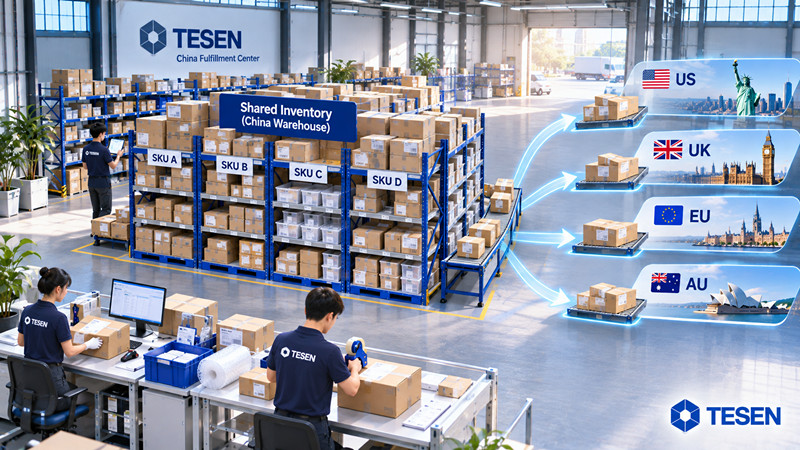
For brands sourcing products from China, a China 3PL can provide a centralized inventory and fulfillment operation that serves multiple markets without requiring separate stock allocations for every destination.
However, centralized fulfillment is not always the best solution.
The right strategy depends on how predictable demand is in each market, which SKUs are selling, and what delivery experience customers expect.
This guide explains how shared inventory works, where it creates value, and when overseas warehouses become commercially justified.
Consider an ecommerce brand selling one product in four markets:
United States
United Kingdom
European Union
Australia
The brand purchases 2,000 units from a manufacturer in China.
If it decides to stock each market locally, it might distribute inventory as follows:
| Market | Initial Inventory |
|---|---|
| United States | 800 units |
| United Kingdom | 400 units |
| European Union | 500 units |
| Australia | 300 units |
| Total | 2,000 units |
This allocation may appear reasonable based on the brand's sales forecasts.
But forecasts are estimates.
Suppose US demand grows faster than expected while Australian sales remain slow.
The US warehouse may need replenishment even though the company still owns hundreds of unsold units elsewhere.
The issue is not necessarily insufficient global inventory.
It is that stock has been committed to locations where demand developed differently from expectations.
For growing ecommerce brands, this creates three operational risks.
One market experiences stockouts while another holds excess inventory.
Cash remains tied up in inventory that is not selling at the expected rate.
Moving stock between countries may require additional freight, customs procedures, warehouse handling, and time.
These risks become more significant when a brand manages multiple SKUs and several destination markets.
International inventory planning should therefore consider where demand is predictable enough to justify dedicated stock.
A China 3PL can receive products from manufacturers, store inventory, and process eligible ecommerce orders for multiple international destinations.
Instead of allocating every unit to a country before demand occurs, the brand can maintain a shared inventory pool in China.
The workflow is relatively straightforward:
China Suppliers → China Warehouse → Shared Inventory → International Customer Orders
When orders arrive, the fulfillment operation identifies the relevant products, prepares the parcels, and dispatches them using shipping services appropriate for the destination.
For example, a Shopify brand may hold 2,000 units of Product A in China.
Orders arrive from the US, UK, France, and Australia.
Rather than maintaining four separate physical inventories, the brand can draw from the same available stock for eligible orders across those markets.
This creates allocation flexibility.
If demand increases in one country, more units from the shared pool can serve that market without first transferring inventory from another regional warehouse.
If demand slows elsewhere, the remaining stock has not necessarily been committed to that location.
However, a shared inventory pool does not mean every destination has the same delivery time, shipping cost, or customs requirements.
International fulfillment remains subject to destination-specific conditions.
The benefit of centralization is inventory flexibility, not the elimination of cross-border logistics.
Regional warehousing can provide faster local delivery and other operational advantages.
The problem arises when brands distribute inventory before they have enough reliable demand data.
Consider the same business after several weeks of sales.
| Market | Remaining Inventory |
|---|---|
| United States | 40 units |
| United Kingdom | 280 units |
| European Union | 350 units |
| Australia | 260 units |
| Total | 930 units |
Illustrative example.
The company still owns 930 units globally.
But only 40 remain in the US warehouse.
If US demand continues, the brand may face a local stockout despite having substantial inventory elsewhere.
Stock held in another country may not be immediately available for US orders.
Transferring that inventory can involve extra handling, transportation, import requirements, and delays.
This is often described as stranded inventory: products exist, but not where they are needed.
A centralized China inventory pool can reduce premature geographic fragmentation.
It allows the brand to postpone some country-level inventory commitments until regional sales patterns become clearer.
That flexibility can be particularly valuable during early international expansion.
Inventory forecasting remains necessary whether a brand uses one warehouse or several.
The difference is the level at which inventory must be allocated.
With separate regional warehouses, the brand needs to plan stock requirements for each location.
That includes regional sales forecasts, safety stock, replenishment timing, and expected stockouts.
With centralized inventory, purchasing can initially be planned around the combined demand of the markets served by that inventory pool.
Country-level demand still matters, especially for shipping costs, delivery commitments, and future expansion decisions.
But the brand may not need to physically divide all inventory between countries in advance.
This is the principle behind inventory pooling.
It may be particularly useful when:
Individual market demand is uncertain
Several markets share the same products
Sales fluctuate differently between regions
New products are being tested internationally
The brand has a large number of slower-moving SKUs
Pooling does not automatically reduce inventory requirements.
If demand rises simultaneously across all markets, the shared inventory still needs enough stock to meet that combined demand.
The potential benefit depends on demand variability, the relationship between regional sales patterns, supplier lead times, and required service levels.
The main advantage is avoiding unnecessary inventory fragmentation.
Opening a new international market does not always justify opening a local warehouse.
Imagine a Shopify brand already selling successfully in the United States.
It starts advertising in France and Australia.
The company does not yet know which products will perform best, whether customers will reorder, or how stable regional demand will become.
Immediately sending dedicated inventory to both markets creates a financial commitment before that demand has been validated.
A shared China inventory pool offers another approach.
The brand can fulfill eligible orders from its existing stock while gathering information about:
Order volume by country
Best-selling SKUs
Customer acquisition and repeat purchases
Delivery expectations
Shipping costs
Returns and customer service requirements
As this data develops, the brand can identify which markets and products justify dedicated local inventory.
The progression may look like this:
Market Entry → Centralized Fulfillment → Demand Validation → Regional Inventory Decision
This approach does not assume that cross-border fulfillment should continue indefinitely.
It allows inventory location decisions to follow stronger evidence.
For brands entering several markets at once, that can help limit unnecessary stock commitments during the testing stage.
Centralized China fulfillment has clear limitations.
Orders shipped directly from China require international transportation, and delivery expectations may vary significantly between markets.
As regional demand grows, local fulfillment can become commercially attractive.
A brand should evaluate overseas warehousing when several conditions are present.
The brand has enough sales history to estimate demand with reasonable confidence.
A small group of products accounts for a large share of orders in a particular market.
Customers expect delivery speeds that are difficult to achieve consistently through cross-border fulfillment.
The total cost of importing, storing, processing, and delivering orders locally becomes commercially attractive.
The brand needs domestic return processing, exchanges, or other after-sales capabilities that cannot be handled effectively through its current cross-border model.
For example, a product selling consistently at high volume in the United States may justify US warehouse inventory.
A different product selling only a few units each week across several countries may remain better suited to centralized fulfillment.
The decision should be made at the product-and-market level rather than for the entire brand at once.
Both models have advantages and limitations.
| Decision Factor | Centralized China Fulfillment | Overseas Warehousing |
|---|---|---|
| Inventory Allocation | Shared across eligible markets | Committed to specific locations |
| Demand Flexibility | Generally higher before regional allocation | Depends on regional stock balance |
| Delivery Speed | Cross-border transit required | Potentially faster local delivery |
| Replenishment | China-side supplier replenishment | International bulk replenishment |
| Inventory Forecasting | Can begin with aggregated demand | Requires location-level forecasts |
| Working Capital | May reduce premature regional stock commitments | May require inventory buffers in several markets |
| Customs | Individual cross-border shipments subject to applicable rules | Bulk imports and local fulfillment requirements |
| Returns | Cross-border arrangements may be limited | Local returns may be easier to support |
Neither model is universally better.
The correct choice depends on product characteristics, order volume, destination markets, delivery expectations, customs requirements, and total operating costs.
For some brands, the most effective solution is a combination of both.
A hybrid model combines centralized China inventory with selected overseas warehouse inventory.
Rather than distributing every SKU to every market, the brand decides which products justify local stocking.
Consider a company selling 50 SKUs internationally.
Five products account for most US orders.
The remaining 45 SKUs sell in smaller quantities across several countries.
The brand might choose to:
Hold the five proven US bestsellers in a US warehouse.
Keep lower-volume and long-tail products in China.
Fulfill eligible international orders from the China inventory pool.
Use China-side inventory to support future regional replenishment where appropriate.
This approach separates two different inventory needs.
Regional inventory supports predictable, concentrated demand.
Centralized inventory supports flexibility across products and markets with less predictable demand.
A hybrid strategy may also reduce the need to stock the full product catalog in every overseas warehouse.
However, it introduces coordination requirements.
The brand needs clear inventory allocation rules, visibility across locations, and reliable replenishment planning.
China-side inventory cannot replenish an overseas warehouse instantly. International freight, customs clearance, and receiving still require time.
The hybrid model should therefore be designed around actual operational requirements rather than the assumption that more warehouses always improve fulfillment.
A common mistake is to compare centralized and regional fulfillment using only the shipping cost of one parcel.
That comparison is incomplete.
The brand should evaluate the total cost of each inventory network.
Potential cost components include:
China warehouse storage
Inventory receiving
Order picking and packing
Packaging materials
International parcel delivery
Applicable customs duties and taxes
Customer support and returns arrangements
Potential cost components include:
Bulk international freight
Import clearance and applicable duties or taxes
Regional warehouse receiving
Storage charges
Local order fulfillment fees
Domestic parcel delivery
Inventory replenishment
Inter-warehouse transfers
Slow-moving or excess inventory
A centralized model may reduce the need for separate regional stock buffers, but international parcel shipping can be more expensive or slower for certain products and destinations.
Regional fulfillment may provide better delivery economics for proven high-volume SKUs, but it also requires inventory commitments and additional warehouse operations.
Before choosing a model, estimate:
Expected monthly orders by country
SKU-level sales volume
Product weight and packed dimensions
Required delivery service levels
Inventory turnover
Warehouse receiving and storage costs
Fulfillment and shipping costs
Customs and tax treatment
Returns requirements
Replenishment lead times
The goal is to identify the inventory structure that delivers the required customer experience at an acceptable total operating cost and inventory risk.
A growing ecommerce brand should not assume that every product requires the same inventory strategy.
Different SKUs may have different sales patterns, shipping requirements, and customer expectations.
A practical starting framework is:
| SKU and Market Situation | Strategy to Evaluate |
|---|---|
| New product with uncertain demand | Centralized China inventory |
| Low-volume product sold across several markets | Shared inventory pool |
| Stable bestseller in a high-volume market | Regional warehouse inventory |
| Product with strong local delivery expectations | Regional fulfillment |
| Long-tail products with unpredictable demand | Centralized inventory |
| Proven regional bestseller with ongoing replenishment | Hybrid fulfillment |
| Product with destination-specific restrictions | Evaluate compliant fulfillment options individually |
These are decision guidelines, not fixed rules.
For example, a product may have low sales volume but still require local warehousing because of shipping restrictions or customer delivery requirements.
Similarly, a high-volume product may remain suitable for China fulfillment if the total economics and service expectations support that model.
The most useful question is not simply whether a brand should use a China warehouse or an overseas warehouse.
It is:
Which SKUs should be stored in which locations, based on actual demand and fulfillment requirements?
A China 3PL supporting international ecommerce should be evaluated on more than the number of countries it can ship to.
Brands should ask operational questions that reveal how inventory and orders will be managed.
Can one inventory pool serve orders from multiple countries?
How is available stock allocated when orders arrive?
How are SKU quantities maintained and reconciled?
How are inventory discrepancies investigated?
What order and inventory information is available to the brand?
Which destinations and product categories are supported?
How are shipping services selected?
How are tracking updates communicated?
What happens when an order encounters a delivery exception?
How are destination-specific packaging and labeling requirements handled?
Can the provider receive inventory from multiple Chinese suppliers?
Can it support replenishment planning?
Can it prepare bulk shipments for overseas warehouses?
How are different order types and packaging requirements managed?
What operational changes would be needed as order volume grows?
The objective is to understand whether the fulfillment partner can support both current orders and future inventory requirements.
A provider may offer international shipping without necessarily offering the inventory management capabilities needed for a growing multi-market operation.
TESEN is a China-based Ecommerce Supply Chain Partner for Shopify and DTC brands.
Our core focus is ecommerce fulfillment, supported by China sourcing, supplier coordination, quality control, inventory management, custom packaging, and international shipping.
For brands sourcing products from Chinese manufacturers, TESEN can support a centralized operating structure in which products are received and stored in China before being fulfilled to customers across supported international markets.
Depending on the project, the workflow may include:
Coordinating inventory deliveries from Chinese suppliers
Receiving and checking incoming products
Storing inventory in the China warehouse
Managing product and SKU information
Preparing orders with approved packaging requirements
Processing Shopify orders through TESEN's integration workflow
Arranging international delivery through available shipping services
Preparing inventory for bulk replenishment shipments when required
Shopify order synchronization and tracking updates can help connect storefront orders with fulfillment operations.
Specific inventory allocation rules, shipping destinations, packaging requirements, and replenishment arrangements should be confirmed during onboarding.
For brands that later establish overseas inventory, China-side operations can also support the upstream supply chain and replenishment process.
TESEN does not need to replace every regional warehouse in a brand's fulfillment network.
The value is in helping brands coordinate China-side inventory and fulfillment as their international sales develop.
Selling in multiple countries does not automatically mean inventory should be stored in multiple countries.
For ecommerce brands entering new markets, splitting stock too early can create inventory imbalance, increase working-capital commitments, and complicate replenishment.
A shared China inventory pool can provide flexibility while regional demand is still developing.
As sales become more predictable, selected products may justify overseas warehousing.
For many Shopify and DTC brands, a hybrid model can eventually provide the right balance between inventory flexibility and local delivery performance.
The central principle is straightforward:
Inventory should be distributed according to demand certainty, not simply according to the number of markets a brand serves.
A well-designed fulfillment network is not necessarily the one with the most warehouses.
It is the one that places inventory where demand, customer expectations, and operating economics justify it.
Yes, provided the fulfillment partner supports the relevant products, destinations, and shipping services. A shared China inventory pool can serve eligible orders across multiple countries without requiring separate stock holdings in every market.
Centralized inventory can preserve allocation flexibility, reduce premature regional stock commitments, and simplify initial replenishment. Its effectiveness depends on demand patterns, international shipping economics, and customer delivery expectations.
Overseas warehousing becomes more attractive when regional demand is stable, order volume supports local operations, faster delivery is important, and the total cost and inventory risk are commercially justified.
Yes. A hybrid model can keep proven regional bestsellers closer to customers while maintaining new products, long-tail SKUs, and lower-volume market inventory in China.
Yes, subject to the provider's capabilities and applicable shipping and customs requirements. China-held inventory can potentially support both individual ecommerce orders and bulk replenishment shipments.
No. Centralization may reduce inventory fragmentation, but total costs also depend on storage, international shipping, customs, delivery service levels, and returns. A complete network-level comparison is necessary.
TESEN supports China-side inventory receiving, storage, supplier coordination, custom packaging, Shopify order fulfillment, and international delivery. The appropriate operating structure depends on each brand's products, destination markets, order volume, and fulfillment requirements.
TESEN is a China-based Ecommerce Supply Chain Partner for Shopify and DTC brands.
We support ecommerce fulfillment through integrated China sourcing, supplier management, quality control, inventory storage, custom packaging, and international shipping.
Our focus is helping growing ecommerce businesses connect supplier operations, inventory management, and order fulfillment as they expand across international markets.
Source Your Products and Start Dropshipping
 IPv6 network supported