
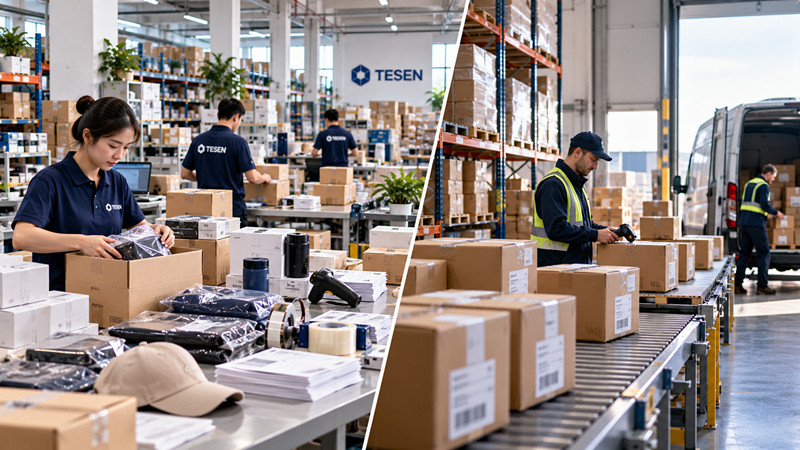
Should your Shopify brand fulfill orders directly from China or move inventory into an overseas warehouse?
For growing ecommerce businesses, this is rarely a simple choice between two warehouse locations.
A brand selling a predictable bestseller in the United States has different fulfillment requirements from a brand testing 20 products across the US, UK, Europe, and Australia.
The first may benefit from keeping inventory close to customers.
The second may benefit from maintaining a centralized inventory pool in China until demand becomes more predictable.
Both approaches can work.
The challenge is understanding which model fits the products, markets, inventory risks, and delivery expectations of the business.
The right fulfillment strategy should follow how your ecommerce business operates—not simply where a warehouse is located.
This guide explains when China fulfillment makes sense, when overseas fulfillment may be the better option, and how Shopify and DTC brands can combine both models as they grow.
China fulfillment is an ecommerce order fulfillment model in which products are stored and prepared in China before being shipped directly to international customers.
For brands sourcing from Chinese manufacturers, the process may include:
Receiving products from suppliers.
Verifying inventory quantities and SKU information.
Performing agreed quality-control checks.
Storing approved inventory.
Preparing products with custom packaging or inserts.
Processing Shopify or other ecommerce orders.
Picking and packing individual orders.
Shipping parcels to customers in destination markets.
China fulfillment differs from simply asking a factory to ship individual parcels.
A dedicated fulfillment operation can coordinate inventory from multiple suppliers, manage SKU-level stock, and apply consistent order-processing instructions.
However, it is not automatically the best solution for every ecommerce brand.
Its suitability depends on the relationship between supply, demand, inventory commitment, and customer expectations.
The most useful starting point is to understand the trade-offs between centralized China fulfillment and inventory stored closer to customers.
| Decision factor | China Fulfillment | Overseas Warehouse |
|---|---|---|
| Inventory location | Centralized in China | Positioned in destination markets |
| Supplier proximity | Close to Chinese manufacturing and suppliers | Inventory must first move to the destination market |
| Delivery speed | Cross-border transit is required | Generally faster local delivery |
| Geographic flexibility | One inventory pool may serve multiple markets | Inventory is allocated to specific regions |
| Demand uncertainty | Can reduce premature market-by-market allocation | Requires stronger demand forecasts |
| Inventory commitment | Less need to pre-position stock across countries | Stock must be committed to markets in advance |
| Custom packaging and QC | Convenient when preparation happens in China | May require preparation before overseas transfer |
| Local returns | Often more complex to arrange | May support easier domestic returns |
| Inventory replenishment | Can remain connected to Chinese suppliers | Requires international replenishment planning |
| Best suited for | Multi-market brands, uncertain demand, new SKUs, China sourcing | Predictable bestsellers, concentrated markets, fast-delivery requirements |
Neither model is universally cheaper or better.
China fulfillment may offer inventory flexibility and closer supplier coordination.
Overseas fulfillment may provide a stronger delivery experience in markets where customers expect fast local shipping.
The decision should reflect which advantages matter most to the brand.
Supplier location is one of the first factors to evaluate.
When most products are manufactured in China, a China-based fulfillment operation can remain closely connected to the upstream supply chain.
This becomes useful when the brand requires ongoing coordination around:
Supplier production
Inventory receiving
Product identification
Quality control
Labeling
Custom packaging
Kitting
Replenishment
Consider a Shopify brand purchasing products from four Chinese suppliers.
One supplier manufactures the main product.
Another supplies accessories.
A third produces branded packaging.
A fourth prints inserts.
If all components are needed to complete customer orders, a China fulfillment center can provide a common location where they are received and prepared together.
This may be more practical than transferring incomplete product components directly into several overseas warehouses.
However, supplier proximity alone is not enough to justify China fulfillment.
The brand must also evaluate customer delivery expectations and the cost of shipping individual orders internationally.
Demand predictability has a direct effect on inventory allocation.
Imagine a brand selling one established product with consistent monthly demand in the United States.
The brand can estimate how much inventory will sell and replenish a US warehouse accordingly.
Now consider another brand.
It sells 30 SKUs across several countries.
Some products perform well in the US.
Others unexpectedly gain traction in Europe.
New products are still being tested.
In this situation, allocating large quantities of inventory to individual overseas markets creates risk.
A product may sell out in one country while unsold stock remains in another.
The business has inventory.
But the inventory is not necessarily where customers need it.
A centralized China inventory pool can offer an alternative.
Instead of deciding the final destination of every unit months in advance, the brand can fulfill orders according to actual customer demand.
China fulfillment does not eliminate forecasting risk. It can reduce the need to make some geographic inventory commitments before demand becomes clear.
This can be valuable during product testing and early international expansion.
Overseas fulfillment usually requires inventory to be positioned before customers place orders.
That means making decisions about:
Which SKUs to send
How many units to allocate
Which markets should receive inventory
When replenishment should happen
How much safety stock to maintain
Consider a brand with 3,000 units available.
It plans to allocate:
| Market | Planned inventory |
|---|---|
| United States | 1,500 units |
| Europe | 700 units |
| United Kingdom | 500 units |
| Australia | 300 units |
| Total | 3,000 units |
This allocation may work if demand develops as expected.
But suppose sales are weaker than expected in the US and significantly stronger in Australia.
The brand may face a stockout in Australia while holding excess inventory in the US.
Rebalancing that inventory may create additional freight, handling, and administrative costs.
A centralized China fulfillment model avoids some of this geographic commitment by keeping stock in one location until customer orders determine the destination.
The trade-off is longer international delivery compared with stock already positioned near customers.
Brands should evaluate the value of inventory flexibility against the commercial importance of local delivery speed.
Selling into several international markets introduces additional inventory decisions.
Consider a Shopify brand serving:
United States
United Kingdom
Germany
France
Australia
United Arab Emirates
If the brand wants local inventory in every major market, it may need to manage several separate inventory pools.
That creates additional forecasting, replenishment, and stock-balancing requirements.
A China fulfillment center can provide a different structure.
One Centralized Inventory Pool → Customer Orders Across Multiple Markets
This can be useful when:
Demand is spread across several countries.
Order volume in each market is relatively low.
The brand is still testing international demand.
Product performance varies by market.
The business wants to avoid excessive overseas inventory commitments.
However, brands should not assume that all countries have identical shipping conditions.
Delivery times, available services, customs requirements, and product restrictions may differ by destination.
The shipping model should be evaluated market by market.
China fulfillment has limitations.
The most important is that international orders require cross-border transportation.
Inventory already stored in the customer's country can generally be delivered faster.
For some brands, this difference is commercially decisive.
Overseas fulfillment may be more appropriate when:
Customers strongly expect next-day or two-day delivery.
Sales are concentrated in one country.
Bestseller demand is stable.
Inventory turnover is predictable.
Domestic returns are an important part of the customer experience.
For example, a brand competing in a highly time-sensitive consumer category may find that local delivery speed has a greater impact on conversion and customer satisfaction than centralized inventory flexibility.
In that case, overseas fulfillment may justify the additional inventory commitment.
A fulfillment model that improves inventory flexibility is not necessarily a good choice if it cannot support the delivery promise made to customers.
Some ecommerce products are ready to ship when they leave the factory.
Others require additional preparation.
That may include:
Visual inspection
Product labeling
Variant verification
Bundle assembly
Branded packaging
Printed inserts
Protective packaging
When products are manufactured in China and these activities are also performed in China, a China fulfillment operation can connect supplier deliveries with order preparation.
Consider a jewelry brand sourcing:
Jewelry from one manufacturer
Gift boxes from another
Branded pouches from a packaging supplier
Printed cards from a separate supplier
If each customer order requires several of these components, the brand needs a coordinated process before shipping.
A China fulfillment center can receive the components, maintain inventory records, and apply the required packaging instructions.
This is not simply a warehouse-location advantage.
It is an operational advantage when multiple preparation activities must happen close to the supply base.
A growing Shopify brand may work with several specialized Chinese suppliers.
Each supplier can remain responsible for its own products or materials.
The fulfillment operation can become the point where those separate deliveries are converted into unified inventory.
This is particularly relevant when customers purchase products from different suppliers in the same order.
For example, a customer may order:
One main product
One accessory
One additional item
One branded gift package
If all required components are available at the same China fulfillment center, the order can potentially be prepared as one parcel.
This may reduce unnecessary split shipments and simplify packaging.
The brand does not need to force all products into one manufacturing relationship.
Instead, it can maintain specialized suppliers while using one coordinated fulfillment operation.
One of the most common mistakes in ecommerce fulfillment planning is treating every SKU the same.
A brand may have:
Three established bestsellers
Five medium-volume products
Eight new products still being tested
Several low-volume variants
These products do not necessarily belong in the same inventory location.
Established bestsellers may justify overseas inventory because demand is predictable.
New products may benefit from remaining in China while the brand learns where demand develops.
Low-volume variants may not justify separate stock positions across multiple markets.
This leads to a more flexible approach:
Choose fulfillment locations by SKU and market—not only by brand.
The question is no longer whether the entire business should use China fulfillment or overseas fulfillment.
It becomes which products should be held in which locations.
Consider a hypothetical DTC brand sourcing its products from China.
It sells 20 SKUs across the US, Europe, and Australia.
Its catalog includes:
| Product group | Number of SKUs | Demand characteristics |
|---|---|---|
| Established bestsellers | 4 | Stable and predictable |
| Growing products | 6 | Moderate but changing demand |
| New products | 6 | Still being tested |
| Long-tail variants | 4 | Low and irregular demand |
| Total | 20 |
The brand is considering three fulfillment models.
All 20 SKUs remain in one China inventory pool.
Potential advantages
Centralized inventory
Less geographic stock allocation
Easier coordination with Chinese suppliers
Flexibility for new and uncertain products
Potential disadvantages
Longer cross-border delivery
Greater dependence on international parcel services
More complex local returns
This may be appropriate while the brand is testing markets and demand remains uncertain.
The brand positions inventory in the US, Europe, and Australia.
Potential advantages
Faster local delivery
Inventory closer to customers
Potentially easier local return handling
Potential disadvantages
More inventory committed in advance
Multiple stock pools to replenish
Greater risk of slow-moving stock in individual markets
More complex inventory balancing
This may be inefficient if many SKUs have low or unpredictable demand.
The brand moves its four established bestsellers into overseas warehouses where demand justifies local inventory.
The remaining 16 SKUs continue to be fulfilled from China.
This model combines:
Overseas Fulfillment
For predictable products in established markets.
China Fulfillment
For new products, long-tail SKUs, and markets with less predictable demand.
The brand can review SKU performance periodically and move additional inventory overseas when sales patterns become more stable.
This is not automatically the cheapest model.
But it allows fulfillment decisions to reflect the different commercial characteristics of the product catalog.
Brands should not compare fulfillment models using only warehouse handling fees.
The full financial picture may include:
| Cost category | China Fulfillment | Overseas Fulfillment |
|---|---|---|
| Supplier-to-warehouse transportation | China domestic movement | International inbound freight |
| Inventory receiving | China warehouse receiving | Overseas warehouse receiving |
| Storage | China warehouse storage | Overseas warehouse storage |
| Order handling | China pick and pack | Overseas pick and pack |
| Packaging | Standard or customized | Standard or customized |
| Final delivery | Cross-border parcel shipping | Domestic or regional parcel shipping |
| Customs and taxes | Depend on destination, shipping terms, and applicable rules | Importation and subsequent delivery costs depend on market and structure |
| Returns | Return arrangements may require additional coordination | Local return services may be available |
| Inventory rebalancing | Less market-specific allocation if stock remains centralized | May require transfers between inventory locations |
A lower storage or pick-and-pack rate does not automatically create a lower total fulfillment cost.
Similarly, higher international shipping costs do not necessarily make China fulfillment the more expensive model.
For some brands, the financial value of avoiding excess overseas inventory may be significant.
For others, faster local delivery and lower domestic parcel costs may justify overseas stock.
The appropriate comparison should use the same product, order volume, destination mix, service level, and inventory assumptions.
Every fulfillment model distributes inventory risk differently.
With centralized China inventory, the brand may accept:
Longer international delivery
Greater reliance on cross-border shipping
More complex international return arrangements
In exchange, it may gain:
Greater geographic inventory flexibility
Less premature allocation to individual markets
Closer coordination with Chinese suppliers
With overseas inventory, the brand may gain:
Faster local delivery
Local order-processing capabilities
More convenient domestic return options
But it may also accept:
Larger advance inventory commitments
Market-specific stockout and overstock risk
More complex replenishment across regions
Neither model eliminates risk.
They place it in different parts of the operation.
Understanding that trade-off is more useful than assuming one warehouse location is always superior.
Before selecting a fulfillment model, evaluate five dimensions.
Where are most products manufactured?
If the supply base is concentrated in China and frequent supplier coordination is required, China fulfillment may offer operational advantages.
How accurately can the brand forecast SKU-level demand by market?
Stable demand can support overseas inventory allocation.
Uncertain demand increases the value of flexibility.
Is the business concentrated in one country or selling across several markets?
Concentrated demand can make local fulfillment easier to justify.
Multi-market demand may favor a centralized inventory pool for selected products.
How important are fast local delivery and domestic returns?
If these are essential to the brand's customer proposition, overseas fulfillment may be more appropriate.
How much work is required between supplier production and customer shipment?
Brands requiring QC, kitting, labeling, or custom packaging in China may benefit from keeping those activities close to their suppliers.
These dimensions should be evaluated together.
A brand may have strong reasons to use China fulfillment for one product category and overseas fulfillment for another.
Moving inventory overseas can become more attractive when several conditions are present.
Demand is consistently predictable.
The brand can estimate how many units will sell in a specific market.
Sales are concentrated geographically.
A substantial share of orders comes from one destination market.
Inventory turns reliably.
The product sells frequently enough to reduce the risk of long-term overseas storage.
Local delivery speed has commercial value.
Faster delivery supports customer expectations, conversion, or repeat purchases.
The full cost comparison supports the move.
Inbound freight, import-related costs, storage, handling, local shipping, and inventory risk have been evaluated together.
Brands should avoid moving inventory overseas simply because order volume is increasing.
A stronger decision is based on the combination of stable SKU demand, market concentration, and customer requirements.
Fulfillment models do not need to be permanent or mutually exclusive.
A brand may begin with centralized China inventory while it develops its customer base.
As demand becomes more predictable, it may move selected bestsellers into overseas warehouses.
The resulting structure could look like this:
China Fulfillment
New products
Long-tail SKUs
Lower-volume international markets
Products requiring China-side preparation
Inventory with uncertain geographic demand
Overseas Fulfillment
Predictable bestsellers
High-volume destination markets
Products requiring fast local delivery
Inventory supporting established regional demand
This hybrid model allows the fulfillment network to evolve with the business.
However, brands must also consider how orders are routed when a customer purchases products stocked in different locations.
A hybrid strategy can create split-shipment situations if inventory and checkout rules are not carefully planned.
The operational design should therefore address both inventory placement and customer-order execution.
TESEN is a China-based Ecommerce Supply Chain & Fulfillment Partner for Shopify and DTC brands.
Our core commercial focus is ecommerce fulfillment, supported by product sourcing, supplier management, quality control, inventory planning and storage, custom packaging, and international shipping.
For brands sourcing from China, TESEN can support China-side fulfillment operations that connect:
Supplier coordination
Inventory receiving
Quality-control requirements
SKU and inventory management
Custom packaging
Kitting and product preparation
Shopify order fulfillment
International shipping
Brands may use China fulfillment for their entire product catalog or for selected products within a broader fulfillment strategy.
For businesses evaluating overseas inventory, the objective should be to determine which products and markets justify advance stock allocation.
TESEN's China-side operations can form part of that broader supply-chain approach.
The right model depends on the brand's product characteristics, order volume, target markets, customer delivery expectations, and inventory requirements.
China fulfillment is not automatically better than overseas warehousing.
Brands sourcing from Chinese suppliers may benefit from keeping fulfillment operations close to production.
Centralized China inventory can reduce the need to allocate stock across markets before demand becomes clear.
Overseas warehouses generally offer faster local delivery when inventory is already positioned near customers.
Demand predictability and geographic sales concentration are important fulfillment-location factors.
Custom packaging, QC, kitting, and multiple suppliers can increase the relevance of China-side operations.
Different SKUs may require different fulfillment models.
Hybrid fulfillment can combine overseas stock for predictable bestsellers with China fulfillment for new and uncertain products.
Fulfillment costs should be compared across the entire operating model, not only warehouse fees.
The best fulfillment strategy balances inventory risk, customer expectations, operational complexity, and total cost.
China fulfillment can make sense when products are manufactured in China, the brand sells across several markets, demand is uncertain, or products require supplier coordination, QC, kitting, or custom packaging before shipping. The decision should also account for customer delivery expectations.
Not always. China fulfillment and overseas fulfillment have different cost structures. Brands should compare receiving, storage, handling, shipping, import-related costs, returns, and inventory allocation risk using the same operating assumptions.
Yes. A hybrid model can use China inventory for new or low-volume products and overseas inventory for established bestsellers. However, brands should confirm how their systems handle inventory locations, order routing, and split shipments.
Consider overseas inventory when demand is stable, sales are concentrated in the destination market, inventory turns reliably, and faster local delivery creates commercial value. The decision should also be supported by a complete cost comparison.
It can be. Order volume is only one factor. A smaller store may benefit from China fulfillment if it sources from Chinese suppliers, serves multiple markets, or needs centralized inventory and product preparation.
The main trade-offs can include longer international delivery times, dependence on cross-border shipping, destination-specific customs requirements, and more complex local returns. These factors should be evaluated against the flexibility of centralized inventory.
Not necessarily. Predictable bestsellers may justify overseas inventory, while new products, low-volume variants, and SKUs with uncertain demand may remain in China. SKU-level fulfillment decisions can provide greater flexibility than using one model for the entire catalog.
Provide product categories, SKU count, dimensions and weights, monthly order volume, average items per order, destination countries, supplier locations, packaging requirements, QC needs, and expected delivery service levels. This helps the fulfillment partner evaluate the appropriate operating model.
The decision between China fulfillment and overseas fulfillment should not begin with warehouse location.
It should begin with the business.
Where are the suppliers?
How predictable is demand?
Which markets generate the most orders?
How much inventory can the brand confidently commit in advance?
What preparation is required before products ship?
How quickly do customers expect delivery?
These questions provide a stronger foundation for choosing a fulfillment model.
For some Shopify and DTC brands, centralized China fulfillment offers the right balance of inventory flexibility and supplier coordination.
For others, overseas fulfillment is the better choice because predictable demand and fast local delivery justify advance inventory allocation.
And for many growing brands, the most practical answer may be a combination of both.
Choose fulfillment locations according to the needs of the products, markets, and customers—not simply the location of the warehouse.
TESEN is a China-based Ecommerce Supply Chain & Fulfillment Partner for Shopify and DTC brands.
Our core focus is ecommerce fulfillment, supported by product sourcing, supplier management, quality control, inventory planning and storage, custom packaging, and international shipping.
We help brands connect China-side suppliers and inventory with ecommerce order fulfillment, supporting operational models designed around their product requirements and international markets.
Source Your Products and Start Dropshipping
 IPv6 network supported