
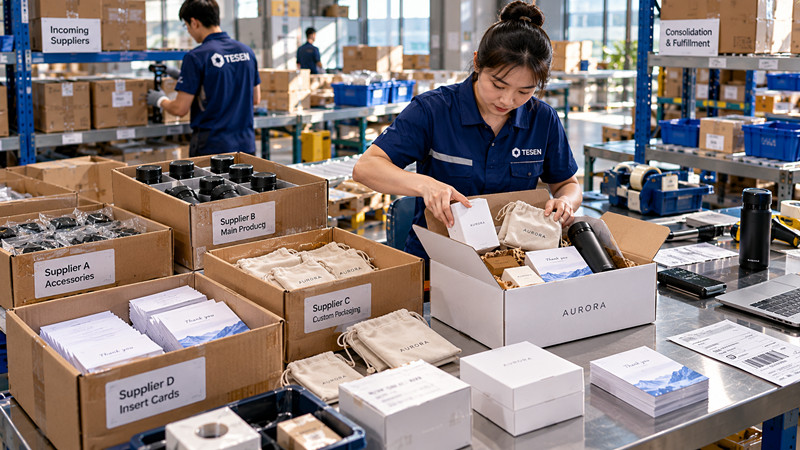
 A growing ecommerce brand rarely depends on just one supplier forever.
One Chinese manufacturer produces the main product. Another supplies accessories. A packaging company makes branded boxes or pouches. A separate printing supplier produces instruction cards or promotional inserts.
From a purchasing perspective, these are independent supplier relationships.
From the customer's perspective, they are all part of one brand.
When a Shopify customer orders several products together, they expect one complete order—not separate shipments from multiple Chinese factories.
This creates an important operational challenge: how can ecommerce brands combine inventory from multiple suppliers into one reliable fulfillment operation?
For brands sourcing products from China, a China fulfillment center can serve as the point where separate supplier deliveries become coordinated inventory, packaging, and customer-order workflows.
This is not simply about putting products into the same warehouse.
It is about making inventory from different suppliers ready to fulfill ecommerce orders together.
Multi-supplier inventory consolidation means receiving products, accessories, packaging materials, or bundle components from different suppliers into one fulfillment operation.
Once received, these items can be identified, verified, stored, and managed according to the brand's customer-order requirements.
A typical workflow looks like this:
Multiple China Suppliers → Centralized Receiving → SKU Verification → Inventory Storage → Order Processing → International Fulfillment
For example, a Shopify brand may work with:
Supplier A: Main product
Supplier B: Accessories
Supplier C: Custom packaging
Supplier D: Printed inserts
Each supplier produces and delivers its own components.
The China fulfillment center receives those components, organizes them into the brand's inventory system, and uses them to prepare complete customer orders.
The suppliers remain separate upstream.
The fulfillment process becomes unified downstream.
This distinction is particularly important for multi-SKU Shopify and DTC brands.
Working with specialized suppliers can offer commercial advantages.
One manufacturer may produce a better main product.
Another may specialize in accessories.
A packaging company may offer better customization.
However, each additional supplier introduces an independent operating schedule.
Suppliers may have different:
Production lead times
Minimum order quantities
Product identification systems
Packaging methods
Delivery schedules
Quality-control requirements
Replenishment cycles
These differences do not necessarily create problems when products are purchased.
They become more important when inventory must support customer orders.
Imagine that a brand sells a gift set containing a product, an accessory, and branded packaging.
The product supplier completes production on Monday.
The accessory supplier delivers on Wednesday.
The packaging supplier will not finish until the following week.
Although two suppliers have completed their work, the full gift set is not yet ready for fulfillment.
The issue is not simply supplier communication.
It is the relationship between separate supply streams and one customer-order requirement.
Supplier-ready inventory is not always fulfillment-ready inventory.
A China fulfillment center can create a shared operating environment for products sourced from multiple suppliers.
Instead of sending each product directly from its original factory to the final customer, the brand can arrange for relevant inventory to arrive at a central fulfillment facility.
There, products can be processed according to a common set of fulfillment requirements.
These may include:
Receiving supplier deliveries.
Matching products to the correct SKUs.
Verifying quantities and identifying discrepancies.
Performing agreed quality checks.
Recording inventory status and location.
Storing packaging materials and components.
Preparing bundles or multi-item orders.
Processing Shopify customer orders.
Packing and shipping completed orders internationally.
Not every product needs every step.
The purpose is to create a consistent operational process for inventory that originates from different suppliers.
This allows the brand to retain specialized sourcing relationships without maintaining separate customer-order fulfillment workflows for every supplier.
Inventory consolidation begins with accurate receiving.
A fulfillment center cannot reliably combine products from different suppliers if it cannot identify what has arrived.
For multi-supplier operations, the receiving process should be structured around clear shipment and SKU information.
Before inventory arrives, the brand or supplier should provide the relevant details.
These may include:
Supplier name
Expected delivery date
Product name
SKU or variant code
Expected quantity
Carton count
Packaging specifications
Required labeling
Inspection instructions, where applicable
This information allows the receiving team to distinguish one supplier's products from another's.
When cartons arrive, the receiving team identifies the shipment and matches it with the expected delivery information.
Products should be linked to the brand's approved SKU structure rather than relying exclusively on each supplier's internal product names.
For example, two suppliers may use different codes for components belonging to the same ecommerce product offer.
The fulfillment operation needs consistent identification to avoid picking or inventory-record errors.
The receiving process should identify discrepancies between expected and actual inventory.
Examples include:
Missing cartons
Quantity shortages
Unexpected products
Incorrect labels
Visible product damage
Mixed variants
If the brand requires additional QC, affected inventory may need to remain unavailable until the agreed checks are completed.
Received inventory should not automatically be treated as available for customer orders.
Depending on the situation, inventory may be classified as:
Received and available
Awaiting verification
QC hold
Damaged
Awaiting labeling or preparation
Incoming but not yet received
This distinction helps prevent incomplete or questionable inventory from being allocated to Shopify orders.
Once the required receiving and preparation steps are completed, approved inventory can become available for order fulfillment.
The objective is to move from supplier delivery information to reliable fulfillment inventory records.
For brands with multiple suppliers, that transition is essential.
One of the most important distinctions in China fulfillment is the difference between inventory reported by suppliers and inventory that can actually be used to fulfill customer orders.
Consider the following situation.
| Supplier update | Reported quantity | Fulfillment status |
|---|---|---|
| Supplier A: Main product | 500 units | Received and approved |
| Supplier B: Accessory | 400 units | Received and approved |
| Supplier C: Branded pouch | 600 units | Received and approved |
| Supplier D: Insert card | 1,000 units | Still at supplier |
The brand has substantial inventory across its supplier network.
But if each customer order requires all four components, the complete order cannot be fulfilled until the insert cards arrive and become available.
A supplier's production-completion message is useful.
However, it does not replace an accurate view of fulfillment-ready inventory.
For Shopify brands, the more important question is:
How many complete customer orders can we fulfill today?
Many ecommerce brands sell products that originate from different manufacturers.
For example:
A skincare brand sources products and branded packaging separately.
An accessories brand purchases products from several specialized factories.
A jewelry brand uses different suppliers for jewelry, boxes, pouches, and inserts.
A lifestyle brand combines multiple products into promotional sets.
Without consolidated inventory, one customer order may require several supplier shipments or additional transfers between locations.
This can introduce:
Multiple parcels
More tracking numbers
Additional coordination
Different delivery schedules
Inconsistent packaging
More customer-service questions
When the required products and packaging are available at one fulfillment center, the order can potentially be prepared as a single parcel.
The fulfillment team can pick products from different supplier origins, apply the correct packaging, and complete one customer order.
This is one of the practical benefits of inventory consolidation for DTC brands.
It simplifies the downstream order experience without requiring every upstream product to come from the same factory.
Brands often think of inventory primarily as products for sale.
But custom packaging can also determine whether an order is ready to ship.
Consider a brand with:
2,000 products in stock
1,500 accessories in stock
300 branded boxes in stock
If every customer order requires one product, one accessory, and one branded box, the brand can currently prepare only 300 complete orders using that packaging configuration.
The packaging is the limiting component.
This means a China fulfillment operation may need to manage several types of inventory:
Sellable Product Inventory
Products that customers purchase.
Packaging Inventory
Branded boxes, pouches, labels, inserts, and protective materials.
Bundle Component Inventory
Individual products that are combined into kits or sets.
Held or Unavailable Inventory
Items awaiting inspection, relabeling, or other required preparation.
A brand may have sufficient finished products but still face fulfillment delays because a packaging component is unavailable.
This is why packaging replenishment should be connected to order fulfillment planning.
Bundle availability is one of the most practical reasons to consolidate inventory.
Imagine a Shopify brand sells a gift bundle containing:
One main product from Supplier A
One accessory from Supplier B
One branded pouch from Supplier C
One printed insert from Supplier D
The fulfillment center has the following approved inventory:
| Component | Available quantity | Units required per bundle |
|---|---|---|
| Main product | 500 | 1 |
| Accessory | 350 | 1 |
| Branded pouch | 600 | 1 |
| Printed insert | 400 | 1 |
The maximum number of complete bundles is determined by the component with the lowest available bundle capacity.
In this example:
Maximum complete bundles = 350
The accessory is the limiting component.
Now suppose the brand changes the offer so that each bundle contains two accessories.
The same inventory would support:
350 accessories ÷ 2 = 175 complete bundles
Even though the main product inventory has not changed, the available bundle quantity falls from 350 to 175.
These calculations assume the listed quantities are unallocated, approved for use, and dedicated to the bundle. Shared inventory used by other products or orders must also be considered.
For brands selling kits, sets, and multi-item offers, understanding component-level availability is more useful than looking at each SKU independently.
The word "consolidation" can describe two different activities.
They should not be confused.
| Inventory Consolidation for Ecommerce Fulfillment | Freight Consolidation | |
|---|---|---|
| Main objective | Prepare inventory for customer orders | Combine cargo for transportation |
| Main activity | Receiving, SKU management, storage, order preparation | Cargo collection and transportation |
| Inventory tracking | SKU and order-level requirements | Primarily shipment and cargo-level requirements |
| Packaging | Can support customer-specific packaging | Primarily transportation packaging |
| Final outcome | Individual ecommerce orders fulfilled | Consolidated freight moved to a destination |
A China fulfillment center is not simply a place where products are combined into a larger shipment.
Its operational purpose is to make products from different suppliers available for individual customer orders.
This is especially relevant for Shopify and DTC brands selling directly to consumers in international markets.
Bringing products together does not eliminate supplier lead-time differences.
A brand may still have:
A product supplier with a 20-day lead time
An accessory supplier with a 35-day lead time
A packaging supplier with a different production schedule
A printing supplier with a separate minimum order quantity
However, centralized inventory information allows replenishment decisions to be evaluated against customer-order requirements.
For example, the brand can review:
Current fulfillment-ready stock
Average sales velocity
Incoming inventory
Supplier lead times
Bundle component dependencies
Packaging availability
Planned promotional campaigns
This creates a more useful planning question.
Instead of asking each supplier independently when production will finish, the brand can evaluate whether all required components will be available before customer orders need to be shipped.
The objective is not necessarily to synchronize every supplier's production schedule.
It is to coordinate replenishment so that one missing component does not unnecessarily interrupt the entire fulfillment workflow.
A split shipment occurs when one customer order is delivered through multiple parcels or fulfillment locations.
Sometimes split shipments are appropriate.
For example, regional inventory distribution may support faster local delivery for certain brands.
But when several complementary products are sourced from China, split shipments may result from fragmented inventory rather than a deliberate fulfillment strategy.
Potential consequences include:
Additional shipping expenses
Multiple tracking numbers
Different delivery dates
More packaging materials
Increased customer-service workload
When relevant products are consolidated and available at the same China fulfillment center, multi-item orders may be packed and shipped together.
This does not guarantee that every order can use one parcel.
Product dimensions, destination rules, shipping restrictions, and inventory availability still matter.
However, consolidation gives the fulfillment operation more opportunities to process complete orders through one coordinated workflow.
Not every ecommerce business needs multi-supplier consolidation.
A brand selling one product from one supplier with standard packaging may have a straightforward fulfillment model.
Consolidation becomes more relevant as product and supplier complexity increases.
If products are purchased from several factories, a central fulfillment operation can reduce the need to manage separate shipping workflows.
Different categories and variants may require specialized suppliers.
Consolidation allows these products to be managed within one order-processing environment.
Products and packaging materials can be purchased independently and brought together during fulfillment.
Products from several suppliers can be picked or assembled into complete customer orders.
As order volume and product variety increase, manual supplier coordination becomes more difficult.
A centralized fulfillment operation can provide clearer inventory information and more consistent order execution.
The deciding factor is not simply daily order volume.
It is the complexity of turning multiple supplier deliveries into complete customer orders.
Before selecting a fulfillment provider, brands working with multiple suppliers should ask specific operational questions.
Confirm whether different supplier shipments can be received under one brand account while maintaining accurate SKU identification.
Ask how supplier product codes are matched with the SKUs used in Shopify and the fulfillment system.
Confirm whether packaging materials, inserts, and labels can be stored and applied according to order requirements.
Ask whether received, held, damaged, and approved inventory can be distinguished.
The provider should explain how products from different supplier origins are picked and packed into one order.
Clarify whether bundles are assembled in advance or during order processing, and how component inventory is managed.
Ask how delayed replenishment is connected to current inventory availability and affected customer orders.
Confirm how orders are imported, how inventory is synchronized, and what operational setup is required before fulfillment begins.
These questions help determine whether a provider can support multi-supplier ecommerce operations rather than only basic storage and shipping.
Consider a growing Shopify accessories brand.
The brand works with four suppliers in China.
Supplier A: Main product
Supplier B: Additional accessory
Supplier C: Branded pouch
Supplier D: Printed insert
Customers can purchase the main product individually or select a gift bundle containing all four components.
Without centralized fulfillment, the brand may need to coordinate several supplier deliveries whenever it prepares a complete gift set.
With a consolidated China fulfillment model, each supplier sends the relevant components to the fulfillment center.
The warehouse receives and identifies the inventory.
Approved products and packaging are stored according to their SKUs and operational requirements.
When a customer places a gift-bundle order, the fulfillment team can:
Pick the main product.
Pick the accessory.
Select the branded pouch.
Add the printed insert.
Verify the bundle components.
Pack the completed order.
Prepare it for international shipping.
The customer receives one branded order.
The brand continues using four specialized suppliers.
The fulfillment center provides the operational connection between them.
This is the value of multi-supplier inventory consolidation.
TESEN is a China-based Ecommerce Supply Chain & Fulfillment Partner for Shopify and DTC brands.
Our core commercial focus is ecommerce fulfillment, supported by product sourcing, supplier management, quality control, inventory planning and storage, custom packaging, and international shipping.
For brands working with multiple suppliers in China, TESEN can help connect separate supplier deliveries with one ecommerce fulfillment operation.
Depending on the agreed service scope, this may include:
Coordinating inventory deliveries from different suppliers
Receiving and identifying products by SKU
Verifying inventory quantities
Arranging quality-control checks where required
Managing product and packaging inventory
Supporting custom packaging requirements
Preparing bundles and kits
Processing Shopify customer orders
Coordinating international order fulfillment
The objective is not to replace every supplier relationship.
It is to help brands turn products and components from multiple suppliers into inventory that can support consistent customer-order fulfillment.
Different suppliers can continue doing what they do best.
The fulfillment operation connects their products to the brand's ecommerce orders.
Multi-supplier inventory consolidation brings products and components from different Chinese suppliers into one fulfillment operation.
It is different from freight consolidation because the objective is individual ecommerce order fulfillment.
Supplier-completed inventory is not necessarily fulfillment-ready inventory.
Accurate receiving, SKU identification, and inventory status are essential.
Products, accessories, packaging, and inserts may all need inventory tracking.
Bundle availability depends on the limiting component, not just the main product's stock level.
Centralized inventory can make multi-item order fulfillment more efficient.
Consolidation may reduce unnecessary split shipments and packaging complexity.
Supplier lead times still matter and should be connected to replenishment planning.
A suitable China fulfillment partner should support the actual product, packaging, and order structure of the brand.
Yes, depending on the provider's capabilities. A China fulfillment center can receive products from different suppliers, identify them by SKU, and manage approved inventory within one fulfillment operation. Brands should confirm receiving procedures, labeling requirements, and applicable service charges.
Not necessarily. However, the fulfillment operation needs a consistent SKU mapping system so that products received under supplier-specific codes can be correctly matched to the brand's ecommerce inventory and orders.
Yes. A brand can source products, branded boxes, pouches, inserts, and labels from separate suppliers. These components can be brought together at a fulfillment center and combined according to the agreed packing instructions.
The fulfillment operation can receive and store individual components, track their availability, and pick or assemble them into bundles. The specific workflow depends on whether the brand uses pre-kitting or on-demand bundle assembly.
It may help reduce unnecessary split shipments when products from different suppliers can be packed into one suitable parcel. Actual shipping costs still depend on parcel weight, dimensions, destination, service level, and applicable carrier rules.
The fulfillment operation can identify which components are available and which are still missing. The brand can then assess affected bundles or orders and coordinate replenishment or other approved actions. Inventory should not be treated as fulfillment-ready until all required components are available.
It can be, particularly when a small brand already uses several suppliers or custom packaging. The need depends more on supplier and order complexity than on a fixed minimum daily order volume.
Provide the number of suppliers, product and SKU lists, expected inventory quantities, receiving schedules, product dimensions, packaging requirements, bundle rules, expected order volume, and shipping destinations. This helps the fulfillment partner assess the required workflow and provide an appropriate quotation.
Growing ecommerce brands do not always need fewer suppliers.
They often need a better way to connect them.
Different manufacturers may remain responsible for products, accessories, packaging, and printed materials.
But customers should not have to experience the complexity of those separate supply streams.
A coordinated China fulfillment model can turn:
Multiple Suppliers → Consolidated Inventory → Unified Order Fulfillment → One Customer Experience
For Shopify and DTC brands sourcing from China, that creates a more practical way to manage product variety, packaging requirements, bundles, and international customer orders.
China fulfillment is not simply about storing products in a warehouse before shipping.
It is about connecting the inventory required to deliver a complete ecommerce order.
TESEN is a China-based Ecommerce Supply Chain & Fulfillment Partner for Shopify and DTC brands.
Our core focus is ecommerce fulfillment, supported by product sourcing, supplier management, quality control, inventory planning and storage, custom packaging, and international shipping.
Through coordinated China-side operations, TESEN helps ecommerce brands manage products from multiple suppliers and prepare them for Shopify and DTC order fulfillment.
Source Your Products and Start Dropshipping
 IPv6 network supported