
When ecommerce brands compare fulfillment providers, one number often receives the most attention:
How much does pick and pack cost per order?
It is a reasonable starting point. Pick-and-pack fees are easy to understand, easy to compare, and often prominently displayed in fulfillment quotations.
But they rarely represent the full cost of an ecommerce fulfillment operation.
A Shopify brand shipping 100 simple, single-item orders per day has a very different cost structure from a brand shipping the same number of orders across 80 SKUs, multiple suppliers, custom packaging requirements, and product bundles.
The daily order volume is identical.
The work required behind each order is not.
For Shopify and DTC brands, understanding ecommerce fulfillment costs means looking beyond the headline handling fee and examining the entire process—from inventory receiving and storage to order preparation and final delivery.
The goal is not simply to find the lowest quoted rate.
It is to understand the total cost of fulfilling a customer order accurately, consistently, and at a level of service that supports the brand.
Ecommerce fulfillment costs are the expenses associated with receiving, storing, preparing, and shipping products to customers.
Depending on the fulfillment model, these costs may include:
Inventory receiving and processing
Warehouse storage
Pick-and-pack operations
Additional-item handling
Kitting and bundle assembly
Custom packaging materials
Special packaging labor
Product labeling and preparation
Quality-control inspections
International shipping
Additional services required by specific products or orders
Not every brand requires every service.
A business selling one lightweight accessory in standard packaging may have a relatively simple cost structure.
A brand managing multiple product variants, branded packaging, supplier deliveries, and custom bundles may require several additional operational steps.
This is why fulfillment pricing should reflect the actual operating requirements of the business.
Consider two hypothetical fulfillment quotations.
Provider A
Pick and pack: $0.80 per order
Provider B
Pick and pack: $1.00 per order
Provider A appears cheaper.
But before deciding, the brand needs to understand what each quotation includes.
Does the fee cover only one item?
Are additional products charged separately?
Does branded packaging require extra handling?
How is incoming inventory processed?
Are receiving and storage charged separately?
Does kitting require an additional fee?
Are quality-control services included or optional?
What happens when inventory arrives with incorrect labels?
A lower pick-and-pack fee does not necessarily mean a lower total fulfillment cost.
The correct comparison depends on the services required to process the same order.
A quotation is useful only when the brand understands the work and assumptions behind it.
Fulfillment begins before the first customer order is shipped.
When inventory arrives at a fulfillment warehouse, it may need to be:
Unloaded and organized
Counted and verified
Matched to expected SKUs
Checked against supplier documents
Labeled or relabeled
Entered into the inventory system
Separated by product, variant, or batch
Receiving requirements can vary significantly.
A brand receiving 20 cartons containing five clearly labeled SKUs may have a relatively straightforward process.
Another brand receiving the same number of cartons containing 70 different SKUs may require more detailed verification.
The physical shipment size is similar.
The receiving workload is different.
Brands sourcing from multiple Chinese suppliers should also consider how frequently inventory arrives and whether suppliers follow consistent labeling and packaging standards.
Poorly organized supplier deliveries can increase receiving work and create inventory discrepancies.
Products occupy warehouse space before they are sold.
Storage costs may depend on:
Inventory volume
Product dimensions
Storage duration
Warehouse space requirements
Stock turnover
Storage method
Provider-specific pricing rules
A compact, fast-moving product and a bulky, slow-moving product create different storage requirements.
Brands should also distinguish between warehouse storage fees and the broader financial cost of holding inventory.
Excess stock can tie up working capital even when the warehouse storage rate is relatively low.
For example, a brand may negotiate an attractive storage price but continue holding six months of inventory for products that sell slowly.
The warehouse fee may be competitive.
The inventory strategy may still be inefficient.
This is why storage cost optimization should consider both the provider's rates and the brand's replenishment decisions.
Pick and pack is the most visible fulfillment handling charge.
A typical workflow involves:
Receiving the customer order.
Identifying the correct inventory.
Picking the required product.
Preparing the package.
Completing packing and labeling.
Releasing the order for shipping.
However, the work required for each order varies.
A single-item order with standard packaging is different from an order containing multiple products and special packaging instructions.
Brands should clarify whether pick-and-pack fees apply per order, per item, or according to a defined combination of services.
They should also understand what is included in the base fee.
Many ecommerce orders contain more than one product.
An order with four separate SKUs may require more picking and verification than an order containing one item.
The additional work can include:
Locating separate inventory positions
Picking multiple products
Checking quantities and variants
Verifying order completeness
Selecting appropriate packaging
Some providers charge a base fee for the first item and additional fees for subsequent items.
Others may use different pricing structures.
When comparing quotations, brands should provide their average number of items per order rather than relying only on monthly order volume.
Bundles can increase average order value and support promotional strategies.
But they also introduce fulfillment requirements.
Imagine a brand sells three products individually:
Product A
Product B
Product C
The brand also offers:
Bundle X = A + B + C
The fulfillment operation must identify the bundle, verify component availability, select the correct products, and assemble the order according to the required configuration.
There are two common operational approaches.
Pre-kitting
Bundle components are assembled before customer orders arrive.
This creates preparation work in advance and may require separate tracking of finished bundles.
On-demand kitting
Bundle components are selected and assembled after the customer places an order.
This can provide more flexibility but adds handling work during fulfillment.
Neither method is automatically better.
The appropriate model depends on order volume, component demand, inventory availability, and operational requirements.
Brands should confirm how kitting is charged and how component inventory is recorded.
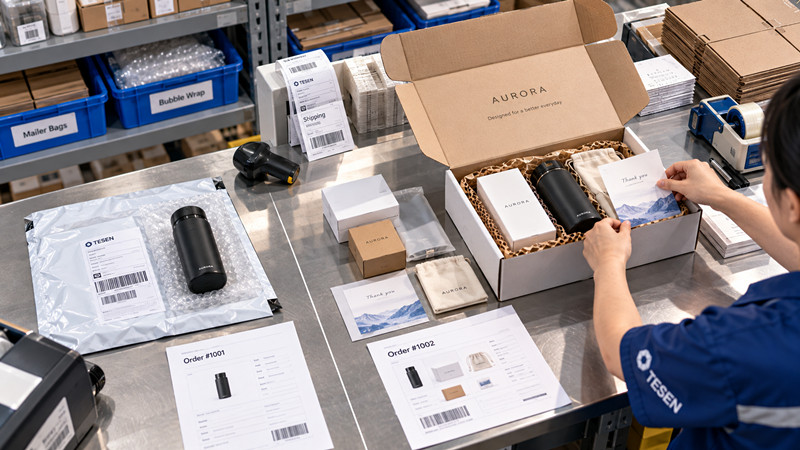
Custom packaging can support brand recognition and customer experience.
However, packaging cost includes more than the purchase price of branded materials.
A standard order may follow:
Pick product → Place in mailer → Apply label → Ship
A customized order may require:
Pick product → Verify variant → Prepare branded box → Add protective material → Insert card → Seal package → Apply label → Ship
Additional costs may arise from:
Branded boxes or pouches
Protective packaging
Printed inserts
Special labels
Extra handling steps
Packaging storage
Campaign-specific packaging instructions
For DTC brands, these costs may be justified by the customer experience they create.
The important point is that customization should be planned as part of fulfillment execution, not treated only as a packaging purchase.
Quality-control requirements vary by product category, supplier reliability, and customer expectations.
Some products may require basic receiving checks.
Others may need:
Visual inspection
Measurement verification
Functional testing
Batch sampling
Product-by-product inspection
Packaging inspection
More inspection is not automatically better.
The appropriate inspection scope should reflect the product's risks and the brand's quality requirements.
When comparing fulfillment providers, brands should clarify whether QC is included in receiving or charged as a separate service.
They should also define what happens when products fail inspection.
For example, inventory may need to be placed on hold, returned to the supplier, reworked, or approved for release.
Those decisions can create additional handling requirements.
International shipping is often a substantial component of the total cost of delivering an ecommerce order.
Shipping charges can depend on:
Destination country
Actual parcel weight
Dimensional weight
Package dimensions
Shipping service
Product category
Delivery requirements
For ecommerce brands fulfilling internationally from China, shipping should be evaluated as part of the total fulfillment model.
However, it should not be confused with warehouse handling fees.
A brand may receive an attractive pick-and-pack quotation but face higher overall costs because of package dimensions or unsuitable shipping-service assumptions.
When comparing quotations, the same destination mix, package weights, dimensions, and service requirements should be used.
A useful calculation starts with all relevant fulfillment expenses over a defined period.
Total Fulfillment Cost per Shipped Order = Total Relevant Fulfillment Expenses ÷ Number of Shipped Orders
Depending on the purpose of the calculation, total expenses may include:
Receiving
Storage
Pick and pack
Additional-item handling
Kitting
Packaging
QC
Shipping
Other agreed operational charges
Brands should use a consistent definition when comparing providers.
For example, if shipping is included for Provider A, it must also be included for Provider B.
If product purchasing costs are excluded from one quotation, they should be excluded from the other.
The objective is a like-for-like comparison.
Imagine a Shopify brand ships 3,000 orders per month.
Its hypothetical monthly fulfillment expenses are:
| Cost component | Monthly cost |
|---|---|
| Inventory receiving | $120 |
| Inventory storage | $180 |
| Pick and pack | $3,000 |
| Additional-item handling | $150 |
| Kitting | $300 |
| Packaging materials and handling | $450 |
| Quality control | $100 |
| International shipping | $15,000 |
| Total | $19,300 |
The average total cost per shipped order is:
$19,300 ÷ 3,000 = approximately $6.43 per order
This example illustrates the calculation only. It is not a TESEN quotation or a representation of typical market pricing.
It also shows why the pick-and-pack fee alone cannot describe the full cost structure.
In this example, warehouse handling is only one part of the overall fulfillment expense.
Consider a hypothetical Shopify brand with the following requirements:
3,000 orders per month
An average of 1.5 items per order
60 active SKUs
Standard packaging for most orders
Custom inserts for selected orders
Occasional kitting
Monthly inventory receiving
International shipping
Two providers submit quotations.
The brand should not compare only their headline pick-and-pack rates.
Instead, it should estimate the monthly cost of the same operating scenario.
| Cost component | Provider A | Provider B |
|---|---|---|
| Receiving | $150 | $100 |
| Storage | $200 | $180 |
| Pick and pack | $2,400 | $3,000 |
| Additional-item handling | $450 | $150 |
| Kitting | $450 | $300 |
| Packaging materials and handling | $600 | $450 |
| QC | $150 | $100 |
| Shipping | $15,300 | $15,000 |
| Monthly total | $19,700 | $19,280 |
| Total per shipped order | $6.57 | $6.43 |
In this illustrative comparison, Provider A has a lower base pick-and-pack cost.
But Provider B has a lower estimated total cost.
The difference comes from other operational charges.
This does not mean a higher pick-and-pack rate is always better.
It means that brands should compare complete cost structures using the same assumptions.
The actual outcome will depend on each provider's quotation, service scope, and the brand's operating requirements.
SKU count affects the work required before and during fulfillment.
More SKUs may require:
Additional inventory locations
More detailed receiving
Stronger barcode identification
More inventory verification
More replenishment decisions
More careful picking
Similar-looking variants can create additional identification requirements.
However, SKU count alone does not determine the final price.
Two brands with 80 SKUs may still have very different costs if one sells simple accessories while the other sells fragile products requiring custom packaging and inspection.
The important relationship is between SKU structure and the actual work required.
For brands managing many variants, the most useful pricing discussion is not simply whether the warehouse can store the products.
It is how those variants affect receiving, inventory control, picking, packaging, and order accuracy.
Order count is not the same as fulfillment workload.
Consider two customer orders.
Order A
One SKU
One unit
Standard mailer
No insert
No special handling
Order B
Four SKUs
Four units
Branded box
Protective packaging
Promotional insert
Thank-you card
Both count as one order.
But Order B involves more operational steps.
This is why brands should track:
Average items per order
Average unique SKUs per order
Percentage of bundled orders
Percentage requiring custom packaging
Frequency of special handling
These metrics can be more useful for estimating fulfillment costs than daily order volume alone.
Not every additional charge is unreasonable.
Some services genuinely require extra labor, materials, or storage.
The problem occurs when brands do not understand which services are included and which are charged separately.
Before signing a fulfillment agreement, ask whether the quotation addresses:
| Potential charge | What to clarify |
|---|---|
| Inventory receiving | Per carton, shipment, unit, or labor time? |
| Storage | Free period, billing unit, minimum charge, and start date? |
| Additional items | How are second and subsequent items charged? |
| Kitting | Pre-assembly versus on-demand assembly? |
| Custom packaging | Material cost versus handling cost? |
| Labeling | Is relabeling included or separately billed? |
| Quality control | Inspection scope, billing method, and minimum charge? |
| Inventory rework | How are corrective operations approved and priced? |
| Shipping | Actual versus dimensional weight and applicable surcharges? |
| Returns | Is return receiving, inspection, or restocking available and charged separately? |
| Special projects | How are non-standard operations quoted? |
Not all providers charge for every item.
The purpose of this checklist is to make the commercial scope clear before operations begin.
Fulfillment costs are not determined only by warehouse price lists.
They are also influenced by the way a brand manages inventory.
Slow-moving products occupy storage space for longer periods.
They can increase storage expenses and tie up working capital.
A brand may reduce inventory holding by replenishing frequently.
But frequent deliveries can create more receiving events and administrative work.
A growing catalog can increase inventory positions, labeling requirements, and picking complexity.
Poor replenishment timing can create rushed supplier coordination, unexpected receiving workloads, or stockout risk.
These are operational design decisions.
A brand may reduce some fulfillment expenses by improving inventory planning rather than negotiating only for lower warehouse fees.
Higher order volume can create economies of scale.
Repeated workflows may become easier to standardize.
Some fulfillment providers offer volume-based handling rates.
Larger volumes may also support more efficient operational planning.
However, higher volume does not automatically remove complexity.
A brand processing thousands of orders across many variants, bundles, and packaging configurations still requires those operational steps.
Scale can improve unit economics without eliminating operational complexity.
Brands should therefore evaluate both order volume and the work required per order.
Before contacting a fulfillment provider, prepare a basic operating profile.
Provide:
Product categories
SKU count
Main variants
Product dimensions and weight
Fragile or special-handling requirements
Provide:
Expected inventory quantity
Number of suppliers
Receiving frequency
Approximate storage requirements
Replenishment pattern
Provide:
Monthly order volume
Average items per order
Typical SKU combinations
Percentage of bundle orders
Expected growth or seasonal peaks
Clarify:
Standard or branded packaging
Inserts and labels
Protective materials
Kitting or assembly
Market-specific packaging instructions
Provide:
Destination countries
Typical parcel weight
Package dimensions
Delivery expectations
Any special shipping requirements
The more accurately the provider understands the operation, the more useful the quotation can become.
A quotation based only on "100 orders per day" may overlook several important cost drivers.
TESEN is a China-based Ecommerce Supply Chain & Fulfillment Partner for Shopify and DTC brands.
Our core commercial focus is ecommerce fulfillment, supported by product sourcing, supplier management, quality control, inventory planning and storage, custom packaging, and international shipping.
When evaluating a brand's fulfillment requirements, it is important to understand the operating model behind its orders.
Relevant factors may include:
Daily or monthly order volume
SKU and variant structure
Average items per order
Supplier delivery requirements
Inventory receiving and storage
Custom packaging
Kitting and bundle assembly
Quality-control requirements
Shipping destinations
Parcel weight and dimensions
A simple product catalog should not automatically be treated as a complex fulfillment operation.
At the same time, a business with many SKUs, custom packaging, and multiple suppliers cannot always be accurately represented by a single headline handling fee.
TESEN's approach is to connect China-side inventory and supplier operations with ecommerce order fulfillment so that brands can understand the services required for their specific workflow.
Actual service charges depend on the agreed scope, product characteristics, order structure, and applicable quotations.
Ecommerce fulfillment costs extend beyond pick-and-pack fees.
Receiving, storage, additional items, kitting, packaging, QC, and shipping can all affect total cost.
Two brands with identical order volumes may have different fulfillment expenses.
SKU count matters because it can change receiving, storage, inventory control, and picking requirements.
Custom packaging creates both material and handling requirements.
Kitting can introduce assembly and inventory-tracking work.
Shipping costs should be compared using consistent destinations, weights, dimensions, and service levels.
Total fulfillment cost per shipped order is more useful than comparing one headline fee.
Fulfillment quotations should use the same operational assumptions.
Clear pricing scope helps brands avoid unexpected charges and make better provider decisions.
Ecommerce fulfillment costs may include inventory receiving, storage, pick and pack, additional-item handling, kitting, custom packaging, quality control, and shipping. The exact components depend on the provider and the brand's operating requirements.
Divide total relevant fulfillment expenses for a defined period by the number of orders shipped during that period. For accurate comparisons, use consistent assumptions about whether shipping, receiving, storage, packaging, and other services are included.
No. A lower base handling fee may be offset by higher charges for additional items, packaging, kitting, storage, receiving, or shipping. Brands should compare total costs under the same operating conditions.
Provide SKU count, product weights and dimensions, monthly order volume, average items per order, inventory quantities, receiving frequency, packaging requirements, destination markets, and any QC or kitting needs.
It can. Custom packaging may involve additional materials, storage, preparation, and handling. The cost depends on the packaging design and the work required to complete each order.
Use the same product, inventory, order, packaging, and shipping assumptions for each quotation. Compare total expected monthly cost and average cost per shipped order, while also reviewing service scope, operational capabilities, and exception-handling procedures.
Some costs may decrease on a per-order basis through volume pricing or operational efficiencies. However, SKU complexity, special packaging, kitting, and other requirements can continue to influence costs.
It depends on the purpose of the calculation. Product purchasing costs are usually tracked separately from fulfillment operating expenses. For broader landed-cost or profitability analysis, brands may also consider sourcing, product cost, and other supply-chain expenses. The important point is to apply the same cost definition consistently.
Pick-and-pack fees matter.
But they are only one part of ecommerce fulfillment pricing.
The total cost of fulfilling an order depends on the product, inventory, order structure, packaging, operational services, and shipping requirements.
A brand that understands these factors can compare fulfillment quotations more accurately and identify which parts of its operation create unnecessary costs.
For Shopify and DTC brands, the better question is not simply:
What is your pick-and-pack fee?
It is:
What is our total fulfillment cost per shipped order, and which operational requirements are driving that cost?
That question creates a stronger foundation for selecting a fulfillment partner and building a more predictable ecommerce operation.
TESEN is a China-based Ecommerce Supply Chain & Fulfillment Partner for Shopify and DTC brands.
Our core commercial focus is ecommerce fulfillment, supported by product sourcing, supplier management, quality control, inventory planning and storage, custom packaging, and international shipping.
We help ecommerce brands coordinate China-side inventory, product preparation, and order fulfillment according to their operational requirements.
Source Your Products and Start Dropshipping
 IPv6 network supported