
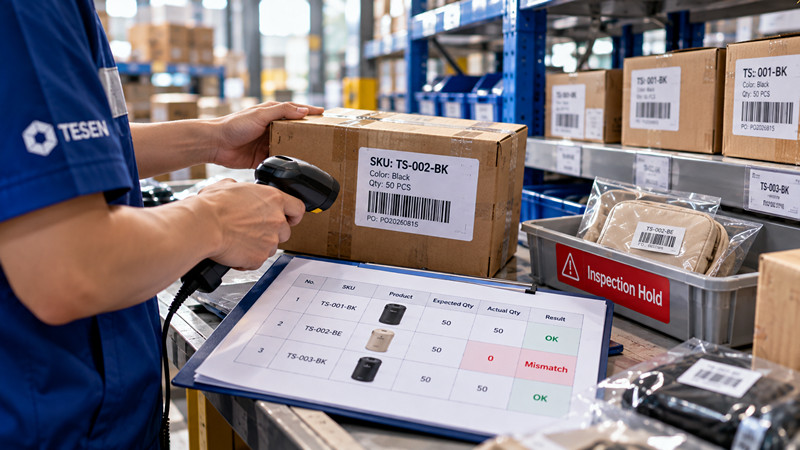
Most ecommerce brands evaluate fulfillment performance through normal orders.
An order enters the system. The correct SKU is available. The address is valid. The product is picked, packed, and shipped.
When everything works as expected, fulfillment appears straightforward.
But normal orders reveal only part of a fulfillment operation's capability.
The more demanding test begins when something goes wrong.
Inventory does not match the system. A product is damaged. A SKU cannot be identified. A customer address is incomplete. A batch fails quality inspection. A supplier misses a production deadline.
These situations are not unusual in growing ecommerce businesses.
They are part of everyday operational complexity.
Reliable ecommerce fulfillment depends not only on how efficiently normal orders are processed, but also on how effectively exceptions are detected, contained, communicated, and resolved.
For Shopify and DTC brands, fulfillment exception management is therefore an important part of operational reliability.
Fulfillment exception management is the process of identifying, investigating, and resolving situations that interrupt the normal movement of inventory or customer orders.
A standard fulfillment workflow follows:
Order Received → Inventory Allocation → Picking → Packing → Shipping
An exception occurs when one or more stages cannot continue as expected.
Common examples include:
Inventory discrepancies
Damaged or questionable stock
Missing or unclear SKU identification
Incorrect customer information
Quality-control holds
Supplier production or replenishment delays
Exception management should answer five practical questions:
What happened?
What inventory or orders are affected?
How urgent is the problem?
Who is responsible for the next decision?
What action is required to restore normal operations?
The objective is not to eliminate every possible exception.
It is to prevent isolated problems from creating unnecessary downstream disruption.
At low order volume, many exceptions can be handled manually.
A warehouse employee notices a problem and contacts the brand.
The issue is discussed and resolved.
As order volume increases, that informal approach becomes harder to maintain.
Growing ecommerce brands often manage:
More SKUs and variants
Multiple suppliers
Frequent inventory replenishment
Different packaging requirements
More customer orders
Several destination markets
Increasingly complex inventory records
A single unresolved discrepancy can affect multiple orders.
A mislabeled batch can create repeated picking errors.
A delayed supplier shipment can affect replenishment planning.
A QC issue can temporarily reduce fulfillment-ready inventory.
This is why growing brands need a consistent exception-management process rather than relying entirely on individual employees to recognize and solve problems.
An inventory discrepancy occurs when recorded stock does not match the physical inventory that can be verified.
For example, the warehouse management system shows 120 units of a SKU, but the team can locate only 114.
The difference is six units.
However, the real operational problem is not necessarily limited to those six units.
The discrepancy raises several questions:
Were products received incorrectly?
Were previous orders recorded accurately?
Were units stored under another SKU?
Was an inventory adjustment missed?
Could current customer orders be affected?
A suitable response involves verifying the discrepancy, identifying affected inventory, reviewing transaction records, and correcting available stock when justified.
The brand should also understand whether the discrepancy affects current orders or replenishment decisions.
Inventory discrepancies should be investigated, not simply hidden through unexplained stock adjustments.
Products may become damaged during supplier delivery, storage, handling, picking, or packing.
When a damaged unit is discovered, the immediate action may be to isolate it and select another approved unit.
But repeated damage can indicate a larger problem.
Potential causes include:
Inadequate supplier packaging
Weak protective materials
Product-quality problems
Unsuitable storage conditions
Incorrect handling procedures
A fulfillment team should distinguish between an isolated damaged unit and a recurring batch-level issue.
Affected inventory may need to be placed on hold until its condition is verified.
SKU identification problems frequently originate before products reach the fulfillment warehouse.
A supplier may use a different product code.
Two variants may look almost identical.
Barcode labels may be missing.
Packaging may change without an updated specification.
When the warehouse cannot confidently identify a product, guessing creates unnecessary risk.
The safer approach is to isolate the affected stock, confirm its identity, and correct the inventory information before releasing it for customer orders.
This protects order accuracy and reduces the possibility of repeated wrong-item shipments.
Some fulfillment exceptions originate from customer-order data rather than inventory.
Examples include:
Incomplete shipping addresses
Incorrect postal codes
Missing phone numbers
Unsupported destinations
Inconsistent recipient information
A fulfillment provider cannot always correct these issues independently.
Customer or brand confirmation may be necessary.
The operational requirement is to identify the issue before shipping, communicate the missing information, and keep the order in a clear pending status until it can be processed.
A problem identified before dispatch usually offers more options than one discovered after a failed delivery attempt.
A product can physically exist in the warehouse without being approved for fulfillment.
Suppose 500 units arrive from a supplier.
During inspection, 60 units require further review.
The inventory system should distinguish approved units from units on hold.
For example:
| Inventory status | Quantity |
|---|---|
| Approved for fulfillment | 440 |
| QC hold | 60 |
| Total physical inventory | 500 |
In this illustrative scenario, only 440 units are fulfillment-ready.
If all 500 units are treated as available, customer orders may be allocated against questionable stock.
This is why quality-control decisions must be reflected in inventory availability.
Supplier delays originate upstream but can create downstream fulfillment problems.
Imagine a bestseller has two weeks of available inventory remaining.
The next replenishment batch is expected in ten days.
The supplier then reports a two-week production delay.
The warehouse cannot manufacture the missing products.
However, a coordinated fulfillment operation can help make the inventory risk visible.
The brand may need to review:
Current fulfillment-ready stock
Recent SKU sales velocity
Incoming inventory
Revised supplier delivery timing
Potential stockout exposure
Alternative replenishment options
Whether promotional activity should change
The party responsible for causing the delay is not necessarily the party responsible for coordinating the response.
That distinction is important in fulfillment exception management.
A useful exception-management framework has six stages.
Identify the issue as close as possible to where it originates.
Examples include:
Quantity discrepancies during receiving
Damaged products during picking
Invalid addresses before dispatch
QC failures before stock release
Supplier delays before inventory becomes critical
Earlier detection generally provides more opportunities to act.
Determine what inventory or orders are affected.
Depending on the issue, containment may involve:
Placing inventory on hold
Pausing affected orders
Separating damaged products
Preventing uncertain stock from being allocated
Correcting an incorrect availability assumption
Containment should be proportionate to the risk.
An isolated damaged unit does not necessarily justify stopping an entire product line.
A suspected batch-wide quality issue may require broader investigation.
The brand should receive specific information rather than vague status messages.
For example:
Instead of:
"There is an inventory problem."
A more useful message is:
"Six units of SKU A cannot be verified during stock reconciliation. Available stock is being checked, and affected orders are under review."
Useful exception communication identifies:
The issue
Affected SKU or order
Quantity or scope
Current status
Required decision
Next action
Not every exception can be resolved immediately.
But uncertainty should not prevent the team from communicating what is already known.
Every exception should have a clear next-step owner.
Depending on the issue, the responsible parties may include:
Warehouse operations
Inventory management
Quality-control team
Supplier
Brand owner
Customer service
Shipping carrier
Responsibility may be shared, but coordination should not be ambiguous.
For each exception, define who investigates, who approves the decision, and who executes the next action.
The corrective action depends on the exception.
Possible actions include:
Correcting verified inventory records
Replacing damaged stock
Relabeling a SKU
Obtaining corrected customer information
Reworking or rejecting inventory
Updating replenishment plans
After the action, the operation should verify that the affected inventory or order is in the correct status.
An exception is not fully resolved merely because someone sent a message saying it was handled.
The relevant operational record should also reflect the outcome.
Once an exception is resolved, determine whether it is isolated or recurring.
Repeated discrepancies may indicate receiving or inventory-control problems.
Repeated wrong-item shipments may indicate labeling or picking problems.
Repeated damage may indicate packaging or handling problems.
Repeated QC holds may indicate supplier-quality issues.
Recurring exceptions should inform process improvement.
The strongest exception-management process does not only resolve problems. It reduces the likelihood of the same problems happening repeatedly.
Not every exception deserves the same response.
A useful approach is to evaluate exceptions based on customer impact, inventory exposure, urgency, and whether normal fulfillment can continue.
| Priority | Illustrative situation | Appropriate response |
|---|---|---|
| Critical | Suspected unsafe or defective batch affecting multiple orders | Contain affected inventory immediately and escalate |
| High | Bestseller inventory discrepancy affecting pending orders | Investigate promptly and communicate order impact |
| Medium | Single damaged product with approved replacement stock available | Replace or isolate, record, and review |
| Low | Minor non-blocking documentation discrepancy | Correct through routine operational workflow |
These are example priority categories, not TESEN's published service-level commitments.
A useful exception priority system should consider:
Impact × Urgency × Scope
For example, one damaged unit may be relatively simple to resolve.
But a batch-level defect affecting hundreds of units may require urgent containment and supplier coordination.
Many fulfillment problems involve multiple organizations.
A supplier is responsible for production.
A warehouse is responsible for receiving and order processing.
A brand controls product standards and commercial decisions.
A carrier handles transportation.
When something goes wrong, each party may understand only part of the situation.
This creates a common failure:
Everyone knows about the problem, but nobody owns the next step.
A fulfillment partner can add operational value by helping coordinate the information and actions required to move the exception forward.
That does not mean the partner has authority to make every commercial decision.
For example, a brand may need to approve product rework, alternative packaging, or a change to customer communication.
The partner's role is to make the decision point clear and coordinate execution after approval.
Exception management depends on accurate inventory information.
A brand needs to distinguish between:
Physical stock
Verified stock
Available stock
Allocated stock
QC-held stock
Damaged stock
Incoming inventory
Consider an inventory discrepancy involving a fast-moving SKU.
If the warehouse cannot identify the available quantity, the brand may need to adjust sales availability or replenishment decisions.
The purpose of inventory visibility is not simply to show a number in a dashboard.
It is to provide enough reliable information to support operational decisions.
Good inventory visibility makes fulfillment exceptions easier to understand and contain.
Individual exceptions should not disappear from the operation once they are resolved.
Useful exception records may include:
Exception category
Date detected
Affected SKU or order
Quantity affected
Suspected cause
Responsible party
Corrective action
Resolution status
Whether the issue has occurred before
Over time, this information can reveal recurring operational patterns.
For example:
Repeated receiving discrepancies
may justify reviewing supplier packing lists and receiving verification procedures.
Repeated wrong-item shipments
may justify reviewing barcode labels, SKU mapping, or picking controls.
Repeated QC holds
may justify reviewing supplier production standards or inspection requirements.
Repeated address exceptions
may justify reviewing Shopify checkout data and shipping rules.
This creates a continuous improvement loop:
Exception → Detection → Containment → Resolution → Root-Cause Review → Process Improvement
The objective is not perfect operations.
It is progressively more reliable fulfillment.
A Shopify fulfillment partner should be evaluated on more than normal order-processing speed.
Brands should understand how the provider handles situations that interrupt fulfillment.
Useful questions include:
How are inventory discrepancies identified?
What happens when damaged products are discovered?
Can uncertain inventory be placed on hold?
How are unclear SKUs investigated?
How are missing address details handled?
Who communicates urgent exceptions?
How are affected orders identified?
Can supplier delays be connected with inventory availability?
Are recurring problems reviewed?
The answers help reveal whether the provider has a structured operating process or relies mainly on ad hoc communication.
A provider does not need to eliminate every operational problem.
But it should be able to explain how problems are managed.
TESEN is a China-based Ecommerce Supply Chain & Fulfillment Partner for Shopify and DTC brands.
Our core commercial focus is ecommerce fulfillment, supported by supplier management, quality control, inventory planning and storage, custom packaging, and international shipping.
These connected operations create several points where fulfillment exceptions may need attention.
Depending on the agreed service scope and situation, TESEN can help coordinate activities such as:
Identifying inventory discrepancies
Separating damaged or questionable stock
Holding inventory for quality review
Clarifying SKU identification problems
Requesting missing order information
Communicating with existing suppliers
Reviewing available inventory after supplier delays
Identifying affected orders or SKUs
The objective is not to promise that exceptions will never occur.
It is to make operational problems visible, identify the next required decision, and coordinate appropriate action before avoidable downstream consequences increase.
Imagine a Shopify brand has 400 units of a bestseller recorded as available.
During stock reconciliation, the fulfillment team cannot verify 25 units.
A weak process might simply reduce the system quantity from 400 to 375.
The inventory record now matches the physical count, but the cause remains unexplained.
A stronger approach would first establish:
Whether the discrepancy is confirmed.
Whether current customer orders are affected.
Whether stock has been stored or recorded incorrectly.
Whether receiving, picking, or adjustment records explain the difference.
Whether available inventory needs correction.
Whether the same problem has occurred before.
The objective is not to turn every discrepancy into a major investigation.
It is to correct the immediate problem while preserving enough information to determine whether a recurring process issue exists.
This is how exception management protects both current orders and future fulfillment accuracy.
Fulfillment exception management is a core part of reliable ecommerce operations.
Normal orders demonstrate process efficiency; exceptions reveal operational resilience.
Common exceptions include inventory discrepancies, damaged stock, unclear SKUs, address problems, QC holds, and supplier delays.
Exceptions should be detected early and contained before their impact spreads.
The brand should know what happened, what is affected, who owns the next step, and what happens next.
Priority should reflect customer impact, urgency, and the scope of the problem.
Inventory status must reflect QC holds, damaged products, and verified availability.
Exception records can reveal recurring supplier, receiving, packaging, or fulfillment problems.
A fulfillment partner's value during exceptions often comes from coordination and operational visibility.
The objective is not to eliminate every exception, but to reduce avoidable disruption and repeated failures.
Fulfillment exception management is the process of detecting, investigating, containing, communicating, and resolving problems that interrupt normal inventory or order-fulfillment workflows.
Common examples include inventory discrepancies, damaged stock, incorrect or missing SKU labels, incomplete customer addresses, quality-control holds, and supplier replenishment delays.
The partner should verify the discrepancy, identify affected inventory and orders, review relevant records, communicate the impact, and correct inventory information when appropriate. Recurring discrepancies should trigger further investigation.
This depends on the provider's capabilities and agreed workflow. A partner offering QC-related inventory controls should be able to distinguish held inventory from stock approved for fulfillment.
Responsibility depends on the issue. The supplier, warehouse, brand, customer, or carrier may need to act. The important requirement is that the next action has a clear owner and the affected parties understand their responsibilities.
Brands can use accurate SKU identification, structured receiving, inventory verification, quality controls, clear packing instructions, and regular review of recurring exception patterns.
Ask how exceptions are detected, how affected orders and inventory are identified, how urgent problems are escalated, who owns resolution, and whether recurring issues lead to process improvements.
No ecommerce fulfillment operation runs perfectly all the time.
Inventory discrepancies occur.
Products become damaged.
Customers provide incomplete information.
Suppliers miss deadlines.
Quality issues require investigation.
The real question is not whether these problems will ever happen.
It is whether the fulfillment operation can respond effectively when they do.
A reliable approach follows:
Detect → Contain → Communicate → Assign → Resolve → Improve
For growing Shopify and DTC brands, this process helps prevent manageable operational issues from becoming larger customer-facing problems.
Because normal orders show how efficiently a fulfillment operation works.
Exceptions show how reliably it works when conditions are no longer normal.
TESEN is a China-based Ecommerce Supply Chain & Fulfillment Partner for Shopify and DTC brands.
Our core focus is ecommerce fulfillment, supported by product sourcing, supplier management, quality control, inventory planning and storage, custom packaging, and international shipping.
By connecting these China-side operations with Shopify order fulfillment, TESEN helps brands manage inventory, coordinate operational exceptions, and maintain more reliable fulfillment processes.
Source Your Products and Start Dropshipping
 IPv6 network supported