
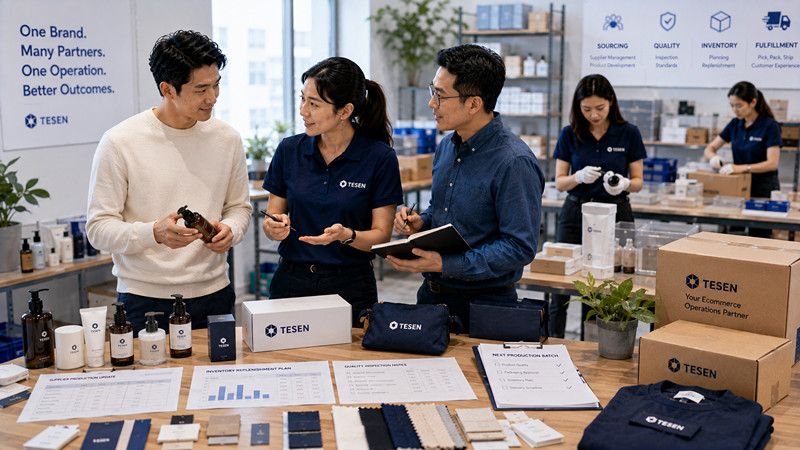
As Shopify brands grow, fulfillment becomes increasingly complex.
More suppliers.
More SKUs.
More inventory.
More orders.
More markets.
And higher customer expectations.
At an early stage, the fulfillment requirement may seem relatively simple:
Receive products → Store inventory → Pick → Pack → Ship
But as order volume increases, many ecommerce founders discover that their biggest operational problems do not actually begin inside the warehouse.
A supplier misses a production deadline.
A fast-selling SKU runs out of stock.
A production batch arrives with quality issues.
Packaging requirements change.
Inventory information becomes unclear.
Suddenly, what appears to be a fulfillment problem is actually connected to sourcing, suppliers, inventory, or quality control.
This is why growing Shopify brands may eventually need more than a company that ships orders.
They need a fulfillment partner that can understand and coordinate the operations surrounding fulfillment.
A Shopify fulfillment partner helps ecommerce brands manage the physical operations required to process and deliver customer orders.
Traditional fulfillment services generally include:
These capabilities remain essential.
Without reliable warehouse execution, even the strongest supply chain cannot provide consistent fulfillment.
But for brands sourcing products internationally—particularly from China—the warehouse is only one part of a much larger operation.
Before an order can be fulfilled, products must first be sourced, produced, inspected, replenished, and delivered into available inventory.
That creates an important distinction between fulfillment execution and fulfillment support.
For a smaller ecommerce business, managing suppliers and fulfillment separately can work.
The founder may communicate directly with factories.
Inventory can be tracked manually.
Quality problems can be handled individually.
Replenishment decisions may be relatively straightforward.
Growth changes this.
A Shopify brand selling hundreds of orders per day may need to coordinate:
The challenge is no longer simply:
Who can ship our orders?
It becomes:
How do we keep the entire operation coordinated so orders can continue shipping reliably?
That is where the role of a fulfillment partner begins to expand.
One of the most important lessons growing ecommerce brands learn is that warehouse problems and fulfillment problems are not always the same thing.
Consider a stockout.
The warehouse may simply report:
SKU unavailable.
But why is it unavailable?
The actual cause could be:
Supplier delay → Late replenishment → Inventory shortage → Fulfillment delay
Or consider a customer receiving a defective product:
Production issue → Insufficient QC → Defective inventory → Fulfillment → Customer complaint
In both situations, the warehouse may have performed its job correctly.
The underlying problem happened earlier.
This is why brands should evaluate fulfillment performance across the complete operational chain rather than focusing only on warehouse execution.
Not every ecommerce brand requires the same level of support.
But as operations become more complex, several capabilities become increasingly valuable.
Products cannot be fulfilled if suppliers cannot produce them on time.
Supplier coordination may include:
Better supplier communication gives fulfillment teams more visibility into when inventory will actually become available.
Inventory management becomes increasingly important as daily order volume grows.
Brands need to understand:
This does not mean a fulfillment partner should make every purchasing decision for the brand.
But better inventory visibility can help brands make those decisions earlier.
Receiving inventory is not the same as receiving sellable inventory.
Depending on product requirements, quality control may include:
Finding a quality problem before fulfillment is usually far less disruptive than discovering it after hundreds of units have reached customers.
As Shopify brands mature, fulfillment becomes part of the brand experience.
Businesses may require:
A fulfillment partner needs to understand these requirements while maintaining consistent order processing.
Different ecommerce markets require different shipping strategies.
Brands may need to evaluate:
The fastest shipping line is not automatically the best solution for every SKU or market.
The goal is to find a shipping structure appropriate to the product, customer expectation, and business model.
As brands scale, one of the biggest challenges is simply understanding what is happening.
Where is production?
How much inventory remains?
Which products need replenishment?
Which orders require attention?
Has the shipment been dispatched?
Operational visibility helps businesses move from reactive problem-solving toward more proactive management.
The distinction is not that one model is good and the other is bad.
They serve different operational needs.
| Traditional Fulfillment Provider | Broader Ecommerce Operational Partner |
|---|---|
| Inventory receiving | Supplier coordination |
| Warehousing | Production follow-up |
| Pick and pack | Quality control |
| Order shipping | Inventory planning support |
| Tracking | Custom packaging coordination |
| Returns where supported | Fulfillment coordination |
| Focuses primarily on warehouse execution | Connects upstream operations with fulfillment |
For established brands with mature sourcing teams and internal supply chain departments, a traditional 3PL may be exactly what they need.
But brands sourcing from China without a large internal operations team may benefit from a partner that can coordinate more of the workflow.
The right model depends on the business.
There is no universal order-volume threshold.
Daily orders are only one indicator.
A brand processing 30 orders per day with five suppliers and frequent customization may have more operational complexity than a brand processing 300 orders per day with one stable SKU.
Instead, brands should look for operational signals.
You may need broader fulfillment support when:
At that point, the issue is not necessarily warehouse capacity.
It is operational coordination.
One Shopify brand initially approached TESEN primarily for order fulfillment.
At the beginning, the workflow was relatively straightforward.
Inventory arrived.
Orders were processed.
Parcels were shipped.
As the brand expanded, however, the operational environment changed.
More products were introduced.
Supplier communication became more demanding.
Replenishment decisions became increasingly important.
Quality issues required faster coordination.
The brand could have continued managing each function through separate providers.
Instead, supplier coordination, quality control, inventory visibility, and fulfillment were gradually connected into one workflow.
As a result:
The warehouse was still important.
But the value of the relationship had expanded beyond warehouse execution.
TESEN works with Shopify and DTC brands that source products from China and sell to customers internationally.
Our role can extend across the ecommerce supply chain, including:
Rather than treating these activities as completely separate services, we aim to connect them around fulfillment.
This is especially useful for brands that want one China-based team coordinating factories, inventory, QC, packaging, warehouse operations, and international fulfillment.
The objective is not simply to add more services.
It is to reduce operational fragmentation.
Before selecting a fulfillment partner, brands should look beyond the shipping quotation.
Useful questions include:
Can they work with your existing suppliers?
You should not necessarily need to replace trusted factories simply because you change fulfillment partners.
Can they inspect products before fulfillment?
Ask what QC services are available and whether customized inspection requirements can be supported.
How is inventory managed?
Understand how inventory is received, recorded, updated, and communicated.
Can they support custom packaging?
This becomes increasingly important as a DTC brand develops.
Which markets can they ship to?
Check shipping coverage, estimated transit times, tracking, and relevant restrictions.
Can their workflow support Shopify?
Order synchronization and tracking updates can reduce manual operations as volume grows.
How are operational problems communicated?
A strong partner should not simply report that something went wrong. Clear communication should help the brand understand where the problem occurred and what options are available.
A growing Shopify brand may otherwise manage:
Factory → QC Company → Warehouse → Fulfillment Provider → Shipping Agent
Every handoff creates another communication point.
When information does not move efficiently between them, problems become harder to trace.
A more connected model can bring:
Supplier → QC → Inventory → Fulfillment → Shipping
under a more coordinated workflow.
This does not eliminate every supply chain problem.
But it can reduce fragmentation and make operational issues easier to identify and manage.
For founders and smaller ecommerce teams, that can become increasingly valuable as the business grows.
Scalability is sometimes interpreted simply as warehouse capacity.
Can the warehouse process 100 orders?
500?
1,000?
Capacity matters.
But true fulfillment scalability also means being able to manage increasing operational complexity.
More SKUs.
More suppliers.
More inventory.
More packaging requirements.
More destination markets.
More exceptions.
A fulfillment partner that works well at low volume should have processes capable of evolving as those requirements become more complex.
That is an important difference between simply processing more parcels and supporting a growing ecommerce operation.
Shopify brands do not necessarily need more logistics providers as they grow.
Often, they need better coordination between the operations they already have.
A reliable fulfillment provider should be able to receive inventory, store products, process orders, and ship them accurately.
But for brands managing suppliers, production, quality control, inventory, packaging, and international shipping from China, broader operational support can create additional value.
At TESEN, we connect these functions around fulfillment so Shopify and DTC brands can manage their China-based operations through a more integrated workflow.
Because fulfillment is still the core.
But as brands grow, what happens before fulfillment increasingly determines how well fulfillment performs.
Look beyond shipping rates. Consider inventory management, order accuracy, Shopify integration, quality control, custom packaging, shipping coverage, supplier coordination, tracking, communication, and the partner's ability to support your business as operational complexity increases.
A fulfillment provider may primarily handle warehousing, picking, packing, and shipping. A broader fulfillment partner may also support supplier coordination, quality control, inventory planning, custom packaging, and other operations connected to fulfillment.
Not necessarily, but a China-based fulfillment partner can be useful when you want to continue using your existing suppliers while centralizing receiving, QC, inventory, packaging, order fulfillment, and international shipping.
There is no fixed order threshold. Brands commonly consider private fulfillment when supplier coordination, inventory, QC, branding requirements, SKU complexity, or international shipping become difficult to manage through standardized fulfillment solutions.
Yes, depending on the provider. TESEN can coordinate with a brand's existing suppliers for production follow-up, receiving, QC, inventory replenishment, packaging, and fulfillment rather than requiring the brand to replace established factories.
TESEN can support product sourcing, supplier management, production coordination, quality control, inventory planning, warehousing, custom packaging, private labeling, order fulfillment, and international shipping for Shopify and DTC brands.
TESEN is a China-based ecommerce fulfillment and supply chain partner supporting Shopify and DTC brands selling internationally.
Our services connect product sourcing, supplier management, quality control, inventory planning, warehousing, custom packaging, order fulfillment, and global shipping.
Rather than positioning fulfillment as an isolated warehouse function, TESEN helps brands connect the China-side operations that determine how reliably fulfillment ultimately performs.
Source Your Products and Start Dropshipping
 IPv6 network supported