When ecommerce brands want to improve fulfillment, shipping speed is often the first thing they examine.
Can we use a faster shipping line?
Can we reduce delivery time by two days?
Should we move inventory closer to customers?
These questions matter.
But shipping is only one part of fulfillment performance.
At TESEN, we've found that many fulfillment problems are actually determined long before an order is picked, packed, or handed to a carrier.
Supplier reliability affects when inventory becomes available.
Inventory planning determines whether products are in stock.
Quality control determines whether inventory is actually ready to ship.
Operational visibility determines how quickly problems can be identified.
Great fulfillment is therefore rarely created by one faster courier.
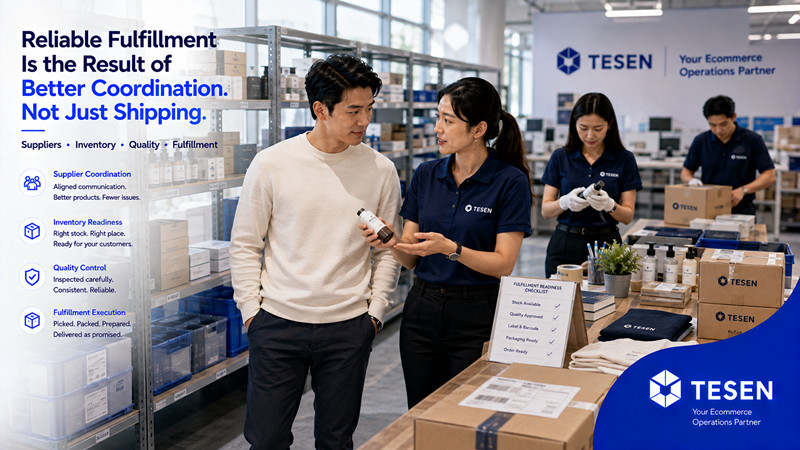
It is the result of an operational system working together.
Ecommerce fulfillment performance describes how reliably and efficiently a business can process customer orders from inventory availability through delivery.
It can include factors such as:
Shipping speed is one measurement.
It is not the entire system.
A parcel delivered quickly does not represent strong fulfillment if the wrong product was shipped.
Similarly, a fast shipping line cannot help when the product is out of stock.
For growing ecommerce brands, fulfillment performance needs to be evaluated across the complete order journey.
Fulfillment is often described as:
Pick → Pack → Ship
Operationally, however, successful fulfillment begins much earlier.
Before a warehouse can process an order, several things must already have happened correctly.
The supplier must have produced the product.
The product must meet quality requirements.
Inventory must be available.
The warehouse must have accurate stock information.
Packaging and labeling requirements must be clear.
Only then can efficient pick, pack, and ship operations begin.
This creates a broader fulfillment chain:
Supplier → Production → Quality Control → Inventory → Warehouse → Fulfillment → Shipping → Customer
A weakness at any stage can affect the final customer experience.
Warehouses cannot fulfill inventory that suppliers have not produced.
This makes supplier performance one of the earliest factors affecting fulfillment.
Common supplier issues include:
When these problems are communicated too late, inventory replenishment can also be delayed.
The result may eventually appear as:
The customer experiences a fulfillment problem.
But the original cause may have occurred at the supplier weeks earlier.
This is why supplier management and fulfillment should not be treated as completely separate operations.
Inventory availability is one of the foundations of fulfillment performance.
A highly efficient warehouse still cannot process an order if the required SKU is unavailable.
Growing Shopify brands therefore need visibility into:
The important question is not simply:
How much inventory do we have?
It is:
Will we have enough sellable inventory when future orders arrive?
This is where inventory planning becomes directly connected with fulfillment.
Better replenishment decisions reduce the likelihood that strong sales create fulfillment disruptions.
Inventory quantity and sellable inventory are not always the same.
Suppose a warehouse receives 1,000 units.
The inventory system may initially show 1,000 units.
But if some products contain unacceptable defects, damaged packaging, incorrect labels, or missing accessories, not every unit should necessarily enter fulfillment inventory.
Quality control helps determine whether products are actually ready to ship.
Depending on product requirements, QC may include:
Finding quality problems before fulfillment helps prevent defective inventory from becoming customer complaints, returns, or replacement shipments.
Quality control therefore protects both fulfillment performance and customer experience.
Once inventory is ready, warehouse operations become critical.
Reliable fulfillment depends on:
As daily order volume grows, small operational errors become increasingly expensive.
A process that works at 20 orders per day may become difficult to manage at 200 orders per day.
This is why fulfillment workflows need to evolve alongside order volume.
One of the biggest challenges for growing ecommerce brands is not always the problem itself.
It is discovering the problem too late.
Without operational visibility:
Better visibility allows teams to understand where an issue is occurring.
Is production late?
Is inventory running low?
Is the warehouse waiting for stock?
Has the parcel already entered the shipping network?
This matters because different fulfillment problems require different solutions.
Using faster shipping does not solve a production delay.
Adding inventory does not solve poor quality.
Changing warehouses does not solve weak supplier communication.
Visibility helps brands solve the right problem.
Imagine an ecommerce brand reducing international transit time from nine days to six days.
That sounds like a major improvement.
But suppose the same business continues experiencing:
The shipping line became faster.
The fulfillment system did not necessarily become better.
This is why brands should evaluate fulfillment as an end-to-end operation rather than optimizing individual shipping metrics in isolation.
Speed matters.
But reliability, accuracy, availability, and predictability matter too.
One Shopify brand experienced inconsistent fulfillment despite maintaining relatively stable sales.
The warehouse processed available orders efficiently.
The shipping method also remained reliable.
Yet customers continued experiencing delays.
Initially, the business considered switching shipping providers.
After reviewing the broader operation, the underlying problems were found elsewhere.
Supplier updates were arriving late.
Replenishment decisions were inconsistent.
Inventory visibility was limited.
Some orders therefore entered fulfillment without sufficient inventory available to support them.
After improving supplier coordination, inventory planning, and operational visibility:
The shipping method remained the same.
The upstream operations improved.
And fulfillment performance improved with them.
At TESEN, we view fulfillment as part of a broader ecommerce operational system.
Depending on the requirements of the brand, our services can connect:
The purpose of connecting these areas is not to make fulfillment more complicated.
It is to reduce the number of disconnected operations a growing brand needs to manage.
When supplier information, inventory, QC, warehousing, and fulfillment are coordinated, teams gain a clearer understanding of what is happening before and after an order reaches the warehouse.
Shipping rates matter.
But they should not be the only factor.
Growing brands should also consider whether a potential fulfillment partner can support:
Inventory visibility
Can you clearly understand what inventory is available?
Order accuracy
How are picking and packing errors managed?
Quality control
Can products be inspected according to agreed requirements?
Supplier coordination
Can the partner communicate with suppliers when replenishment or production issues occur?
Operational communication
How are exceptions and problems reported?
Shipping options
Are suitable shipping solutions available for your main markets?
Scalability
Can the workflow continue functioning as order volume grows?
The lowest shipping rate does not automatically create the lowest total fulfillment cost.
Operational reliability matters.
There is no single solution that improves every fulfillment operation.
A useful starting point is to identify where instability actually originates.
Brands can review:
This approach helps separate the cause of a fulfillment problem from the symptom.
Great ecommerce fulfillment is not created at the shipping label.
It begins much earlier.
Supplier management determines when products become available.
Inventory planning determines whether enough stock exists.
Quality control determines whether that stock is ready to ship.
Warehouse operations determine whether orders are processed correctly.
Operational visibility helps teams identify problems before customers do.
Shipping then completes the journey.
For Shopify and DTC brands, improving fulfillment therefore requires more than searching for a faster courier.
At TESEN, we help connect sourcing, suppliers, quality control, inventory, warehousing, fulfillment, and international shipping into a more coordinated ecommerce operation.
Because better fulfillment is not the result of one fast step.
It is the result of the entire system working reliably.
Fulfillment performance depends on inventory availability, supplier reliability, quality control, warehouse accuracy, operational visibility, shipping consistency, and exception management. Improving only shipping speed may not solve problems elsewhere in the operation.
Brands should first identify where fulfillment problems originate. Common areas to review include supplier lead times, inventory replenishment, product quality, warehouse workflows, tracking visibility, and shipping performance.
Consider inventory visibility, order accuracy, quality control capabilities, supplier coordination, communication, shipping options, technology integration, and the partner's ability to support increasing order volume—not only shipping price.
Some fulfillment partners provide services beyond pick, pack, and ship, including sourcing, supplier coordination, production follow-up, quality control, inventory management, and replenishment support. Brands should confirm which services are included before choosing a partner.
Not necessarily. Faster transit can improve delivery experience, but it cannot compensate for stockouts, processing delays, incorrect orders, product defects, or poor tracking visibility. Reliable fulfillment requires the entire operation to work together.
TESEN supports Shopify and DTC brands through product sourcing, supplier management, quality control, inventory visibility, warehousing, order fulfillment, custom packaging, and international shipping, connecting upstream operations with fulfillment execution.
TESEN is a China-based ecommerce fulfillment and supply chain partner supporting Shopify and DTC brands with product sourcing, supplier management, quality control, inventory planning, warehousing, private labeling, order fulfillment, and global shipping.
By connecting upstream supply chain operations with fulfillment, TESEN helps growing ecommerce brands build more predictable and scalable operations.
Source Your Products and Start Dropshipping
 IPv6 network supported