
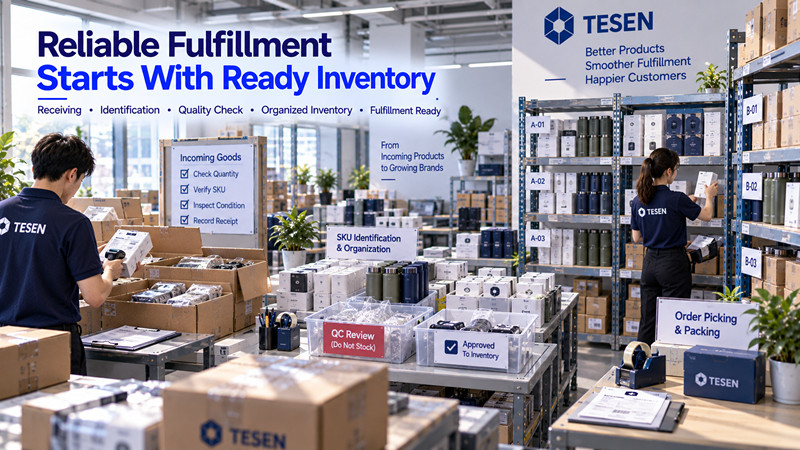
 When ecommerce brands think about fulfillment performance, they usually focus on what happens after an order is placed.
How quickly is the order picked?
Was the correct product packed?
When was the parcel shipped?
These things matter.
But reliable ecommerce fulfillment begins much earlier.
Before an order can be picked accurately, the right inventory must already be received, identified, visible, available, and ready for fulfillment.
That makes inventory storage more than a question of warehouse space.
For growing Shopify and DTC brands, the way inventory is stored and managed directly affects how reliably customer orders can be fulfilled.
Good fulfillment doesn’t begin when an order is picked. It begins with whether the right inventory is ready before the order arrives.
Imagine a Shopify store receives an order containing three products.
From the customer's perspective, the fulfillment process has just started.
Operationally, much of the work required to fulfill that order has already happened.
The products needed to be received.
The correct SKUs needed to be identified.
Inventory needed to be recorded accurately.
Products needed to be stored in appropriate locations.
Available stock needed to be distinguishable from damaged, reserved, uninspected, or otherwise unavailable inventory.
If these conditions are not in place, even a fast pick-and-pack operation can struggle.
This is why ecommerce fulfillment performance should not be measured only from the moment an order enters the warehouse.
The condition of inventory before the order exists is already influencing the fulfillment outcome.
A warehouse can have plenty of available space without providing effective fulfillment inventory management.
Basic storage answers one question:
Where can we put the products?
A fulfillment operation needs to answer several more:
Physical inventory and fulfillment-ready inventory are not always the same.
A brand may technically have 500 units inside a warehouse.
But if 100 units have not been properly received, another 50 are waiting for QC, and 30 have been allocated to existing orders, the physical quantity does not accurately describe what is available for new customer orders.
For ecommerce fulfillment:
Inventory availability matters more than storage capacity alone.
Fulfillment-ready inventory is stock that can actually be used to process customer orders.
Depending on the operation, this generally means that products have been:
This distinction becomes increasingly important as SKU counts and order volumes grow.
Inventory sitting inside a warehouse is not necessarily useful inventory.
For fulfillment, the relevant question is:
Can the correct product be located, picked, and shipped when the customer orders it?
Poor inventory storage rarely remains only a warehouse problem.
It creates downstream fulfillment consequences.
As product ranges expand, similar SKUs, sizes, colors, bundles, and packaging variations become harder to manage.
If products are not clearly identified and organized, picking errors become more likely.
The warehouse may physically contain the correct product but still ship the wrong variant.
Physical stock may exist while the operational inventory record shows something different.
The brand may continue selling inventory that is not actually available.
Or it may stop selling products that physically exist.
Both situations affect revenue and customer experience.
New inventory can physically arrive at the warehouse without immediately becoming available for fulfillment.
If incoming products cannot be quickly identified, recorded, checked, and placed into the appropriate inventory location, replenishment exists physically but not operationally.
A brand can therefore appear out of stock while replacement inventory is already inside the warehouse.
This is one of the more frustrating ecommerce inventory problems.
The business has invested in stock.
Products exist somewhere in the operation.
Yet the required SKU is unavailable when customer demand arrives.
The problem is not always insufficient inventory.
It may be insufficient inventory visibility, inaccurate records, or poor organization.
Poor visibility can create the opposite problem.
If a brand cannot confidently understand available inventory, it may purchase more products than necessary.
That ties up working capital and increases storage requirements.
Poor inventory management can therefore contribute to both stockouts and excess stock.
Simple storage systems can work surprisingly well at low volume.
A small Shopify brand may have:
Warehouse staff may be able to identify products manually.
The founder may know roughly how much inventory exists.
Replenishment may be managed through a spreadsheet.
Growth changes this.
A scaling brand may eventually have:
The number of physical products increases.
But more importantly, the number of inventory decisions increases.
Which SKU needs replenishment?
Which batch has arrived?
Which inventory has completed receiving?
Which stock is fulfillment-ready?
Which SKU is moving slowly?
Which bestseller may run out before the next production batch arrives?
At this stage, simply adding more warehouse space does not solve the problem.
The brand needs better inventory management.
For ecommerce brands, good storage should create visibility.
The operation needs to distinguish between:
Products physically inside the warehouse
and
Inventory actually available for fulfillment
This creates an important relationship:
Storage → Visibility → Availability → Fulfillment
Better organization makes it easier to understand what inventory exists.
Better visibility makes it easier to determine what inventory is actually available.
Better availability information helps fulfillment operate more reliably.
But the relationship should not end there.
Inventory information should also support replenishment decisions.
Knowing what inventory exists today is useful.
Knowing what that inventory means for tomorrow is more valuable.
Suppose a Shopify brand has 600 units of a bestseller available.
Is that healthy?
It depends.
If the product sells 20 units per week, 600 units may represent substantial inventory coverage.
If it sells 200 units per week, the situation is very different.
Supplier lead time also matters.
If replenishment requires six weeks, the brand may already need to place another production order.
A more useful relationship is therefore:
Available Inventory + Sales Velocity + Supplier Lead Time + Incoming Inventory → Replenishment Decision
This is why inventory storage should not operate as an isolated warehouse function.
Inventory information should help brands make better decisions before stock availability begins affecting fulfillment.
This distinction is particularly important.
Brands should not solve every availability problem by purchasing more stock.
More inventory creates its own risks:
The objective is not maximum inventory.
It is appropriate inventory with sufficient visibility and availability.
A growing ecommerce brand should understand:
That creates a healthier relationship between inventory investment and fulfillment performance.
When brands evaluate ecommerce storage solutions, they often start with two questions:
How much warehouse space do you have?
and:
How much does storage cost?
Both questions matter.
But neither tells the brand whether customer orders can be fulfilled reliably.
A more useful question is:
How will my inventory be managed so it remains ready for fulfillment?
That leads to better questions:
These questions reveal whether a provider is simply selling storage space or supporting an ecommerce fulfillment operation.
When evaluating inventory management as part of a fulfillment solution, Shopify and DTC brands can focus on five areas.
Can the operation reliably distinguish between different SKUs, variants, batches, and product conditions?
Without accurate identification, every downstream fulfillment process becomes harder.
Can the brand understand what inventory is physically present and what is actually available for fulfillment?
The difference matters.
How quickly can incoming inventory move from warehouse receiving into available stock?
Inventory sitting inside a warehouse is not useful if customer orders cannot access it.
Does inventory information help the brand identify when stock levels require attention?
Inventory management should support better decisions, not simply record quantities.
Will the same inventory system continue working when SKU count, inventory volume, suppliers, and daily orders increase?
A process designed only for today's complexity may become a constraint as the brand grows.
Customers rarely think about inventory storage.
But they experience its consequences.
When inventory is well managed:
When inventory is poorly managed:
The customer never sees the warehouse.
But the way inventory is managed inside that warehouse influences what the customer experiences.
This is why inventory management belongs inside the broader conversation about ecommerce fulfillment.
A large warehouse may offer significant storage capacity.
But square meters do not tell a brand whether its inventory will be managed effectively.
Likewise, a low storage rate does not reveal:
Warehouse capacity is only one part of the decision.
For ecommerce brands, the more important question is:
Does the inventory operation support reliable fulfillment?
A fulfillment partner does not become more capable simply because it has more storage space.
Its inventory needs to remain organized, visible, and usable as operational complexity grows.
At TESEN, inventory storage is not positioned as a standalone warehouse service.
Our core commercial focus is ecommerce fulfillment for Shopify and DTC brands.
Inventory is stored for an operational purpose:
To make the right products available when customer orders arrive.
Depending on a brand's requirements, TESEN can connect inventory management with:
Because these activities are connected, inventory information can support decisions elsewhere in the operation.
If a fast-moving SKU is getting low, replenishment becomes relevant.
If new inventory arrives with a quality problem, it should not automatically become fulfillment-ready stock.
If inventory accumulates faster than it sells, future purchasing decisions may need to be reconsidered.
If several suppliers deliver products for the same customer order, inventory needs to be received and organized so those products can later become one fulfillment-ready order.
The value of inventory storage is therefore not simply that products have somewhere to sit.
The value is that inventory remains visible, manageable, and available for ecommerce fulfillment.
Reliable ecommerce fulfillment does not begin with picking and packing.
It begins with inventory.
The right products need to be received, identified, visible, available, and ready before customer demand arrives.
As Shopify and DTC brands grow, the inventory question therefore needs to evolve from:
Where do we keep our products?
to:
How do we manage our inventory so fulfillment remains reliable?
That is a more useful way to evaluate ecommerce inventory and fulfillment partners.
At TESEN, we connect inventory management with supplier coordination, quality control, replenishment planning, custom packaging, and ecommerce fulfillment so inventory supports the broader operation rather than functioning as an isolated warehouse service.
Because the purpose of ecommerce inventory storage is not simply to hold stock.
It is to make the right inventory available when the next customer order arrives.
Inventory management determines whether the correct products are identifiable, available, and ready when customer orders arrive. Poor inventory organization or inaccurate availability can contribute to picking errors, stockouts, overselling, and fulfillment delays.
Fulfillment-ready inventory is stock that has been received, identified, recorded, and made available for customer orders according to the warehouse's agreed procedures. Products physically inside a warehouse may not yet be fulfillment-ready if they are awaiting receiving, QC, labeling, or another required step.
Brands should consider SKU management, inventory visibility, receiving processes, inventory accuracy, fulfillment readiness, replenishment support, exception handling, and whether the operation can scale as SKU count and order volume increase.
Not necessarily. Excess inventory can tie up working capital, increase storage costs, and create slow-moving or obsolete stock. The objective is appropriate inventory levels combined with sufficient visibility and reliable replenishment.
Basic inventory storage primarily provides physical space for products. Fulfillment-oriented inventory management also considers SKU identification, receiving, stock availability, inventory status, replenishment, and how quickly products can be used to process customer orders.
Yes. TESEN can receive products from multiple suppliers into its China fulfillment operation. Depending on the agreed workflow, inventory can be received, organized by SKU, checked as required, stored, and later used for Shopify and ecommerce order fulfillment.
For this Blog I would not answer this as a simple sales FAQ unless you specifically want to promote standalone storage.
TESEN's website positioning should emphasize that inventory storage is primarily part of the broader ecommerce fulfillment operation, rather than positioning TESEN as a general warehouse provider.
TESEN is a China-based Ecommerce Supply Chain & Fulfillment Partner for Shopify and DTC brands.
Our core commercial focus is ecommerce fulfillment, supported by product sourcing, supplier management, quality control, inventory planning and storage, custom packaging, and international shipping.
By connecting inventory with upstream suppliers and downstream order fulfillment, TESEN helps growing ecommerce brands keep products visible, manageable, and ready for customer demand.
Source Your Products and Start Dropshipping
 IPv6 network supported