
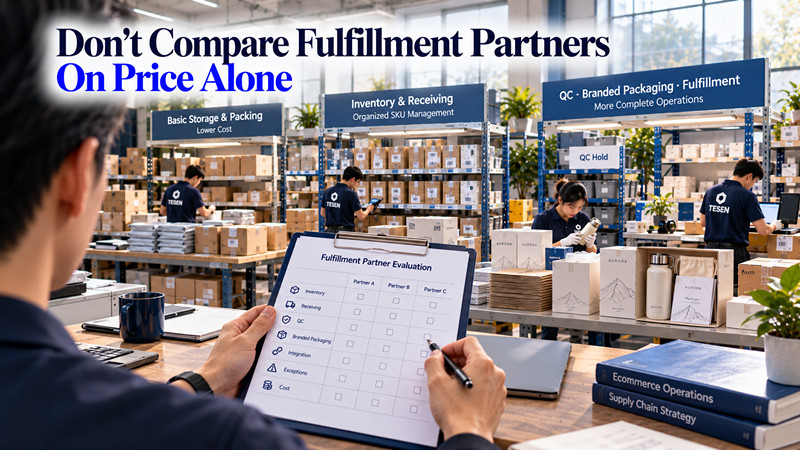
Choosing an ecommerce fulfillment partner often begins with a spreadsheet.
One provider charges less for pick and pack.
Another offers cheaper storage.
A third has a lower shipping rate.
Those numbers are easy to compare, which is why they often dominate the decision.
But fulfillment partnerships rarely become difficult because one provider charged slightly more per order.
The bigger problems usually appear later.
Inventory cannot be located.
A supplier shipment is delayed.
A batch fails quality control.
A SKU discrepancy appears.
A customer address is incomplete.
An order requires special handling.
At that point, the question is no longer:
Who gave us the lowest quote?
It becomes:
Which fulfillment partner can actually manage the operation when something changes?
For growing Shopify and DTC brands, choosing a fulfillment partner is therefore not simply a price comparison.
It is an operational decision.
This guide explains what ecommerce brands should evaluate before making that decision.
Most brands begin with the easiest numbers to compare:
These numbers matter.
A fulfillment model has to work within the brand's economics.
But price tells you only what the provider charges when the operation works as expected.
It tells you much less about what happens when it does not.
A lower fulfillment fee can quickly become less attractive if the operation creates:
These costs are much harder to identify in a quotation.
That is why fulfillment partner evaluation needs two layers:
Commercial Cost
and
Operational Capability
The right partner needs to make sense across both.
Before comparing fulfillment companies, first define what your business actually needs.
A provider that works well for one ecommerce brand may be completely unsuitable for another.
Start with your own operating model.
How many orders do you currently process?
How quickly is volume changing?
A brand processing 20 orders per day has different requirements from one processing 500.
But order volume alone does not determine complexity.
Ten simple SKUs may be easier to manage than 100 products with:
SKU complexity affects receiving, storage, inventory accuracy, picking, and replenishment.
Ask:
These requirements can materially change what you need from a fulfillment partner.
Some products may require:
These requirements should be understood before requesting quotations.
A brand selling only in one country has different requirements from a business serving customers across the US, UK, Europe, Australia, and other markets.
If you use branded boxes, inserts, pouches, labels, or other packaging materials, determine how these materials will be:
If QC matters to your business, understand how inspection results affect inventory availability.
A product physically inside the warehouse is not necessarily fulfillment-ready inventory.
The objective is not to find the provider offering the largest number of services.
The objective is to find a fulfillment operating model that matches your actual complexity.
Storage price is easy to compare.
Inventory capability is harder.
Asking:
How much do you charge per cubic meter?
does not tell you how well inventory will actually be managed.
Ask instead:
For ecommerce fulfillment, warehouse space alone is not enough.
Inventory needs to remain:
Visible
Identifiable
Accurate
Available
Fulfillment-ready
Cheap storage combined with weak inventory control can become expensive later.
Brands naturally focus on outbound fulfillment.
How quickly can orders ship?
Which carriers are available?
What does delivery cost?
But many fulfillment problems begin before the first customer order is picked.
They begin during inventory receiving.
When supplier inventory arrives, the fulfillment operation should understand:
If receiving is inaccurate, every downstream process becomes less reliable.
For example:
Incorrect Receiving
↓
Incorrect Inventory
↓
Incorrect Order Allocation
↓
Fulfillment Exception
↓
Customer Problem
This is why receiving capability deserves serious attention when evaluating a fulfillment partner.
Inventory accuracy begins before the first order is picked.
Not every ecommerce brand needs its fulfillment partner to manage suppliers.
But if you source products from China, you should understand what happens when upstream problems affect downstream fulfillment.
For example:
A supplier delays production.
A batch arrives late.
Packaging does not match the approved specification.
QC identifies a product issue.
These are upstream events.
But their consequences may include:
A capable fulfillment operation should therefore have a clear process for converting upstream information into downstream action.
Suppose QC places 300 units on hold.
The system should not continue treating those 300 units as normal available inventory.
Or suppose a supplier delays a replenishment batch by two weeks.
The brand may need to know whether its existing inventory can still cover expected demand.
The important question is:
Can upstream information change downstream decisions quickly enough?
You are not simply evaluating individual services.
You are evaluating whether the operation remains connected.
Many fulfillment problems are manageable.
They become dangerous when the brand does not know what is happening.
When an issue appears, you should be able to answer four questions:
What happened?
What is affected?
What is being done?
What happens next?
That is operational visibility.
Consider an inventory discrepancy affecting a fast-moving SKU.
The brand may need to:
Those decisions require information.
Good operational visibility does not mean receiving constant messages.
It means receiving the right information when a business decision is required.
When evaluating a fulfillment partner, ask how operational issues are communicated—not just how normal orders appear in a dashboard.
Normal orders are usually the easiest part of ecommerce fulfillment.
The address is correct.
Inventory is available.
The product is in good condition.
The order is picked, packed, and shipped.
Most fulfillment providers can explain this workflow.
The harder question is:
What happens when the order is not normal?
This is where fulfillment partners are really tested.
The system shows 100 units.
The warehouse can locate only 94.
Ask:
A picker discovers that a product is damaged.
Ask:
One damaged product may be an isolated exception.
Repeated damage may indicate a supplier or packaging issue.
The wrong SKU is discovered during receiving or fulfillment.
Ask:
Customer addresses are not always complete or valid.
Ask how the provider handles:
Otherwise, orders can remain unresolved without clear ownership.
If replenishment is late, can the operation identify:
If inventory cannot immediately pass inspection, can the provider distinguish:
Physical Inventory
from
Fulfillment-Ready Inventory
That distinction prevents questionable inventory from accidentally entering customer orders.
At scale, these small exceptions collectively determine fulfillment reliability.
A process can exist on paper and still fail if nobody owns it.
Before choosing a fulfillment partner, ask:
This is particularly important when working with a fulfillment partner in another country.
The objective is not simply fast communication.
It is clear operational ownership.
Technology matters.
Shopify integration can reduce manual work.
Inventory systems can improve visibility.
Tracking synchronization can improve customer communication.
But a polished dashboard should not be confused with operational capability.
When evaluating technology, ask whether it supports the real workflow.
For example:
A sophisticated interface cannot compensate for poor warehouse execution.
At the same time, a strong fulfillment team should not depend entirely on manual processes as volume grows.
The stronger model combines:
Technology + Operational Execution
rather than treating one as a replacement for the other.
Shipping cost matters.
But the cheapest shipping line is not automatically the best option.
Compare:
Different products and markets may require different shipping methods.
For example, a lightweight product going to one market may need a completely different solution from a heavier parcel going somewhere else.
A fulfillment partner should therefore help the brand understand the available options rather than simply defaulting every order to the cheapest channel.
Reliable fulfillment is not:
Pick → Pack → Cheapest Shipping
It is selecting an appropriate operational method for the product, destination, and customer expectation.
Communication is sometimes treated as a soft factor during supplier evaluation.
For fulfillment, it directly affects decision speed.
A useful fulfillment partner should communicate clearly when:
Good communication does not mean sending constant updates.
It means communicating when information requires action.
Evaluate:
This becomes especially important when your fulfillment operation is located in another country or time zone.
Pricing still belongs in the evaluation.
Compare:
But the lowest unit fee does not necessarily create the lowest total operational cost.
Operational problems can create additional costs through:
This does not mean brands should automatically choose a more expensive provider.
It means:
Price should be evaluated together with the operational consequences of the service.
Before choosing a provider, evaluate these eight areas.
| Area | What to Evaluate |
|---|---|
| 1. Operational Fit | Order volume, SKU complexity, product type, markets, supplier structure, packaging |
| 2. Inventory Management | Receiving, SKU identification, visibility, discrepancies, replenishment |
| 3. Fulfillment Execution | Pick and pack, accuracy, cut-off time, special handling |
| 4. Supplier & QC Coordination | Supplier issues, inspection, QC holds, packaging discrepancies, rework |
| 5. Exception Handling | Missing inventory, damaged products, wrong SKU, address issues, supplier delays |
| 6. Operational Visibility | What happened, what is affected, what is being done, what happens next |
| 7. Technology & Integration | Shopify integration, inventory, tracking, operational management |
| 8. Commercial Structure | Fulfillment, storage, receiving, value-added services, shipping, payment terms |
Pricing belongs in the framework.
It should not dominate the framework.
Before signing, you should be able to get clear answers to questions such as:
If a provider cannot answer these questions clearly before the partnership begins, the uncertainty is unlikely to become smaller after operations start.
Not every ecommerce brand needs the same operating model.
For some businesses, a traditional warehouse or 3PL relationship is sufficient.
The brand sends inventory to the warehouse.
The warehouse stores it and fulfills customer orders.
Other brands require more coordination.
A private fulfillment agent may be more suitable when the operation involves:
The distinction is not simply company size.
It is the amount of coordination required between the stages before and during fulfillment.
This is why brands should evaluate the operating model rather than relying only on labels such as “3PL,” “warehouse,” or “fulfillment agent.”
TESEN works with Shopify and DTC brands as a China-based Ecommerce Supply Chain & Fulfillment Partner.
Our core commercial focus is ecommerce fulfillment.
Depending on the brand's requirements, supporting operations can include:
But the important question is not simply how many services are available.
It is whether those functions work together.
When QC affects usable stock, inventory availability should reflect it.
When supplier timing changes, the inventory impact should be understood.
When an inventory discrepancy appears, it should be investigated.
When an exception occurs, the brand should know:
What happened?
What is affected?
What happens next?
That coordination is difficult to represent in a simple fulfillment quotation.
But it is often what determines the quality of a fulfillment partnership over time.
Start by defining your order volume, SKU complexity, product requirements, supplier structure, target markets, packaging, and QC needs. Then compare providers across inventory management, fulfillment execution, exception handling, operational visibility, technology, communication, and total cost.
Ask how inventory is received and tracked, how Shopify orders and tracking synchronize, how discrepancies and damaged products are handled, what happens when inventory fails QC, who manages exceptions, and how urgent issues are communicated.
Not necessarily. Price is important, but the lowest quotation can become more expensive if weak inventory control, errors, delays, poor exception handling, or additional management work create downstream costs.
Ask how inventory is received, identified, recorded, separated by status, reconciled, and made fulfillment-ready. Also ask how physical and system inventory discrepancies are investigated.
Yes, depending on the provider's operating model. TESEN can work with existing suppliers and coordinate areas such as incoming inventory, production timing, QC, packaging, receiving, and fulfillment.
A traditional fulfillment provider may focus mainly on storage and order processing. A private fulfillment agent may also coordinate upstream activities such as suppliers, sourcing, QC, inventory planning, and packaging. The appropriate model depends on the brand's operational complexity.
Normal orders usually follow predictable workflows. Inventory discrepancies, damaged products, wrong SKUs, address issues, supplier delays, and QC holds require investigation and coordination. How a provider handles these situations often reveals more about operational capability than the normal pick-and-pack process.
Choosing an ecommerce fulfillment partner is not simply a purchasing exercise.
It is an operational decision.
A quotation can tell you:
Pick-and-pack cost
Storage price
Shipping rate
But it cannot fully tell you how the partner will perform when inventory does not match, a supplier is late, QC blocks a batch, or an order requires an exception.
Before making a decision, evaluate:
Operational Fit → Inventory → Receiving → QC & Supplier Coordination → Fulfillment → Exceptions → Visibility → Technology → Total Cost
Because the real test of a fulfillment partner is often not how efficiently it handles the routine.
It is how reliably it handles what happens when the routine breaks.
TESEN is a China-based Ecommerce Supply Chain & Fulfillment Partner for Shopify and DTC brands.
Our core commercial focus is ecommerce fulfillment, supported by product sourcing, supplier management, quality control, inventory planning and storage, custom packaging, Shopify integration, and international shipping.
By connecting upstream supplier and inventory operations with fulfillment execution, TESEN helps growing ecommerce brands build more coordinated and reliable fulfillment operations.
Source Your Products and Start Dropshipping
 IPv6 network supported