
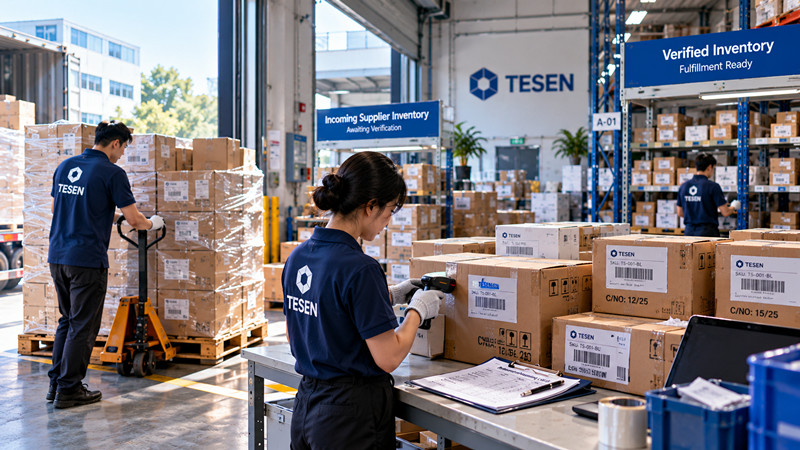
Many ecommerce brands assume fulfillment begins when products arrive at a warehouse in China.
The supplier completes production. Cartons are delivered. The warehouse receives the goods. Then customer orders can begin shipping.
But for growing Shopify and DTC brands, the process is rarely that simple.
A product can be finished at the factory without being ready for fulfillment.
SKU labels may not match warehouse records. Actual quantities may differ from the purchase order. Packaging may need adjustment. Some products may require quality inspection before they can be released into available inventory.
These issues can delay fulfillment even when the products have physically arrived.
That is why reliable China fulfillment begins before inventory reaches the warehouse.
It begins with a well-managed supplier handoff.
China fulfillment is the process of managing ecommerce inventory and fulfilling customer orders from a China-based operation.
For Shopify and DTC brands sourcing products from Chinese suppliers, the process can include:
Supplier delivery coordination
Inventory receiving
SKU identification
Quantity verification
Quality control
Inventory storage
Custom packaging
Order picking and packing
International shipping
The core service remains ecommerce fulfillment.
However, the reliability of that service depends partly on how inventory moves from supplier production into a fulfillment-ready state.
A warehouse cannot accurately fulfill products that have not been properly identified, received, or approved for use.
This is why China fulfillment should be evaluated as an operational process, not simply a warehouse location.
The supplier handoff is the transition between completed production and warehouse receiving.
It involves more than physically transporting cartons.
It also involves transferring the information the fulfillment team needs to process those products correctly.
Before a supplier sends inventory, the fulfillment operation should ideally know:
Which supplier is sending the products
Which SKUs are included
Expected quantities
Number of cartons
Expected delivery date
Product labeling requirements
Packaging specifications
Whether quality control is required
Whether any special receiving instructions apply
Without this information, the warehouse may need to identify incoming products from scratch.
That creates unnecessary receiving work and increases the possibility of inventory errors.
A properly coordinated supplier handoff helps the warehouse prepare before the goods arrive.
SKU accuracy is one of the foundations of reliable ecommerce fulfillment.
For brands selling multiple product variations, SKU identification can become complicated.
Consider a Shopify brand selling apparel with:
Five sizes
Four colors
Two packaging versions
That creates 40 possible inventory combinations.
If suppliers and the fulfillment warehouse use different product references, receiving becomes more difficult.
For example, a supplier may identify a product using its internal factory code while the Shopify store uses a different SKU.
Without a clear mapping between those references, the warehouse may receive the correct physical products but record them incorrectly.
The consequences can appear later:
Incorrect SKU Receiving → Incorrect Inventory Record → Wrong Product Picked → Customer Complaint
The customer experiences a fulfillment error.
But the underlying problem may have started before the products entered the warehouse.
Before supplier delivery, brands and fulfillment partners should establish:
Consistent SKU references
Product descriptions
Size and color variations
Barcode requirements
Packaging variations
Bundle or kit identification
The objective is to ensure that every product can be correctly identified when it arrives.
A fulfillment warehouse should know what quantities to expect.
Suppose a supplier confirms that 1,000 units are ready.
When the warehouse receives the shipment, only 940 units are verified.
The difference is 60 units.
That discrepancy may affect:
Inventory availability
Replenishment planning
Order allocation
Stock coverage
Customer fulfillment
If the discrepancy is identified immediately, the brand can investigate with the supplier before relying on an incorrect inventory figure.
If it is discovered later, the warehouse system may already show inventory that does not physically exist.
The receiving team should be able to compare:
Expected Quantity → Received Quantity → Verified Quantity → Available Quantity
These quantities are not always identical.
A structured receiving process makes the differences visible before they affect customer orders.
Packaging decisions can directly influence warehouse receiving and fulfillment.
For example, products may arrive:
Individually packed
In bulk packaging
Without barcode labels
With incorrect SKU stickers
In packaging unsuitable for direct customer fulfillment
Without required accessories or inserts
If packaging requirements are unclear, additional work may be needed after the goods reach the warehouse.
That could include:
Relabeling
Repacking
Adding accessories
Applying barcodes
Preparing branded packaging
Separating product variations
These activities may be necessary, but they should not become unexpected problems.
A China fulfillment partner should understand the packaging requirements before the supplier dispatches the products.
For brands using custom packaging, this coordination becomes particularly important.
Products, branded boxes, pouches, labels, and insert cards may come from different suppliers.
Fulfillment cannot begin as planned unless the required components are available and correctly matched.
A supplier may report that production is complete.
But production completion does not mean the inventory is immediately available for customer orders.
Several steps may still be required:
Production Completion → Final Packaging → Supplier Dispatch → Warehouse Delivery → Receiving → Verification → QC → Fulfillment-Ready Inventory
Each stage takes time.
For fast-moving products, the difference between the production completion date and the fulfillment-ready date can be commercially important.
Consider a Shopify brand with two weeks of remaining inventory.
The supplier says production will finish next Monday.
But the products may still require transportation, receiving, inspection, and labeling.
If the brand assumes inventory will be available on Monday, it may underestimate the risk of a stockout.
The more useful question is:
When will the inventory actually become available for customer fulfillment?
This is why supplier timing and receiving readiness should be connected with inventory replenishment planning.
Warehouse receiving is often described as a simple physical process.
Goods arrive.
Cartons are counted.
Products are stored.
But receiving is also an operational checkpoint.
A structured receiving process should help determine:
Did the expected shipment arrive?
Were the correct SKUs delivered?
Do actual quantities match expectations?
Is packaging consistent with requirements?
Are there visible signs of damage?
Does the inventory require further inspection?
Can the products enter available stock immediately?
Receiving is the point where supplier information becomes warehouse inventory data.
If that transition is inaccurate, downstream fulfillment may also become inaccurate.
The problem becomes more complicated when a brand purchases products from several Chinese suppliers.
One supplier may deliver finished products.
Another supplies branded packaging.
A third supplies accessories.
The warehouse may need all three components before a finished customer order can be prepared.
Receiving therefore needs to confirm not only that individual shipments arrived, but also whether the required products and materials are ready for fulfillment.
One of the most important distinctions in China fulfillment is the difference between inventory that has arrived and inventory that can actually be used for customer orders.
Imagine a warehouse physically receives 2,000 units.
After receiving and verification, the inventory status may look like this:
| Inventory Status | Units |
|---|---|
| Approved and fulfillment-ready | 1,800 |
| Awaiting quality inspection | 100 |
| Held for packaging issues | 50 |
| Quantity discrepancy pending investigation | 50 |
| Total expected units | 2,000 |
In this illustrative example, 1,950 units have been physically accounted for, while 50 units remain unresolved.
The brand should not assume that all 2,000 expected units are available for fulfillment.
Only 1,800 units are currently fulfillment-ready.
This distinction affects:
Available-to-sell inventory
Order allocation
Replenishment timing
Promotion planning
Stockout risk
Inventory should become available for customer orders based on verified operational status, not simply because a supplier says production is finished or cartons have arrived.
Quality control is another reason why received inventory may not immediately become available.
Some products require inspection before they can enter normal fulfillment.
For example:
A supplier delivers 1,000 units.
During the agreed inspection, 80 units are identified for further review.
Those units may need to remain on hold while the issue is investigated.
The inventory record should distinguish between:
Approved inventory
Inventory awaiting inspection
Inventory on hold
Inventory requiring rework
Fulfillment-ready stock
The purpose is not to make every product pass through an unnecessarily complicated inspection process.
It is to ensure that QC decisions are reflected in inventory availability.
A quality problem should not remain isolated in an inspection report while the fulfillment system continues treating the affected units as sellable stock.
Consider a supplier that uses an incorrect SKU label.
The warehouse receives the goods without identifying the mismatch.
The inventory is stored under the wrong SKU.
Later, a customer orders SKU A.
The warehouse picks the product labeled SKU A.
But the actual product is SKU B.
From the customer's perspective, the warehouse shipped the wrong item.
From an operational perspective, the problem may have originated during supplier labeling or receiving.
This is why fulfillment performance cannot always be evaluated by looking only at the final picking and packing stage.
Some errors originate upstream and become visible only after customer orders are shipped.
A reliable China fulfillment operation should therefore identify supplier-to-warehouse discrepancies as early as practical.
Supplier coordination is also connected with replenishment planning.
Imagine a fast-moving SKU is expected to arrive next week.
The supplier reports a delay.
If the fulfillment operation has visibility into current inventory, the brand can assess whether existing stock is sufficient to cover demand until the delayed shipment becomes available.
Useful information includes:
Current fulfillment-ready inventory
Recent order volume
Expected incoming quantity
Supplier completion date
Expected warehouse arrival
Receiving and QC requirements
Estimated fulfillment-ready date
A supplier delay does not automatically mean customer orders will be delayed.
The impact depends on current stock coverage and the timing of replenishment.
But without reliable information, the brand cannot evaluate that risk accurately.
This is where supplier coordination becomes part of inventory planning rather than a separate administrative task.
Many ecommerce brands work with several independent providers.
A supplier manages production.
A sourcing agent handles purchasing.
A warehouse receives products.
A fulfillment provider ships customer orders.
The brand manages the communication between them.
This structure can work.
However, as order volume and SKU complexity grow, information gaps can become more expensive.
One provider knows when production is complete.
Another knows when goods were dispatched.
The warehouse knows what physically arrived.
The Shopify store shows what customers are ordering.
If no one connects those details, the brand may struggle to answer basic questions about inventory readiness.
A more coordinated China fulfillment operation helps connect:
Supplier Production → Supplier Handoff → Warehouse Receiving → Verification / QC → Available Inventory → Shopify Fulfillment
This does not mean every brand needs one company to control its entire supply chain.
It means the information required for reliable fulfillment should move alongside the products.
A China warehouse and a China fulfillment partner can overlap in their services, but the operational scope may differ.
| Capability | Basic Warehouse Storage | Integrated China Fulfillment |
|---|---|---|
| Inventory storage | Core service | Included |
| Receiving | Usually available | Connected with SKU and order requirements |
| Supplier coordination | Depends on provider | May be included |
| SKU identification | Basic or system-dependent | Connected with fulfillment records |
| Quality control | Often separate or optional | Can be coordinated |
| Custom packaging | Depends on provider | Can be integrated |
| Shopify order fulfillment | Not always available | Core service |
| Inventory availability | Warehouse stock records | Can reflect receiving and QC status |
| International shipping | Depends on provider | Supports customer-order fulfillment |
The distinction is not simply that one provider is better than another.
A warehouse may be sufficient for brands with straightforward inventory requirements.
A more integrated China fulfillment model becomes useful when suppliers, inventory, quality control, packaging, and order processing require closer coordination.
Before choosing a China fulfillment partner, brands should evaluate how the provider manages the transition from supplier to warehouse.
Can the fulfillment partner communicate with existing suppliers?
What shipment information is required before delivery?
How are incoming SKUs matched with Shopify product references?
What happens when labels or product descriptions do not match?
How are expected and actual quantities compared?
How are discrepancies communicated?
Can incoming inventory remain unavailable until agreed inspections are completed?
Can the partner coordinate product labels, branded packaging, inserts, and repacking requirements?
Can the brand distinguish between received inventory, inventory on hold, and fulfillment-ready inventory?
Can supplier delivery information be used to understand potential stockout risk?
Who investigates supplier shortages, damaged cartons, incorrect labels, or missing products?
These questions reveal whether the provider can manage more than the physical movement of cartons.
Imagine a Shopify brand purchasing three SKUs from two Chinese suppliers.
Supplier A finishes production on Monday.
Supplier B finishes on Wednesday.
Both suppliers send their products to the same fulfillment center.
Supplier A delivers unexpectedly.
Some cartons have missing SKU labels.
The warehouse needs additional time to identify the products.
Supplier B sends fewer units than expected.
The shortage is discovered after inventory has already been entered.
Some products require QC, but inspection requirements were not communicated before arrival.
The brand sees inventory physically delivered but cannot immediately use all of it for customer orders.
Before delivery:
Expected SKUs are confirmed.
Quantities are shared.
Carton information is provided.
QC requirements are documented.
Receiving timing is coordinated.
When inventory arrives:
Products are matched against expected records.
Quantity discrepancies are identified.
QC inventory is separated.
Approved products are released into available stock.
The brand receives a clearer picture of fulfillment readiness.
The warehouse did not necessarily become physically faster.
The incoming inventory was better prepared for receiving.
That preparation can reduce avoidable delays and improve inventory accuracy.
TESEN is a China-based ecommerce fulfillment partner serving Shopify and DTC brands.
Our core focus is order fulfillment, supported by the China-side operations that help inventory become ready for customer orders.
Depending on the brand's requirements, TESEN can support:
Coordination with existing Chinese suppliers
Product sourcing and supplier management
Production follow-up
Supplier delivery coordination
Incoming inventory receiving
SKU identification and inventory management
Quality control
Packaging and labeling coordination
Inventory storage
Shopify order fulfillment
International shipping
The objective is not simply to move products from a supplier into a warehouse.
It is to create a clearer transition between supplier production and fulfillment-ready inventory.
If a supplier delivers the wrong quantity, the discrepancy should be identified.
If products require inspection, their inventory status should remain clear.
If packaging does not match the agreed requirements, the issue should be addressed before affected products enter normal fulfillment.
If supplier timing changes, the brand should understand how that may affect inventory availability.
This is how supplier coordination supports reliable China fulfillment.
China fulfillment starts before products physically arrive at the warehouse.
Supplier handoff involves both product movement and information transfer.
SKU references, quantities, packaging, QC requirements, and delivery timing should be confirmed before receiving.
Warehouse receiving is an operational checkpoint, not merely a carton-counting activity.
Physical inventory and fulfillment-ready inventory are not necessarily the same.
Supplier labeling or quantity errors can become downstream fulfillment problems.
QC decisions should be reflected in inventory availability.
Supplier delivery timing can affect replenishment and stockout risk.
China-side coordination becomes more valuable as brands manage more suppliers and SKUs.
A China fulfillment partner should be evaluated on its ability to connect supplier information with inventory and order fulfillment.
China fulfillment is the process of storing inventory and fulfilling ecommerce customer orders from a China-based operation. Depending on the provider, it may also include supplier coordination, inventory receiving, quality control, custom packaging, and international shipping.
Yes, depending on the provider. TESEN can coordinate with existing Chinese suppliers for incoming deliveries, inventory receiving, QC, packaging requirements, and fulfillment preparation.
Useful information includes SKU references, expected quantities, carton count, supplier details, purchase or production references, expected delivery timing, packaging requirements, and any agreed QC or labeling instructions.
Not always. Products may require receiving, quantity verification, SKU confirmation, inspection, labeling, or repacking before becoming fulfillment-ready.
The fulfillment operation should identify and record the discrepancy, confirm the actual received quantity, and communicate the issue so the brand can investigate with the supplier and adjust inventory or replenishment plans.
Supplier coordination helps the warehouse prepare for incoming inventory, identify SKUs correctly, understand delivery timing, and complete necessary receiving or QC steps before products become available for customer orders.
Evaluate supplier coordination, SKU management, receiving accuracy, QC capabilities, inventory visibility, Shopify integration, exception handling, packaging support, and total fulfillment costs—not only warehouse location or shipping rates.
China fulfillment does not begin when a carton crosses the warehouse door.
It begins when the supplier prepares inventory for handoff.
SKU identification, expected quantities, packaging, delivery timing, and quality requirements all influence how reliably products move into fulfillment.
For growing Shopify and DTC brands, the goal is not simply to have inventory stored in China.
It is to have inventory that is accurately received, properly identified, and ready to support customer orders.
Because the real value of inventory is not that it has arrived. It is that it is ready for the next customer order.
TESEN is a China-based Ecommerce Supply Chain & Fulfillment Partner for Shopify and DTC brands.
Our core commercial focus is ecommerce fulfillment, supported by product sourcing, supplier management, quality control, inventory planning and storage, custom packaging, and international shipping.
By connecting supplier coordination with inventory receiving and Shopify fulfillment, TESEN helps growing ecommerce brands build more reliable China-side operations.
Source Your Products and Start Dropshipping
 IPv6 network supported