
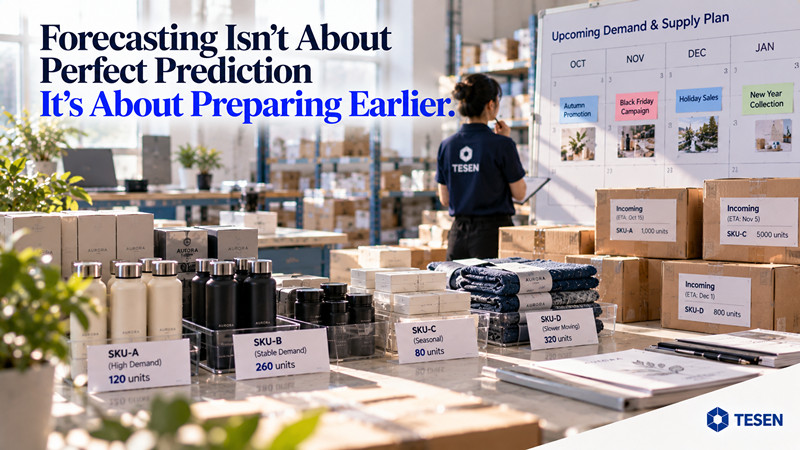
Inventory forecasting is often misunderstood.
Many ecommerce brands think forecasting means trying to predict exactly how many units they will sell next week, next month, or next quarter.
In practice, ecommerce demand rarely behaves that predictably.
Advertising campaigns can accelerate sales.
Influencer exposure can create sudden demand.
Seasonality affects different products differently.
Supplier lead times can change.
One SKU may accelerate while another slows down.
The purpose of inventory forecasting is therefore not to predict the future perfectly.
It is to help brands make better inventory decisions before changing demand begins to affect fulfillment.
A useful inventory forecast does not need to predict demand perfectly. It needs to give the business enough time to act.
For growing Shopify and DTC brands, that means connecting demand signals with inventory availability, supplier lead times, replenishment, and actual fulfillment activity.
Inventory forecasting is the process of estimating future inventory requirements using available demand and operational information.
Useful inputs can include:
Forecasting does not tell a brand exactly what customers will buy.
Instead, it helps answer questions such as:
Which SKUs may require more inventory soon?
Which products may be slowing down?
Could an upcoming campaign create a stockout?
Do we need to start supplier production earlier?
Are we carrying too much inventory for current demand?
The forecast itself is not the objective.
The decision it supports is.
Ecommerce demand constantly changes.
A product that sold steadily last month may accelerate because of:
The opposite can happen too.
A previously successful product may slow unexpectedly.
That uncertainty means brands should avoid treating forecasts as promises.
A forecast is better understood as a decision-making tool.
Instead of asking:
Can we predict exactly how many units customers will buy?
a more useful question is:
What demand scenarios should we prepare for?
That change in thinking is important.
The goal is not certainty.
The goal is better preparation.
Without forecasting, inventory management often becomes reactive.
Consider a fast-moving product.
Sales begin increasing.
Inventory starts falling faster.
The team notices the problem only when stock is already approaching a critical level.
The supplier is contacted.
But production requires several weeks.
The brand now knows it has a problem, but has very little time left to solve it.
Forecasting is useful because it can identify the change earlier.
That can give the brand time to:
This is why inventory forecasting is directly connected with fulfillment.
Fulfillment reliability depends partly on having the right inventory available before customer orders arrive.
A warehouse cannot fulfill inventory that does not exist.
And faster pick-and-pack cannot compensate for a replenishment decision made several weeks too late.
Recent sales velocity is one of the most useful forecasting inputs.
Suppose a SKU sells approximately 100 units per week.
That tells the brand something important about current demand.
But it does not yet tell the brand what action to take.
Several other factors matter.
How many units can actually be used for customer orders now?
Physical stock should not automatically be treated as available stock if some units are awaiting QC, rework, labeling, or another operational step.
How long will it take to produce the next batch?
A product selling 100 units per week with a 10-day replenishment cycle creates a different risk from one requiring 50 days.
Does the supplier consistently meet the expected production timeline?
Average lead time becomes less useful if actual production timing varies significantly.
Is another batch already:
Is the brand preparing for:
Are all variants behaving similarly?
Or are specific sizes, colors, or configurations moving faster than others?
Forecasting becomes more useful when these signals are considered together.
Total inventory can hide significant fulfillment risk.
Consider an apparel brand.
Overall inventory may look healthy.
But customer demand exists at SKU level.
One color in Medium may be selling rapidly.
Another color in Extra Large may hardly move.
The business can therefore have:
High Total Inventory
while simultaneously experiencing:
Stockouts on High-Demand SKUs
This matters because a fulfillment operation does not ship “total inventory.”
It fulfills specific customer orders for specific SKUs.
Growing Shopify brands should therefore monitor questions such as:
SKU-level forecasting provides a more useful operational picture than store-level sales alone.
A useful forecasting concept is inventory coverage.
Instead of looking only at units on hand, ask:
Approximately how long will current fulfillment-ready inventory last at the expected demand rate?
Suppose a SKU has:
900 fulfillment-ready units
and normally sells:
150 units per week
That represents approximately:
6 weeks of inventory coverage
This gives the business a much more useful starting point than simply knowing it has 900 units.
Now imagine demand increases to 230 units per week.
The same 900 units suddenly represent less than four weeks of coverage.
Nothing changed about the physical quantity.
What changed was the relationship between:
Inventory and Demand
That change may require the brand to revisit its replenishment decision.
A demand forecast that ignores supplier constraints is incomplete.
Consider two SKUs with identical expected demand.
SKU A can be replenished in 10 days.
SKU B requires 50 days.
Even if their sales forecasts are identical, their inventory risks are not.
Forecasting should therefore connect demand with supplier information such as:
This is particularly important for brands sourcing products from China.
The question is not only:
How much might we sell?
It is also:
How quickly can the supply side respond if demand changes?
The best demand forecast in the world cannot prevent a stockout if the supplier cannot replenish inventory in time.
Marketing activity has inventory consequences.
Imagine a brand is preparing a major campaign.
The marketing team expects sales to increase significantly.
But inventory planning continues using normal historical sales velocity.
The campaign launches.
It works.
Orders increase.
Then inventory runs out.
The marketing campaign succeeded.
The operation was not prepared for that success.
This is why planned commercial activity should be included in inventory forecasting before it happens.
Relevant information may include:
Historical sales tell the business what customers bought before.
Planned commercial activity helps explain why future demand may behave differently.
Inventory decisions should reflect not only what the brand sold, but also what the brand is planning to sell.
Forecasting only becomes operationally valuable when it influences action.
A useful relationship looks like:
Demand Signal
↓
Inventory Forecast
↓
Inventory Coverage
↓
Replenishment Decision
↓
Supplier Production
↓
Inventory Receiving / QC
↓
Fulfillment Availability
Suppose the forecast suggests demand may increase.
That does not automatically mean:
Order more inventory immediately.
The brand still needs to consider:
Forecasting identifies a possible future condition.
Replenishment determines what action should be taken now.
This is why forecasting and replenishment are related but should not be treated as the same decision.
This distinction is especially important because the two terms are often mixed together.
What inventory might we need next?
It looks forward using demand and operational information.
When should we act, and how much inventory should we order?
It turns current inventory, forecast demand, supplier timing, and incoming stock into a purchasing decision.
For example:
A forecast may show that a SKU is accelerating.
The replenishment decision then considers whether:
So:
Forecasting creates the signal. Replenishment creates the action.
This distinction also prevents this article from overlapping with our separate discussion of when ecommerce brands should reorder inventory.
Inventory visibility and inventory forecasting are also closely connected but different.
What inventory do we have now?
It helps the brand understand:
What are we likely to need next?
A strong operating model needs both.
Visibility without forecasting may tell the brand exactly what it has today but still leave it reacting too late.
Forecasting without accurate visibility can produce decisions based on incorrect inventory assumptions.
Together:
Inventory Visibility → Demand Forecast → Replenishment Decision → Supplier Production → Fulfillment Availability
This is how forecasting becomes operational rather than theoretical.
Because forecasts are never perfect, brands may need some protection against uncertainty.
Safety stock can help absorb:
But more safety stock is not automatically better.
Excessive safety stock can create:
The objective is therefore not to eliminate every possible stockout by holding excessive inventory.
It is to choose an appropriate buffer based on the risk profile of each SKU.
A high-volume product with a long, unreliable supplier lead time may require a different buffer from a slow-moving product that can be replenished quickly.
Forecasting helps make that decision more deliberate.
Imagine a Shopify brand selling a product that normally moves:
150 units per week
The brand currently has:
900 fulfillment-ready units
Under normal conditions:
900 ÷ 150 = approximately 6 weeks of inventory coverage
The supplier requires four weeks to produce the next batch.
At first, the inventory position looks manageable.
Then a successful advertising campaign changes demand.
The SKU begins selling:
230 units per week
The same 900 units now represent:
Less than four weeks of inventory coverage
The supplier still needs four weeks to produce.
The operational risk has changed significantly.
A useful forecast does not need to know whether next week's demand will be exactly 225, 230, or 240 units.
It simply needs to identify that the previous demand assumption is no longer safe.
The brand can then:
The forecast did not predict the future perfectly.
It created enough warning to support a better decision.
That is the practical value of inventory forecasting.
Inventory forecasting does not need to begin as a complicated analytics project.
For many growing brands, seven operational signals provide a practical starting point.
How quickly is each SKU selling?
Look for meaningful changes rather than relying only on long-term averages.
How much inventory can actually be used for customer orders now?
Do not automatically treat all physical stock as available.
Approximately how long will current stock last at the expected demand rate?
How long will replenishment take from purchase decision to fulfillment-ready inventory?
What stock is already in production, transit, receiving, or QC?
Are promotions, launches, seasonal events, pricing changes, or advertising campaigns likely to affect demand?
Which products would create the greatest operational or commercial impact if inventory became unavailable?
These signals can create a much more useful inventory forecast than sales history alone.
Fulfillment is often treated as the final stage of ecommerce operations.
Orders arrive.
Products are picked.
Parcels ship.
But fulfillment also produces valuable demand information.
Fulfillment activity can reveal:
This creates a useful feedback loop:
Customer Orders → Fulfillment Activity → Inventory Consumption → Demand Signal → Forecast → Replenishment
The operation should not separate:
What customers are ordering now
from:
What inventory should we prepare next?
Actual fulfillment activity provides evidence of real customer demand.
That evidence should feed back into inventory planning.
Forecasting becomes increasingly useful as operational complexity grows.
Typical signals include:
At a very early stage, founders may be able to manage inventory largely through intuition.
As the business grows, the cost of reacting late increases.
A stockout may affect more orders.
Overstock may tie up more capital.
Supplier decisions may require longer lead times.
More SKUs make total inventory less meaningful.
At that point, inventory forecasting becomes less about sophisticated prediction and more about creating enough decision time.
A fulfillment partner does not need to predict future demand for the brand.
But it should provide reliable operational information that helps the brand make inventory decisions.
Depending on the service model, useful information can include:
For brands sourcing from China, additional supplier-side visibility can also be useful:
The brand can then combine this information with its own:
This creates a stronger basis for forecasting than either side working with incomplete information.
TESEN's core commercial focus is ecommerce fulfillment for Shopify and DTC brands.
For brands sourcing products from China, fulfillment reliability also depends on having sufficient inventory available when customer orders arrive.
Depending on the agreed workflow, TESEN can help connect information across:
Fulfillment activity provides evidence of current inventory consumption.
Supplier information helps explain how quickly inventory can be replenished.
Inventory visibility shows what stock is actually available.
Together, these signals can help brands identify potential inventory pressure earlier.
The objective is not to promise perfect demand forecasting.
It is to help create enough operational visibility for brands to make replenishment decisions before inventory problems begin disrupting fulfillment.
Inventory forecasting estimates future inventory requirements using information such as sales velocity, current stock, supplier lead times, incoming inventory, seasonality, planned campaigns, and SKU performance. It supports inventory and replenishment decisions rather than predicting sales with perfect accuracy.
Inventory forecasting estimates what inventory may be needed in the future. Inventory replenishment determines when action should be taken and how much inventory should be ordered based on current stock, forecast demand, supplier lead time, and incoming inventory.
Useful information can include SKU-level stock, fulfillment-ready inventory, recent order activity, inventory consumption, incoming inventory, receiving status, QC status, and inventory discrepancies. The exact information available depends on the provider and service model.
A fulfillment partner can provide operational data that supports forecasting, but the brand usually has additional information such as marketing plans, advertising budgets, product launches, and promotions. Better forecasting typically combines commercial demand information with fulfillment and inventory data.
Fulfillment activity shows what customers are actually ordering at SKU level. Changes in order velocity, product mix, and inventory consumption can reveal demand shifts that should be considered in future inventory and replenishment decisions.
There is no single period that fits every SKU. The appropriate horizon depends on supplier lead time, production reliability, demand variability, seasonality, and the time required for inventory to become fulfillment-ready.
Forecasting cannot guarantee that stockouts will never happen. Demand and supply remain uncertain. However, forecasting can identify potential inventory pressure earlier, giving the brand more time to replenish or adjust its plans.
Inventory forecasting is not about knowing exactly what customers will buy next.
It is about understanding enough about:
Demand
Fulfillment-Ready Inventory
Supplier Lead Time
Incoming Inventory
Fulfillment Activity
to act before inventory becomes a fulfillment problem.
The strongest question is therefore not:
Can we predict demand perfectly?
It is:
Do we have enough information and enough time to prepare for what demand may do next?
For growing Shopify and DTC brands, that is where inventory forecasting creates operational value.
Because reliable fulfillment is easier to protect when inventory decisions happen before stock becomes critical.
TESEN is a China-based Ecommerce Supply Chain & Fulfillment Partner for Shopify and DTC brands.
Our core commercial focus is ecommerce fulfillment, supported by product sourcing, supplier management, quality control, inventory planning and storage, custom packaging, and international shipping.
By connecting supplier information, inventory visibility, and fulfillment activity, TESEN helps growing ecommerce brands identify inventory risks earlier and make better replenishment decisions before those risks affect customer orders.
Source Your Products and Start Dropshipping
 IPv6 network supported