
When ecommerce brands compare suppliers, one number usually gets the most attention:
Unit price.
Supplier A offers a product for $8.20.
Supplier B offers it for $7.60.
Supplier C offers it for $7.10.
At first glance, the decision seems obvious.
But the lowest unit price does not always create the lowest business cost.
A supplier that looks cheaper on a quotation can become significantly more expensive once production delays, inconsistent quality, difficult communication, inventory pressure, stockouts, and fulfillment disruptions are included.
For Shopify and DTC brands, these problems rarely stay at the supplier stage.
They eventually affect inventory availability, fulfillment reliability, and customer experience.
For growing ecommerce brands, effective supplier management therefore requires a broader question:
What does this supplier actually cost our operation?
That is very different from asking only how much the product costs.
Product cost matters.
A difference of even a few percentage points can become significant as purchasing volume increases.
But unit price measures only the direct purchasing cost.
It does not measure whether the supplier can consistently support the business.
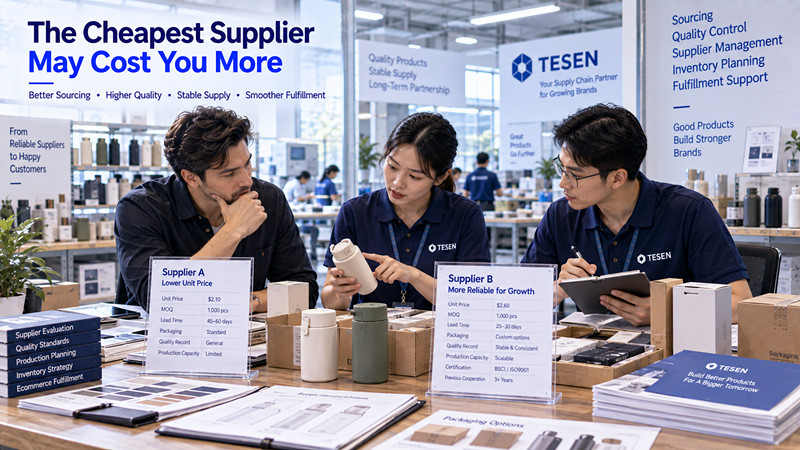
Consider two suppliers.
Supplier A offers the lowest unit price but regularly changes production dates.
Supplier B costs slightly more but maintains stable quality, communicates clearly, and delivers within predictable lead times.
If Supplier A creates repeated stockouts, rework, urgent replenishment, additional inspections, or customer complaints, the initial price advantage can disappear quickly.
The better question is not:
Which supplier gives us the lowest price?
It is:
Which supplier gives us the best combination of cost, reliability, quality, and operational predictability?
For ecommerce brands, supplier selection should support the complete operation — not purchasing alone.
Many supplier costs never appear on the original quotation.
They appear elsewhere in the business.
An unreliable supplier can create costs through:
These costs are harder to calculate than unit price.
That does not make them less real.
This is why supplier performance should be evaluated across the entire ecommerce operation.
A supplier does not only influence purchasing.
Supplier performance eventually affects quality control, inventory availability, fulfillment, and customers.
One useful way to evaluate suppliers is to think beyond the purchase price.
The real cost is closer to:
**Purchase Cost
- Quality Cost
- Inventory Cost
- Operational Cost
- Fulfillment Impact
- Customer Impact**
Not every part of this equation can be measured perfectly.
But ignoring these costs does not make them disappear.
For example, saving $0.30 per unit may appear attractive.
But if that supplier regularly causes production delays that require additional safety stock, the inventory cost may exceed the purchasing savings.
If inconsistent quality requires additional inspections or replacement shipments, the economics change again.
The lowest purchase price and the lowest total operational cost are not necessarily the same thing.
Suppose a supplier quotes a production lead time of 20 days.
But actual production sometimes takes 20 days, sometimes 30, and occasionally 40.
For inventory planning, the problem is not simply that production is slow.
The problem is that it is unpredictable.
A brand cannot confidently determine when to reorder.
To compensate, it may carry additional safety stock.
That ties up more working capital.
If the brand does not hold enough additional inventory, it risks running out of stock.
Now compare that with a supplier that consistently requires 25 days.
The second supplier appears slower on paper.
Operationally, however, it may be easier to manage because the business can plan around a reliable 25-day lead time.
For growing ecommerce brands:
Predictability can be more valuable than theoretical speed.
This is why supplier lead time should be measured by reliability, not just the number written on a quotation.
Reliable production timelines create more reliable replenishment.
Reliable replenishment creates more predictable fulfillment.
A low purchase price can also hide quality costs.
Imagine Supplier A charges $7.00 per unit while Supplier B charges $7.40.
Supplier A looks approximately 5% cheaper.
But what happens if Supplier A produces inconsistent batches?
The brand may need additional inspections.
Some products may require rework.
Others may need replacement.
And if defective units enter inventory and eventually reach customers, the costs expand further:
The original $0.40 saving begins to look very different.
This is why supplier quality management should be considered part of supplier cost evaluation.
Quality problems are significantly easier to manage when they are identified before products enter fulfillment.
Once defective inventory reaches customers, the issue is no longer simply a supplier problem.
It becomes a fulfillment cost and a customer experience problem.
MOQ is another area where unit-price comparisons can become misleading.
A supplier may offer an attractive price — but only if the brand purchases 5,000 units.
Another supplier may charge more per unit but accept 1,000.
Which is cheaper?
It depends on what happens to the inventory.
If the product sells quickly, the larger MOQ may work well.
But if demand is uncertain, the lower unit price can create:
This becomes especially important for brands with many SKUs and variants.
Purchasing large quantities of every product simply to achieve the lowest unit price can create an unhealthy inventory position.
Good ecommerce supplier management therefore connects purchasing decisions with inventory planning.
The objective is not to purchase the cheapest possible inventory.
It is to maintain the right inventory for actual demand and fulfillment requirements.
Supplier communication is difficult to represent in a spreadsheet.
But it becomes extremely valuable when something changes.
Imagine a supplier discovers that production will be delayed.
One supplier tells the brand immediately.
Another waits until the expected completion date.
The production problem may be identical.
The operational consequences are not.
Early information gives the brand options.
It may:
Late information removes those options.
This is why communication quality should be treated as part of supplier reliability.
Good communication does not eliminate problems.
It gives the business more time to manage them.
Most suppliers can perform well when everything goes according to plan.
The real test often comes when something goes wrong.
A material becomes unavailable.
A production batch fails inspection.
Demand suddenly increases.
Packaging needs to change.
A replenishment order becomes urgent.
At these moments, supplier performance becomes much easier to see.
Does the supplier communicate clearly?
Do they acknowledge the problem?
Can they identify alternatives?
Do they take responsibility for corrective action?
Can they give realistic timelines?
A supplier’s ability to manage exceptions can be more valuable than a small difference in product price.
Growing ecommerce businesses rarely operate in perfectly predictable conditions.
Reliable partners become particularly valuable when normal processes stop being normal.
Consider two hypothetical suppliers producing the same product:
| Factor | Supplier A | Supplier B |
|---|---|---|
| Unit price | $7.10 | $7.50 |
| MOQ | 5,000 | 2,000 |
| Quoted lead time | 20 days | 25 days |
| Actual lead time | 20–40 days | 24–27 days |
| Quality consistency | Variable | Stable |
| Communication | Reactive | Proactive |
| Problem handling | Inconsistent | Structured |
Supplier A has the lower visible purchase cost.
Supplier B provides greater operational predictability.
Which structure creates the lower total cost depends on the brand’s demand, inventory requirements, quality risk, working capital, and fulfillment operation.
The extra $0.40 is visible.
The cost of uncertainty is not.
That is exactly why supplier selection becomes more complex as ecommerce brands scale.
Price should remain part of supplier selection.
But it should sit alongside several other metrics.
Does the supplier maintain the agreed product standard across repeated batches?
How close are actual production timelines to what was promised?
Do purchasing requirements match the brand’s actual inventory needs?
Does the supplier provide accurate information early enough for the business to act?
Can the supplier support higher demand without creating instability?
How does the supplier respond when something goes wrong?
Can the brand confidently plan future inventory around the supplier?
Together, these factors provide a much more useful picture of supplier performance than unit price alone.
Supplier decisions made during sourcing eventually influence fulfillment performance.
Consider a few common examples:
Unreliable lead times → uncertain replenishment → stockouts → delayed fulfillment
Inconsistent quality → additional QC → inventory holds → fulfillment delays
High MOQ → excess inventory → higher storage requirements
Poor communication → late production information → reactive inventory decisions
This is why supplier management should not operate independently from inventory and fulfillment.
A fulfillment partner can improve receiving, storage, picking, packing, and shipping.
But fulfillment cannot completely compensate for inventory that arrives late, products that fail quality requirements, or replenishment schedules that constantly change.
For growing Shopify brands, the objective is not simply to find a factory that can manufacture the product.
It is to build a supplier structure that can consistently support fulfillment as order volume grows.
At low order volumes, supplier problems may be manageable manually.
A founder can chase production updates.
A small delay may affect relatively few orders.
A quality issue may involve only a limited number of products.
Scale changes the impact.
More orders require more inventory.
More inventory requires larger or more frequent production.
More production increases exposure to supplier performance.
A one-week delay affecting 50 future orders is one problem.
The same delay affecting thousands of future orders is very different.
As brands grow, supplier management becomes less about purchasing and more about operational risk management.
That is an important shift.
The supplier is no longer simply producing products.
Its performance is influencing whether the brand can maintain inventory availability and fulfill customer orders reliably.
At TESEN, we work with Shopify and DTC brands across product sourcing, supplier management, quality control, inventory planning, warehousing, and ecommerce fulfillment.
Supplier price matters, but it is only one part of the operational decision.
Depending on the project, we may evaluate factors such as:
More importantly, we connect supplier performance with what happens downstream.
If lead times become unstable, inventory planning may need to change.
If quality becomes inconsistent, QC requirements may need to change.
If demand increases, production capacity and replenishment timing may need to be reviewed.
If inventory availability changes, fulfillment planning may also need to adapt.
The objective is not simply to find the cheapest factory.
It is to build a supplier structure that can reliably support inventory availability and ecommerce fulfillment as the brand grows.
This distinction becomes increasingly important as ecommerce brands grow.
A cheap supplier can save money on every purchase order.
A reliable supplier can help protect:
Sometimes the cheapest supplier will also be the best operational choice.
But brands should not assume that from the quotation alone.
The decision should be based on total operational cost, not just unit price.
For Shopify and DTC brands, this becomes increasingly important as supplier performance, inventory planning, quality control, and fulfillment become more closely connected.
Supplier management is ultimately about balancing cost with reliability.
Unit price is easy to compare because it is visible.
Operational risk is harder to compare because much of it appears later.
But growing ecommerce brands need to consider both.
A supplier that consistently delivers the right product, at predictable times, with clear communication can create value far beyond the purchase price.
At TESEN, we help Shopify and DTC brands connect supplier management with quality control, inventory planning, warehousing, and ecommerce fulfillment so supplier decisions can be evaluated in the context of the entire operation.
Because the lowest price on a quotation is only useful when the rest of the business can reliably operate around it.
Ecommerce brands should compare unit price alongside quality consistency, lead-time reliability, MOQ, communication, production capacity, replenishment reliability, and how supplier performance affects inventory and fulfillment.
No. A lower unit price may be offset by additional costs caused by quality problems, production delays, excess inventory, stockouts, rework, additional inspections, or operational workload.
Total supplier cost considers more than purchase price. It may include quality costs, inventory costs, operational workload, fulfillment impact, and other consequences created by supplier performance.
Reliable lead times help brands plan inventory replenishment more accurately. Unpredictable production timelines may require additional safety stock or increase the risk of stockouts and fulfillment disruptions.
Supplier performance affects when inventory becomes available, whether products meet quality requirements, and how accurately replenishment can be planned. Supplier problems can therefore become inventory and fulfillment problems later.
Yes. TESEN can support brands working with their existing suppliers in China. Depending on the agreed service scope, this can include supplier communication and coordination, inventory receiving, quality control, inventory management, warehousing, and ecommerce fulfillment.
TESEN is a China-based Ecommerce Fulfillment & Supply Chain Partner for Shopify and DTC brands.
We connect product sourcing, supplier management, quality control, inventory planning, warehousing, order fulfillment, and international shipping to help growing ecommerce brands build more reliable operations.
Rather than treating sourcing, inventory, and fulfillment as separate activities, TESEN helps brands coordinate them as one connected ecommerce supply chain.
Source Your Products and Start Dropshipping
 IPv6 network supported