
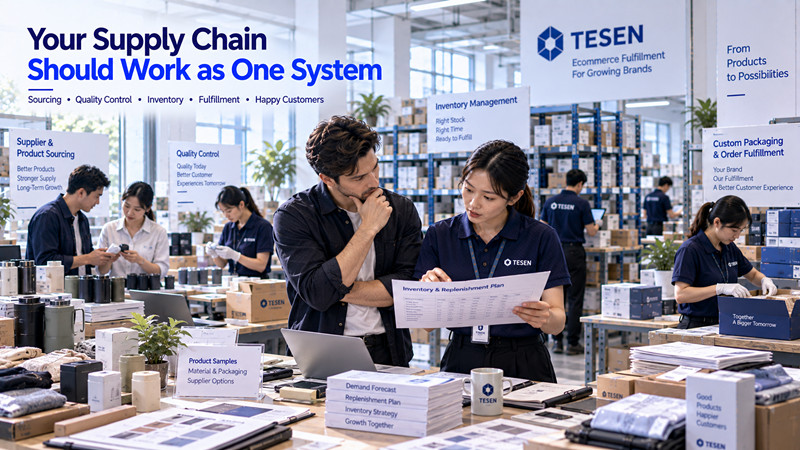
When a Shopify brand is small, supply chain management can be surprisingly simple.
The founder talks directly with the supplier.
Inventory is tracked in a spreadsheet.
Products are sent to a warehouse.
Another provider handles fulfillment.
When something changes, the founder connects the dots manually.
At 10 or 20 orders per day, this can work.
But as the business grows, the same structure often becomes difficult to manage.
More suppliers create more production schedules.
More SKUs create more inventory decisions.
More orders leave less room for stockouts and operational mistakes.
More customers increase the impact when something goes wrong.
At this stage, Shopify supply chain management becomes less about managing individual activities and more about connecting them.
For growing ecommerce brands, sourcing, supplier management, quality control, inventory, and fulfillment increasingly need to operate as parts of the same system.
Because customers do not experience these functions separately.
They experience whether the product is available, whether the quality meets expectations, and whether the order arrives correctly.
Early-stage ecommerce businesses rarely build a complete operational system from the beginning.
Instead, they solve problems as they appear.
Need a product?
Find a supplier.
Need somewhere to store it?
Find a warehouse.
Orders are increasing?
Find a fulfillment provider.
Need better inventory tracking?
Build another spreadsheet.
Each solution addresses an immediate problem.
When the operation is small, the founder often becomes the integration layer.
Information may flow like this:
Supplier → Founder
Warehouse → Founder
Inventory Spreadsheet → Founder
Fulfillment Provider → Founder
This structure can be flexible and relatively simple.
The problem appears when operational complexity begins growing faster than the founder's ability to coordinate it.
A Shopify brand moving from 20 orders per day to 200 is not simply processing ten times more parcels.
The structure behind those orders changes.
The business may now have:
Every additional variable creates another relationship between different parts of the operation.
A supplier delay is no longer only a sourcing problem.
It can become:
Supplier Delay
↓
Late Replenishment
↓
Inventory Shortage
↓
Fulfillment Disruption
↓
Customer Experience Problem
This is why scaling Shopify fulfillment requires more than making each individual provider faster.
It requires better coordination between them.
Product sourcing is often evaluated around:
But each of these decisions eventually affects inventory.
Consider MOQ.
A supplier may offer an attractive unit price when the brand purchases 5,000 units.
But if the SKU sells slowly, that decision can create months of excess inventory.
The brand may then face:
Now consider supplier lead time.
A supplier requiring 45 days to replenish a product creates a very different inventory requirement from one requiring 15 days.
Supplier reliability matters as well.
If production timelines frequently change, the brand may need additional safety stock simply to protect product availability.
This means sourcing cannot be optimized independently from inventory.
Every sourcing decision eventually becomes an inventory decision.
The cheapest sourcing decision does not necessarily create the healthiest inventory position.
Finding a supplier is only the beginning.
Once a product enters regular production, the business needs ongoing information.
For example:
This is where supplier management becomes important.
A brand cannot make reliable inventory decisions using unreliable supplier information.
Production status, supplier lead time, and expected completion dates should inform replenishment decisions before inventory reaches a critical level.
For growing Shopify brands, supplier management therefore becomes part of fulfillment reliability.
The same connection exists between inventory and fulfillment.
A warehouse cannot fulfill inventory that does not exist.
And a fast fulfillment operation cannot compensate for a bestseller being out of stock.
At the same time, carrying more inventory does not automatically solve the problem.
Brands need visibility into:
These factors determine whether fulfillment can remain reliable.
This is why inventory management should not sit between sourcing and fulfillment as an isolated function.
It needs information from both.
A Shopify dashboard may show that a product has 1,000 units in inventory.
But what does that number actually represent?
Some units may already be allocated to customer orders.
Some may be waiting for quality checks.
Some may have packaging problems.
New inventory may already be in production but not yet received.
This means physical inventory and fulfillment-ready inventory are not always the same.
Growing brands should ideally understand:
Available Inventory + Incoming Inventory + Sales Velocity + Supplier Lead Time
rather than looking only at a static warehouse quantity.
Better inventory visibility allows sourcing and fulfillment decisions to be made with the same operational picture.
Quality control creates another important connection across the ecommerce supply chain.
A product quality issue usually begins upstream.
Perhaps:
If the problem is identified early, the brand still has options.
The supplier may be able to correct it.
Affected inventory can be isolated.
Products can potentially be reworked or inspected.
But if the same problem passes through inventory and fulfillment, the customer becomes the person who discovers it.
Then the consequences may include:
From the customer's perspective, it does not matter which supply chain provider caused the problem.
They purchased from the brand.
This is why quality control should connect supplier management with fulfillment rather than operate as an isolated inspection activity.
Internally, a Shopify brand may divide operations into different functions:
Product Sourcing
↓
Supplier Management
↓
Quality Control
↓
Inventory
↓
Fulfillment
↓
International Shipping
Operationally, these may involve different teams, providers, systems, and locations.
Customers do not experience those boundaries.
They experience one outcome.
The product is available — or it is not.
The product meets expectations — or it does not.
The order arrives as expected — or it does not.
This creates an important principle for ecommerce supply chain management:
The business can divide operations into functions. The customer still experiences them as one system.
That is why coordination matters.
Connecting the supply chain does not necessarily mean putting every activity under one company.
It means having enough visibility to understand how a decision in one area affects another.
A growing Shopify brand should be able to answer questions such as:
When these answers exist in separate WhatsApp conversations, spreadsheets, supplier updates, and warehouse systems, decision-making becomes slower.
When information is better connected, the business can act earlier.
That is the real value of operational visibility.
It does not simply tell the brand what happened.
It helps the brand understand what needs attention next.
Consider a Shopify bestseller whose sales suddenly accelerate.
Sales increase.
↓
The warehouse eventually reports low inventory.
↓
The brand contacts the supplier.
↓
The supplier confirms a four-week production lead time.
↓
The brand realizes current inventory may run out.
↓
Fulfillment becomes disrupted.
Sales velocity increases.
↓
Inventory coverage decreases.
↓
Supplier lead time is considered.
↓
Replenishment begins earlier.
↓
Production progress is monitored.
↓
New inventory arrives before existing stock is exhausted.
The difference is not necessarily better software.
It is better coordination between sourcing, supplier management, inventory, and fulfillment.
This distinction is important.
A connected ecommerce supply chain does not mean a brand must replace every existing provider.
A Shopify brand may already have:
There may be no reason to change them.
Instead, the objective should be to connect those providers more effectively with inventory and fulfillment.
For example, an ecommerce fulfillment partner can work with existing Chinese suppliers while coordinating:
The objective is not vendor consolidation for its own sake.
It is information and operational coordination.
There is no universal order-volume threshold.
A brand processing 100 daily orders with three simple SKUs may have less operational complexity than a brand processing 30 orders across 50 SKUs and several suppliers.
Order volume matters.
But operational structure matters too.
Brands should consider improving supply chain coordination when they begin experiencing patterns such as:
These are often signs that individual functions may be working, but the overall system is not.
The phrase ecommerce supply chain partner can mean many things.
The value should not simply come from offering more services.
A useful partner should help connect decisions.
Supplier decisions should consider not only price but also MOQ, lead time, quality, reliability, and future inventory requirements.
Production progress and potential problems should be visible early enough for the brand to respond.
Quality issues should be identified before they become fulfillment and customer problems whenever possible.
Current stock, sales velocity, incoming production, and supplier lead times should support replenishment decisions.
The fulfillment operation should understand inventory availability, packaging requirements, and exceptions that could affect customer orders.
Shipping options should connect with order requirements, destination markets, parcel characteristics, and customer expectations.
The objective is not to create more operational layers.
It is to reduce the gaps between existing ones.
TESEN's core commercial focus is ecommerce fulfillment for Shopify and DTC brands.
For brands sourcing products from China, however, fulfillment performance often depends on what happens before inventory reaches the warehouse.
Depending on the brand's requirements, TESEN can support:
The value is not simply that these capabilities are available through one partner.
The greater value comes from connecting the information between them.
If a supplier delays production, inventory planning can be reviewed.
If sales accelerate, replenishment can be discussed earlier.
If a quality issue appears, affected inventory can be identified before normal fulfillment.
If inventory accumulates too quickly, future purchasing decisions can be reconsidered.
This is how separate supply chain activities begin working together to support more reliable ecommerce fulfillment.
Some founders worry that integrating supply chain operations means becoming more dependent on one partner.
A well-structured operating model should instead provide better visibility.
The brand should understand what is happening across:
The brand should continue to own important commercial decisions.
The role of the supply chain and fulfillment partner is to provide better information, coordination, and execution around those decisions.
Integration should reduce operational blindness — not create it.
This is one of the biggest operational changes that happens as ecommerce brands mature.
Early-stage founders often manage providers.
They contact the supplier.
Then the QC provider.
Then the warehouse.
Then the fulfillment provider.
Growing brands need to start managing the system connecting those providers and decisions.
The question changes from:
Is each provider doing its job?
to:
Is the entire operation working together to support customer demand and reliable fulfillment?
That is the foundation of effective Shopify supply chain management.
A growing Shopify brand does not need sourcing, supplier management, quality control, inventory, and fulfillment to exist as isolated functions.
It needs them to work together.
Sourcing decisions affect inventory.
Supplier performance affects quality and replenishment.
Inventory decisions affect fulfillment.
Quality control protects customer experience.
And operational visibility connects the entire system.
For Shopify and DTC brands sourcing from China, better coordination can reduce the gaps between factories, inventory, warehouse operations, and customer orders.
At TESEN, we connect these China-side supply chain activities around our core ecommerce fulfillment operation.
Because scaling ecommerce is not simply about adding more suppliers, inventory, warehouses, or fulfillment capacity.
It is about making the entire system work better together.
Shopify supply chain management involves coordinating the operational activities behind a Shopify business, including sourcing, suppliers, product quality, inventory, warehousing, fulfillment, and delivery. As brands grow, the main challenge is ensuring decisions across these functions remain connected.
Sourcing decisions affect supplier lead times, MOQ, product quality, production reliability, and inventory availability. Connecting sourcing information with fulfillment helps brands make better replenishment decisions and identify upstream risks earlier.
Inventory management determines whether fulfillment-ready products are available when customer orders arrive. Poor inventory planning can create stockouts or excess inventory even when the warehouse itself is operating efficiently.
No. Integration does not require one company to perform every activity. Brands can retain existing suppliers and specialized providers while improving the information and coordination between sourcing, QC, inventory, and fulfillment.
Common signals include repeated stockouts, excess inventory, late supplier updates, recurring quality problems, increasing SKU complexity, multiple suppliers, custom packaging requirements, and founders spending too much time manually coordinating providers.
Yes, depending on the provider. TESEN can work with existing Chinese suppliers and coordinate agreed activities such as production follow-up, incoming inventory, QC, packaging, storage, and Shopify fulfillment.
The exact scope depends on the brand, but useful capabilities may include supplier coordination, production visibility, quality control, inventory management, storage, custom packaging, fulfillment, and international shipping. More importantly, information between these activities should support better operational decisions.
TESEN is a China-based Ecommerce Supply Chain & Fulfillment Partner for Shopify and DTC brands.
Our core commercial focus is ecommerce fulfillment, supported by product sourcing, supplier management, quality control, inventory planning and storage, custom packaging, and international shipping.
By connecting upstream supplier and inventory operations with fulfillment execution, TESEN helps growing ecommerce brands build more coordinated China-side operations.
Source Your Products and Start Dropshipping
 IPv6 network supported