
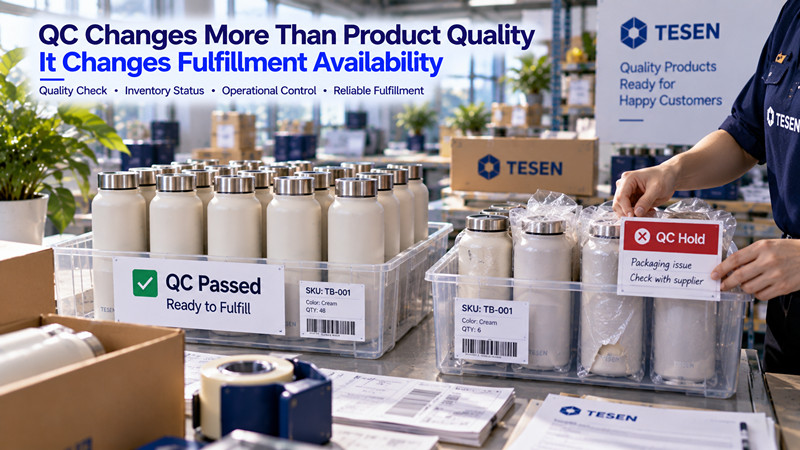
Quality control and ecommerce fulfillment are often managed as two separate activities.
One team checks products.
Another team manages inventory and fulfills customer orders.
On paper, that structure seems reasonable.
But for growing ecommerce brands, the separation can create an important operational gap.
A quality inspection does not create value simply because a defect was found.
The real value comes from what happens after the inspection.
Can the affected products enter available inventory?
Should the batch be held?
Does anything need to be reworked?
Which SKUs are affected?
Does the brand still have enough fulfillment-ready inventory to cover upcoming orders?
Does replenishment timing now need to change?
These are no longer just quality-control questions.
They are inventory and fulfillment decisions.
For Shopify and DTC brands, quality control should therefore be connected directly with ecommerce fulfillment planning.
A QC result should not end with “Pass” or “Fail.” It should tell the operation what inventory can actually be fulfilled.
Many ecommerce businesses build their operations one function at a time.
First, they find suppliers.
Then they introduce product inspection.
Later, they add warehousing and fulfillment.
The resulting process may look like:
Supplier → QC Provider → Warehouse → Fulfillment → Customer
Each provider may perform its individual job correctly.
The problem is that information does not always move through the operation as effectively as the products themselves.
Imagine an inspection identifies a problem.
The QC team knows there is an issue.
But does the fulfillment operation know:
If those answers are unclear, quality control becomes an isolated inspection activity.
For growing ecommerce brands, that is not enough.
QC information needs to become operational information.
One of the most important concepts in ecommerce fulfillment is the difference between:
Inventory on hand
and
Inventory available for fulfillment
They are not necessarily the same.
Imagine a fulfillment center physically holds:
Physical inventory is:
1,300 units
But fulfillment-ready inventory is:
1,000 units
The remaining 300 units physically exist.
They simply cannot yet be treated as normal available stock.
This distinction matters because inventory availability influences:
If a Shopify brand makes decisions using only physical inventory quantity, its view of inventory may be inaccurate from a fulfillment perspective.
As ecommerce brands scale, inventory visibility needs to show more than quantity.
Products can exist in several operational states:
Received
↓
Under Inspection
↓
Approved
↓
Fulfillment-Ready
But not every product follows that path immediately.
Some inventory may instead become:
On Hold
Awaiting Rework
Damaged
Unavailable
This creates an important operational principle:
Inventory should become available for fulfillment based on its actual status, not simply because it has physically arrived at the warehouse.
That is where quality control and inventory management intersect.
QC determines whether inventory meets the agreed requirements.
Inventory management records what is actually usable.
Fulfillment uses the approved inventory to process customer orders.
Consider a new production batch of 2,000 units.
During inspection, part of the batch shows a packaging problem.
The inspection itself answers one question:
Is there a quality issue?
Fulfillment planning needs several more answers.
Not every unit received into the warehouse should automatically become available for customer orders.
If the issue is still being evaluated, affected inventory may need to remain unavailable.
Some issues require a temporary hold until the brand decides what action to take.
Without a clear inventory status, questionable products can accidentally enter normal order processing.
Some packaging, labeling, or minor assembly problems may be correctable.
If so, the operation needs to understand:
A quality problem may affect:
This distinction matters because each scenario creates a different inventory impact.
If part of the incoming batch cannot be released, the brand may suddenly have less usable stock than expected.
That can immediately change replenishment and customer-order decisions.
This is why a QC report should not be the end of the process.
The inspection result needs to change the inventory status when appropriate.
Consider another example.
A supplier sends 5,000 units.
The warehouse receives all 5,000.
The inventory record initially shows:
5,000 units
QC then identifies 600 units that require further review.
If the business continues treating all 5,000 units as available, it may:
The quality issue itself may be manageable.
The larger operational problem comes from continuing to make fulfillment decisions using the wrong inventory number.
After the QC decision, the operation needs to distinguish:
Physical Inventory: 5,000
from:
Fulfillment-Ready Inventory: 4,400
That 600-unit difference is operationally significant.
Quality control also connects directly with inventory replenishment.
Suppose a Shopify brand normally maintains four weeks of stock coverage.
A new batch arrives.
But 15% of the products fail inspection or need additional review.
Expected inventory coverage immediately becomes shorter.
The brand may now need to:
Nothing changed about customer demand.
What changed was the amount of inventory actually available to support that demand.
This is why replenishment planning should use fulfillment-ready inventory, rather than physical warehouse quantity alone.
A quality problem upstream can immediately change the inventory decision downstream.
There is an important timing difference between identifying a problem before fulfillment and identifying it after fulfillment.
The brand still has operational choices.
It may:
The customer may become the person who discovers the problem.
The operation may then face:
For ecommerce brands, the purpose of connecting QC with fulfillment is therefore not simply to inspect more products.
It is to create an operational checkpoint before questionable inventory reaches normal order processing.
As ecommerce brands grow, it can be tempting to assume that more orders require more inspection.
More SKUs.
More suppliers.
More production.
Therefore, more QC.
But inspection volume alone does not solve the coordination problem.
The more important questions are:
The objective is not maximum inspection.
The objective is better operational control.
A simple product with a reliable supplier may require a different QC approach from a complex product, a new supplier, or a product with a history of quality problems.
QC should therefore be appropriate to product and supplier risk while remaining connected with inventory and fulfillment.
QC should not only protect the warehouse from defective inventory.
It should also help improve future production.
If the same issue repeatedly appears in incoming batches, the long-term solution should not simply be:
Inspect more.
The information should feed back into supplier management.
For example:
Quality Issue Identified
↓
Affected Inventory Isolated
↓
Fulfillment Availability Updated
↓
Supplier Receives Feedback
↓
Corrective Action
↓
Future Production Reviewed
This creates a more useful operating loop.
The warehouse handles the immediate inventory issue.
Supplier management addresses the upstream cause.
The objective is to reduce the probability that the same problem continues entering the fulfillment operation.
For growing Shopify brands, four areas should work together.
Suppliers should understand agreed product, packaging, labeling, and other relevant requirements.
Repeated problems should feed back into supplier management.
QC should identify more than whether a problem exists.
Where practical, it should identify:
That makes the information operationally useful.
Inventory records should reflect whether products are:
The fulfillment operation needs to know exactly which inventory can be picked for customer orders.
When these four areas are connected, the brand gets a much more accurate picture of operational risk.
When brands evaluate an ecommerce fulfillment partner, common questions include:
What is your pick-and-pack fee?
How quickly can you process orders?
How much inventory can you store?
Those questions matter.
But brands with meaningful QC requirements should also ask:
These questions help reveal whether quality control and fulfillment actually work together operationally.
A fulfillment partner does not necessarily need to perform every type of specialized inspection.
But it should have a clear process for preventing questionable inventory from entering normal fulfillment when a problem is identified.
Imagine a Shopify brand expects a new production batch of 3,000 units for a fast-moving SKU.
The products arrive at the fulfillment center.
During the agreed inspection, a packaging problem is identified on part of the batch.
In a disconnected operation:
3,000 units received
↓
Inventory record shows 3,000 available
↓
QC issue discussed separately
↓
Fulfillment continues using the original inventory number
That creates unnecessary risk.
In a connected model:
Incoming Batch Identified
↓
Questionable Inventory Placed on Hold
↓
Approved Inventory Released
↓
Fulfillment-Ready Quantity Updated
↓
Replenishment Coverage Reviewed
↓
Supplier Receives Quality Feedback
The inspection did more than identify a packaging problem.
It changed the fulfillment plan.
That is the connection growing ecommerce brands need.
The value of supplier management should not be measured only by how many defects are found.
A more useful question is whether QC helps the business make better decisions.
Did it prevent unsuitable inventory from entering fulfillment?
Did the business understand its real available inventory?
Was questionable stock separated correctly?
Did replenishment timing change when usable inventory decreased?
Did the supplier receive useful feedback?
Did the business reduce the risk of the same issue happening again?
When QC contributes to these decisions, it becomes more than an inspection function.
It becomes part of reliable ecommerce fulfillment.
At TESEN, our core commercial focus is ecommerce fulfillment for Shopify and DTC brands.
For brands sourcing products from China, however, fulfillment reliability can depend heavily on the condition of inventory entering the fulfillment operation.
That is why quality-control information can be connected with supplier management, inventory, warehousing, and fulfillment.
Depending on the product and agreed service scope, this can include:
The purpose is not to add unnecessary inspection.
It is to prevent a manageable quality problem from becoming an inventory problem, a fulfillment problem, and eventually a customer problem.
A useful QC result should help answer three operational questions:
What can we fulfill now?
What inventory requires action?
What needs to change upstream?
That is when quality control becomes part of fulfillment planning.
QC can change which inventory is actually usable for customer orders. Connecting inspection results with inventory and fulfillment helps prevent questionable products from entering normal order processing and gives the brand a more accurate view of available stock.
Fulfillment-ready inventory is stock that has completed the required receiving, QC, labeling, packaging, or other agreed preparation and can be used for customer orders. Physical inventory inside a warehouse is not necessarily fulfillment-ready inventory.
If part of an incoming batch is placed on hold or rejected, usable inventory may be lower than expected. This can reduce stock coverage and may require the brand to replenish earlier.
Ask how questionable inventory is identified and separated, how QC results affect available stock, whether agreed product or packaging checks can be supported, how rework is handled, and how quality issues are communicated.
Depending on the provider and agreed inspection scope, yes. TESEN can receive products from existing suppliers and support agreed QC activities before inventory enters normal fulfillment.
Not necessarily. Inspection requirements should depend on the product, supplier history, quality risk, previous issues, and the brand's requirements. Sampling may be appropriate in some situations, while other products may require more extensive inspection.
Yes, depending on the agreed workflow. Questionable inventory can be identified and kept separate from approved fulfillment-ready inventory while the issue is reviewed or corrective action is coordinated.
Quality control and fulfillment should not operate as separate worlds.
QC determines whether products meet agreed requirements.
Inventory management records what is actually available.
Fulfillment turns approved inventory into customer orders.
Supplier management helps address the causes of recurring problems upstream.
For growing ecommerce brands, the more useful operating model is:
Supplier Quality → Quality Control → Inventory Status → Fulfillment Availability → Customer Experience
The question after a quality inspection should therefore not simply be:
Did the product pass?
It should also be:
What does this mean for inventory and fulfillment?
That is the point where quality control stops being an isolated inspection activity and becomes part of a more reliable ecommerce fulfillment operation.
TESEN is a China-based Ecommerce Supply Chain & Fulfillment Partner for Shopify and DTC brands.
Our core commercial focus is ecommerce fulfillment, supported by product sourcing, supplier management, quality control, inventory planning and storage, custom packaging, and international shipping.
By connecting quality-control results with inventory status and fulfillment execution, TESEN helps growing ecommerce brands identify operational risks before they affect customer orders.
Source Your Products and Start Dropshipping
 IPv6 network supported