Product sourcing is often treated as a purchasing decision.
Find the right product.
Compare suppliers.
Negotiate the price.
Confirm the order.
Then send the products to a warehouse and let fulfillment take over.
That sequence looks logical.
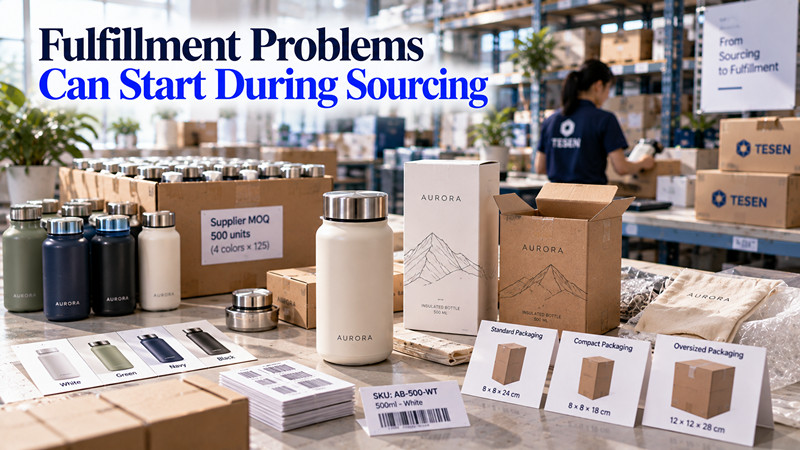
But for growing ecommerce brands, many of the decisions that determine fulfillment performance are actually made before production begins.
A slightly different product size can change packaging and shipping requirements.
A high MOQ can create months of excess inventory.
An unreliable supplier lead time can create stockouts.
Too many product variants can increase SKU complexity.
Inconsistent specifications can prevent incoming inventory from becoming fulfillment-ready.
Packaging designed without ecommerce fulfillment in mind can create additional work on every customer order.
This means product sourcing and fulfillment are not separate operational worlds.
The sourcing decision creates conditions that the fulfillment operation later inherits.
For Shopify and DTC brands, the question should therefore not only be:
Can we source this product at the right price?
It should also be:
Can this sourcing decision support reliable inventory and ecommerce fulfillment as we grow?
Unit price is one of the easiest sourcing metrics to compare.
Supplier A quotes $6.80.
Supplier B quotes $7.10.
Supplier A appears cheaper.
But the purchase price tells only part of the story.
Product sourcing decisions can influence:
A decision that saves money during manufacturing can create additional cost later in the operation.
This does not mean brands should ignore product cost.
It means sourcing decisions should be evaluated in the context of the complete ecommerce operation.
Product specifications are usually finalized during sourcing and product development.
But those specifications continue through inventory and fulfillment.
Consider something as basic as product dimensions.
A small change in size can affect:
Now consider product variation.
A product may initially look simple.
But add:
and the operation may suddenly need to manage dozens of inventory combinations.
The commercial reason for offering more choices may be completely valid.
But every additional variant can affect:
Supplier Production → QC → SKU Identification → Inventory Accuracy → Picking Accuracy
This is why product development should consider more than whether a supplier can manufacture the specification.
A second question matters:
How will this product specification behave inside the fulfillment operation?
Minimum order quantity is another sourcing decision with direct downstream consequences.
Suppliers often offer lower unit prices when brands purchase larger quantities.
For example:
Supplier A: MOQ 5,000 units at a lower price
Supplier B: MOQ 1,500 units at a slightly higher price
Which is the better offer?
There is no universal answer.
If the product has strong, predictable demand, 5,000 units may be commercially sensible.
But if demand is uncertain, the larger MOQ can create:
The risk becomes larger when the brand carries many SKUs.
A large MOQ for one bestseller may be manageable.
Large MOQs across 30 different SKUs can create a very different inventory position.
This is why the sourcing question should not simply be:
What MOQ gives us the lowest unit price?
It should also be:
What MOQ creates the inventory position this product actually needs?
At that point, product sourcing has already become part of inventory planning.
Production lead time often appears on a quotation as a simple number:
20 days.
30 days.
45 days.
Operationally, however, that number determines how early the brand needs to make replenishment decisions.
Imagine two SKUs sell at exactly the same rate.
SKU A: replenishment takes 2 weeks
SKU B: replenishment takes 6 weeks
They should not necessarily use the same inventory strategy.
The six-week product may require:
But the length of the lead time is only part of the issue.
Consider two suppliers.
Supplier A quotes 25 days but actual production varies between 25 and 50 days.
Supplier B usually requires 32 days and is consistently close to that figure.
Supplier B appears slower on paper.
But it may be much easier to plan inventory around.
For growing ecommerce brands, sourcing should therefore evaluate:
Production Lead Time + Lead-Time Reliability
because reliable ecommerce fulfillment depends on replenishment being sufficiently predictable.
A warehouse cannot solve an inventory shortage caused by a production order that started too late.
Suppose a warehouse receives 2,000 units.
Does that mean the brand has 2,000 units available for customer orders?
Not necessarily.
If the batch contains:
some inventory may need to be:
This creates an important distinction:
Inventory Received ≠ Inventory Available for Fulfillment
A supplier that consistently produces according to agreed specifications creates more predictable fulfillment-ready inventory.
An inconsistent supplier creates additional decisions after every batch arrives.
This is where supplier management, quality control, inventory, and fulfillment become connected.
The sourcing decision determines which supplier the operation will need to manage later.
Packaging is sometimes treated as something to solve after the product has already been manufactured.
For ecommerce brands, that can be too late.
Packaging can affect:
Consider a fragile product with attractive retail packaging that provides insufficient protection during ecommerce delivery.
The packaging may look excellent.
But the fulfillment team may need to add protective material to every customer order.
The brand now pays twice:
First: for the original product packaging.
Second: for additional fulfillment materials and packing work.
This does not necessarily mean the original packaging was a bad commercial decision.
But its fulfillment consequences should have been understood earlier.
During sourcing, brands should therefore ask:
Will this packaging work efficiently through storage, fulfillment, and customer delivery?
For DTC brands, packaging is both a branding decision and an operational decision.
Some sourcing decisions look small until inventory reaches the warehouse.
Barcodes are a good example.
Suppose products arrive from several suppliers using inconsistent SKU references.
The warehouse may need additional work to:
Likewise, visually similar colors or sizes without clear product identification can increase picking complexity later.
The cost does not necessarily appear on the supplier quotation.
It appears as additional warehouse work.
For growing brands, product identification should therefore be considered before mass production.
Questions include:
Good SKU design makes inventory easier to manage.
Poor SKU design creates recurring operational friction.
Many fulfillment costs originate before inventory ever reaches the warehouse.
For example:
Supplier does not apply consistent labels
→ Additional warehouse labeling
Product packaging is not suitable for direct fulfillment
→ Additional repacking or protective materials
Multiple suppliers use different SKU references
→ More receiving and inventory-identification work
Products need assembly after arriving
→ Additional kitting
Product dimensions increase unnecessarily
→ Higher storage or dimensional shipping weight
None of these decisions is automatically wrong.
There may be good commercial reasons for them.
The important point is:
The fulfillment consequence should be visible before the sourcing decision becomes difficult to change.
Otherwise, the brand discovers the true operational cost only after production has already been completed.
Consider a Shopify brand sourcing a new apparel product.
The supplier offers an attractive price at an MOQ of 3,000 units.
The product has:
That creates:
15 SKU combinations
If the order is divided evenly, each variation receives 200 units.
That looks balanced from a purchasing perspective.
Customer demand, however, is unlikely to be evenly distributed.
Medium and Large in popular colors may sell quickly.
Other combinations may sell much more slowly.
The result could be:
High Total Inventory
but at the same time:
Stockouts on the SKUs customers actually want
From the warehouse perspective, there may still be substantial inventory.
From the customer's perspective, the desired product is unavailable.
The fulfillment operation did not create this problem.
The underlying decision was made earlier through:
MOQ + SKU Structure + Demand Assumptions
This is why product sourcing should consider how inventory will actually behave after production.
As brands grow, another problem often appears.
The sourcing team knows:
The fulfillment operation knows:
If these two sets of information remain disconnected, operational decisions become less accurate.
A better relationship looks like:
Sourcing Decision → Supplier → QC → Inventory → Fulfillment
Information should travel with the product.
If packaging changes during sourcing, fulfillment should know.
If supplier lead time increases, inventory planning should know.
If QC reduces usable inventory, fulfillment availability should change.
If a SKU begins selling faster than expected, sourcing and replenishment should know earlier.
The objective is not simply more communication.
It is better operational decision-making.
Before a purchase order becomes difficult to change, brands should consider several areas.
Ask:
Ask:
Ask:
Ask:
Ask:
Ask:
Ask whether the product requires:
These questions help identify fulfillment complexity while there is still time to change the sourcing decision.
This is one of the most important principles in this article.
Some fulfillment problems cannot be efficiently solved inside a warehouse.
If SKU structure is unnecessarily complex:
Faster picking cannot remove the SKU complexity.
If MOQ creates excessive inventory:
More warehouse space cannot fix the purchasing decision.
If supplier lead times are unpredictable:
Faster pick-and-pack cannot prevent a stockout.
If packaging is poorly designed for ecommerce delivery:
The fulfillment operation may need to compensate on every order.
If supplier specifications are inconsistent:
Warehouse staff may need to repeatedly inspect, separate, or rework inventory.
The earlier these issues are identified, the more options the brand has.
That is why product sourcing is not simply about acquiring products.
For growing ecommerce brands, it is also one of the earliest stages of fulfillment planning.
Early-stage brands can often absorb inefficient sourcing decisions.
The founder manually solves a problem.
Warehouse staff relabel a few products.
Inventory exceptions are handled individually.
As the brand grows, the same inefficiency starts multiplying across:
A packaging issue affecting 50 units is one thing.
A packaging issue repeated across thousands of units and customer orders is very different.
This is why product sourcing for a growing ecommerce brand should not be evaluated only on whether the supplier can manufacture the product.
The sourcing structure should also support the operation the brand is trying to build.
Scale amplifies operational design.
Good sourcing decisions become easier to fulfill at scale.
Poor sourcing decisions become increasingly expensive to compensate for.
When choosing sourcing support in China, brands should not evaluate only whether a provider can find a supplier or negotiate a price.
Useful questions include:
For growing brands, sourcing becomes more valuable when upstream decisions are made with downstream consequences in mind.
TESEN's core commercial focus is ecommerce fulfillment for Shopify and DTC brands.
Product sourcing sits upstream from that fulfillment operation.
Depending on the brand's requirements, TESEN can support areas including:
The objective is not to make every sourcing decision based only on fulfillment.
Product quality, brand positioning, supplier capability, purchase cost, and other commercial considerations still matter.
The objective is to make downstream consequences visible before production decisions become expensive to change.
For example:
If packaging creates unnecessary fulfillment work, it may be possible to adjust it before mass production.
If MOQ creates excessive inventory exposure, purchasing quantities can be reconsidered.
If supplier lead time creates replenishment risk, inventory planning can reflect that earlier.
If product consistency becomes a concern, QC requirements can be defined before affected inventory enters normal fulfillment.
If several suppliers use different SKU references, identification can be standardized before products reach the warehouse.
This creates a more connected operating model:
Product Sourcing → Supplier Management → QC → Inventory → Ecommerce Fulfillment
rather than treating sourcing and fulfillment as unrelated services.
Product sourcing determines factors such as product specifications, SKU structure, MOQ, supplier lead time, quality consistency, packaging, and labeling. These decisions can later affect inventory, storage, picking, packing, replenishment, and fulfillment costs.
Yes. Supplier capability and pricing remain important, but brands should also understand whether the supplier's MOQ, lead time, quality consistency, packaging, and product-identification processes will support the planned fulfillment operation.
Yes, depending on the provider. TESEN can work with existing suppliers and coordinate agreed activities such as production follow-up, incoming inventory, QC, packaging, SKU identification, storage, and ecommerce fulfillment.
No. MOQ should be evaluated against demand, unit economics, supplier capability, inventory requirements, and purchasing frequency. A lower MOQ can reduce inventory exposure, but it may also increase unit cost or require more frequent replenishment.
Relevant information can include SKU references, product specifications, packaging requirements, barcodes, production timelines, incoming quantities, QC requirements, and any special handling, kitting, or labeling requirements.
Yes. Packaging can affect storage space, protective-material requirements, packing time, dimensional shipping weight, and product damage risk. Reviewing packaging before mass production can help identify unnecessary downstream work.
Coordination becomes particularly useful when a brand has multiple suppliers, growing SKU complexity, custom packaging, meaningful inventory investment, regular replenishment, or product requirements that affect receiving and fulfillment.
Product sourcing decisions travel much further through an ecommerce operation than the original purchase order.
Specifications affect complexity.
MOQ affects inventory.
Lead time affects replenishment.
Supplier consistency affects fulfillment-ready inventory.
Packaging affects storage and order processing.
For growing Shopify and DTC brands, those consequences should be considered before production begins.
Because reliable fulfillment is not created only after products arrive at the warehouse.
In many cases:
The best time to solve a fulfillment problem is while the product is still being sourced.
TESEN is a China-based Ecommerce Supply Chain & Fulfillment Partner for Shopify and DTC brands.
Our core commercial focus is ecommerce fulfillment, supported by product sourcing, supplier management, quality control, inventory planning and storage, custom packaging, and international shipping.
By connecting upstream sourcing decisions with downstream inventory and fulfillment requirements, TESEN helps growing ecommerce brands identify operational consequences earlier and build more reliable China-side operations.
Source Your Products and Start Dropshipping
 IPv6 network supported