
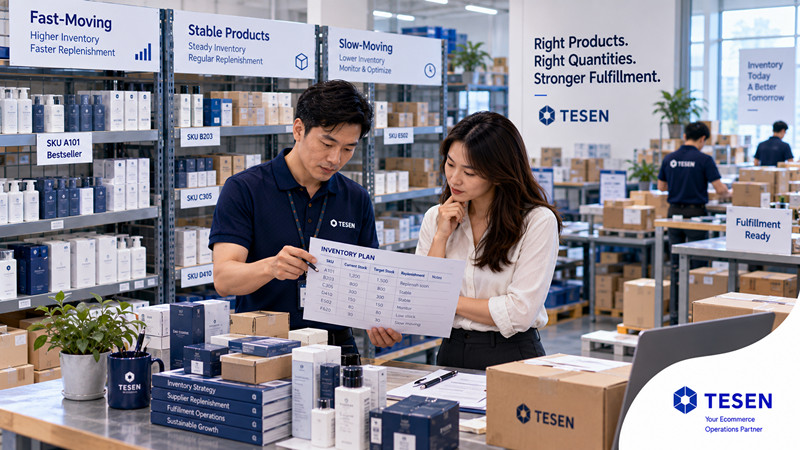
As ecommerce brands grow, inventory storage often appears to be a simple capacity problem.
More products require more shelves.
More orders require more inventory.
More inventory requires a larger warehouse.
But warehouse capacity is only one part of the problem.
A Shopify brand can have thousands of units in storage and still experience stockouts, excess inventory, poor replenishment decisions, and fulfillment delays.
The real question is not:
How much inventory can we store?
It is:
What inventory should we store, how much should we hold, and how does that inventory support fulfillment?
For growing ecommerce brands, inventory storage should be treated as part of fulfillment strategy—not as a separate warehouse decision.
Ecommerce inventory storage is the process of receiving, organizing, holding, tracking, and preparing products before they are fulfilled for customer orders.
But good inventory storage involves more than placing cartons on warehouse shelves.
A scalable storage operation also needs to manage:
This is why inventory storage, inventory management, and ecommerce fulfillment are closely connected.
A warehouse stores physical products.
An effective ecommerce storage system helps the business understand what those products are doing.
When brands run short of warehouse capacity, moving to a larger warehouse may be necessary.
But a bigger facility does not automatically solve inventory problems.
Consider a brand with 20 SKUs.
Five products generate most of its sales.
Another five sell steadily.
The remaining products move slowly.
If the business purchases large quantities of every SKU simply because storage space is available, it may create:
At the same time, the fastest-moving SKUs can still sell out.
The brand now has more inventory and more warehouse space—but fulfillment availability has not improved.
That is why storage strategy should begin with inventory behavior, not warehouse size.
One of the most common inventory mistakes is treating every SKU the same.
Different products have different operating characteristics.
For example:
These products should probably not have the same inventory policy.
SKU A may require:
SKU B may require:
A good ecommerce inventory storage strategy therefore considers each SKU separately.
There is no universal inventory level that works for every ecommerce brand.
Storage decisions should consider several variables.
How quickly is the SKU selling?
Fast-moving products consume available inventory faster and generally need closer replenishment monitoring.
How long does it take the supplier to manufacture and deliver replacement inventory?
Longer lead times may require inventory to be ordered earlier.
Is demand relatively predictable, or does it change significantly between weeks or months?
Higher variability can require additional buffer inventory.
Some products may sell heavily during specific seasons, promotions, or holidays.
Storage plans should reflect expected demand rather than historical averages alone.
Can the supplier replenish small quantities frequently, or does the brand need to purchase larger batches?
Expensive products or bulky products may create higher capital and warehouse-storage costs.
The goal is not maximum stock.
It is appropriate inventory.
Storage and fulfillment are often discussed as separate warehouse services.
Operationally, they are closely connected.
Consider what happens when an important SKU runs out:
Low Inventory
↓
Orders Cannot Be Fulfilled
↓
Processing Delays or Backorders
↓
Customer Experience Is Affected
Now consider the opposite:
Excess Inventory
↓
Products Remain in Storage
↓
Storage Costs Increase
↓
Working Capital Is Tied Up
↓
The Brand Has Less Flexibility to Replenish Faster-Moving Products
Both problems begin with inventory decisions.
That is why ecommerce brands should evaluate storage based on how well it supports fulfillment—not simply how cheaply the warehouse can hold cartons.
Knowing that inventory is “in the warehouse” is not enough.
Growing brands should understand inventory at SKU level.
Useful information includes:
This matters because physical inventory does not always equal fulfillment-ready inventory.
For example:
A warehouse may contain 1,000 units.
But:
The brand may physically own 1,000 units.
But actual available inventory may be significantly lower.
Storage visibility helps prevent decisions based on misleading stock numbers.
A good storage strategy should not stop at current warehouse inventory.
It should also answer:
When does the next inventory need to arrive?
This requires connecting warehouse stock with:
Suppose a bestseller has 300 units remaining.
That number alone does not tell you whether inventory is healthy.
If the product sells 10 units per day and can be replenished in 7 days, there may be limited risk.
If it sells 30 units per day and the supplier requires 30 days to replenish, the situation is very different.
Storage data becomes much more useful when it supports replenishment decisions.
Inventory storage is relatively simple when a brand has:
Growth changes that.
A scaling Shopify brand may eventually manage:
At that stage, warehouse storage becomes an inventory-management system.
Every SKU does not need the same amount of space.
Every product does not need the same replenishment policy.
And every item sitting in a warehouse is not necessarily contributing equally to the business.
Brands often focus on shipping cost and pick-and-pack fees.
Slow-moving inventory creates another cost.
Products that remain in storage for long periods can generate:
The problem becomes more significant when the same warehouse also holds high-demand inventory.
A useful storage strategy should therefore identify inventory that is not moving.
Brands may then decide to:
Warehousing should provide visibility into these decisions—not simply hide slow-moving products on shelves.
When comparing ecommerce storage providers, price per cubic meter or pallet is only one factor.
Growing brands should evaluate several operational capabilities.
Storage requirements change over time.
Brands should be able to expand without being forced to maintain unnecessarily large inventory commitments.
The warehouse should organize and track inventory at product and SKU level.
Stored products should connect directly with picking, packing, and order fulfillment.
Brands should understand:
The business should understand what stock is available and what requires attention.
Warehouse inventory should ideally connect with supplier lead times and incoming stock.
Incoming quantities should be checked and recorded accurately before inventory becomes available.
The brand should know how damaged, defective, incorrectly labeled, or unidentified stock is managed.
These questions reveal much more about an ecommerce storage provider than warehouse size alone.
For brands sourcing from China, another decision is where inventory should be stored.
Some brands send all inventory directly to local-market warehouses.
Others keep part of their inventory in China and replenish markets as needed.
There is no single correct structure.
The best model depends on:
China-side storage can be particularly useful when products come from multiple Chinese suppliers and need to be:
For some brands, it can provide more flexibility before inventory is committed to a specific overseas market.
Growing ecommerce brands often source different products from different factories.
Without coordination, inventory can become fragmented.
Supplier A completes production this week.
Supplier B finishes next week.
Supplier C has a packaging delay.
A China-based storage and fulfillment partner can potentially receive products from multiple suppliers and consolidate inventory into one operational location.
This can support:
The value is not simply having warehouse space.
It is reducing operational fragmentation between suppliers and fulfillment.
Imagine a Shopify brand with ten SKUs.
Two products generate most of its sales.
Four products sell steadily.
Four products move slowly.
The brand decides to purchase three months of inventory for every SKU.
On paper, it appears well stocked.
Operationally, however, the inventory position may be unhealthy.
The fast-moving SKUs could still run out before replenishment arrives.
Meanwhile, cash remains tied up in the slower products.
A better strategy would classify the SKUs according to sales behavior.
Hold deeper inventory and monitor replenishment earlier.
Maintain moderate stock based on normal sales velocity.
Reduce purchasing and monitor long-term storage risk.
Total inventory could actually decrease.
Yet product availability and fulfillment reliability could improve.
That is the difference between storing inventory and managing inventory.
Growing brands should review their inventory storage model when they begin experiencing:
These are signs that the existing storage model may no longer support the business effectively.
TESEN treats inventory storage as part of the ecommerce fulfillment workflow rather than as an isolated warehouse service.
For Shopify and DTC brands sourcing from China, our support can include:
This means brands can connect what happens before inventory arrives with what happens after a customer places an order.
The objective is not to maximize warehouse inventory.
It is to maintain enough inventory to support demand while keeping the operation visible, flexible, and fulfillment-ready.
These terms are often used interchangeably.
But for ecommerce brands, there is a useful distinction.
Warehousing usually refers to the physical facility and handling of goods.
Ecommerce inventory storage includes the broader operational management of inventory inside that facility.
That may involve:
For growing brands, this operational layer matters more than simply renting warehouse space.
Scaling ecommerce fulfillment does not begin with finding a bigger warehouse.
It begins with making better inventory decisions.
Growing Shopify brands need storage systems that support:
The goal of ecommerce inventory storage is not to hold as much stock as possible.
It is to hold the right products, in the right quantities, at the right time, ready for fulfillment.
At TESEN, we help Shopify and DTC brands connect supplier management, inventory storage, quality control, replenishment, warehousing, and ecommerce fulfillment through one China-based workflow.
Because good storage does more than hold inventory.
It helps make fulfillment more predictable.
Look beyond warehouse space and storage rates. Important factors include SKU-level inventory visibility, receiving accuracy, flexible storage capacity, fulfillment integration, replenishment support, transparent storage fees, and exception management.
They do not always have to, but combining them can reduce operational fragmentation. When the same operation manages receiving, inventory, and fulfillment, inventory availability and order processing can be easier to coordinate.
There is no universal quantity. Inventory levels should consider sales velocity, supplier lead time, seasonality, demand variability, replenishment frequency, and the importance of each SKU.
It can be useful for brands sourcing from Chinese suppliers, particularly when products need consolidation, QC, custom packaging, SKU management, or fulfillment before international shipping.
Storage alone cannot prevent stockouts. Better inventory visibility combined with sales velocity, incoming inventory, and supplier lead-time information can help brands make replenishment decisions earlier.
Storage pricing depends on the agreed service model, inventory volume, storage period, and any additional receiving or handling requirements. Brands should review the specific storage terms for their project rather than comparing warehouse rates alone.
Yes. TESEN can coordinate inventory arriving from multiple Chinese suppliers, then support agreed receiving, QC, SKU management, storage, custom packaging, and ecommerce fulfillment.
TESEN is a China-based Ecommerce Supply Chain & Fulfillment Partner for Shopify and DTC brands.
We support product sourcing, supplier management, quality control, inventory receiving and storage, inventory management, custom packaging, Shopify order fulfillment, and international shipping.
Our fulfillment-led model connects upstream supplier and inventory operations with warehouse execution so growing ecommerce brands can maintain more reliable fulfillment as they scale.
Source Your Products and Start Dropshipping
 IPv6 network supported