
When growing ecommerce brands experience inventory problems, one of the most common reactions is simple:
Buy more stock.
More inventory appears to provide more protection against stockouts, supplier delays, and unexpected demand.
Sometimes it does.
But increasing inventory without improving visibility can create a different set of problems.
A Shopify brand may own thousands of units and still struggle to answer basic operational questions:
For growing ecommerce brands, the challenge is therefore not simply how much inventory you own.
It is how clearly you understand the inventory available across your operation.
That is why inventory visibility becomes increasingly important as fulfillment scales.
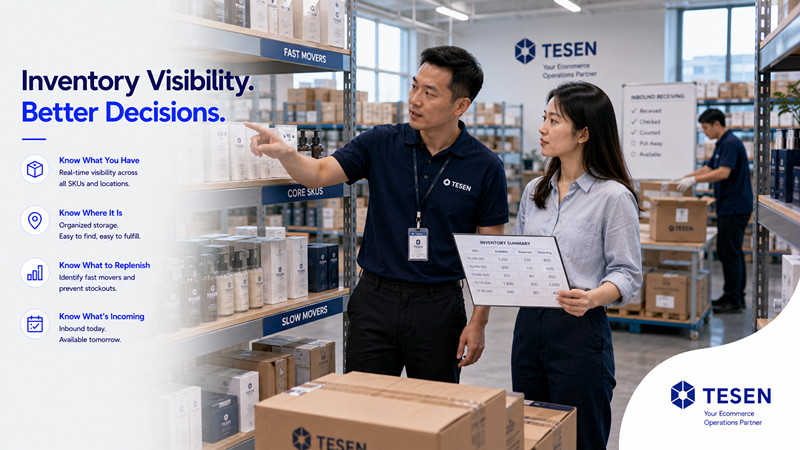
Inventory visibility is the ability to understand the status, quantity, and location of inventory across different stages of an ecommerce supply chain.
Depending on the business model, inventory may exist in several different states:
Production inventory
Products currently being manufactured by suppliers.
Incoming inventory
Products completed by suppliers but not yet received by the fulfillment warehouse.
Inventory under inspection
Products that have arrived but are still undergoing quantity or quality checks.
Available inventory
Sellable products ready for customer orders.
Allocated inventory
Products already assigned to existing orders.
Unusable or defective inventory
Products physically present but unavailable for fulfillment.
Understanding these differences is important.
A warehouse may physically contain 1,000 units.
But that does not necessarily mean there are 1,000 units available to fulfill Shopify orders.
This distinction between physical inventory and available inventory becomes increasingly important as brands scale.
Increasing inventory can provide useful safety stock.
But it cannot solve poor inventory information.
Consider a Shopify brand with several products.
The company increases purchasing because it wants to reduce stockouts.
Total inventory rises.
However:
The business now has more inventory investment, but not necessarily better product availability.
This creates an important distinction:
Inventory volume tells you how much stock you own. Inventory visibility tells you what you can actually do with that stock.
For fulfillment operations, the second question is often more useful.
Fulfillment depends on inventory being available when an order enters the system.
If inventory information is inaccurate, several problems can occur.
Shopify may show an item as available even though the physical inventory has already been allocated, damaged, or exhausted.
A customer places an order.
The fulfillment team then discovers that the SKU cannot be shipped.
Products may exist physically but still be waiting for receiving, inspection, labeling, or another warehouse process.
Without visibility into that status, the brand may expect orders to ship before inventory is actually fulfillment-ready.
If teams cannot clearly see current inventory, incoming production, and sales velocity, purchasing decisions become reactive.
Replenishment may begin too late.
The opposite problem can also occur.
A brand may purchase additional inventory because it does not have a clear view of stock already in production or transit.
This increases working capital tied up in inventory and can create additional storage requirements.
For Shopify brands, inventory visibility is therefore not simply an inventory-management issue.
It is part of fulfillment reliability.
Shopify provides merchants with important inventory information.
But for brands sourcing products internationally, the ecommerce platform may represent only one part of the inventory picture.
Before products become available for Shopify fulfillment, they may still be:
Supplier → Production → QC → Inbound → Warehouse Receiving → Available Inventory → Fulfillment
This upstream inventory matters.
Suppose Shopify shows that only 200 units remain.
Whether this represents an immediate stock risk depends on additional information:
Without those answers, the inventory number alone provides limited decision-making value.
This is why growing Shopify brands need visibility beyond a single stock count.
One of the most valuable uses of inventory visibility is better replenishment.
A simple replenishment decision can be understood through three variables:
Available Inventory + Incoming Inventory + Expected Demand
But supplier lead time also matters.
Consider two products with exactly 500 units available.
Product A sells 10 units per day.
Product B sells 40 units per day.
The stock quantity is identical.
The inventory risk is completely different.
Now add supplier production time.
If Product B requires several weeks to replenish, the brand may need to act long before inventory reaches a visibly low level.
Better inventory visibility allows teams to combine:
That creates a much stronger basis for purchasing decisions.
Inventory protects product availability.
But inventory also consumes cash.
Buying too little can create stockouts.
Buying too much can create:
For growing DTC brands, the goal should therefore not simply be maximum inventory.
The goal is having enough inventory, in the right products, at the right time.
Visibility helps brands make that balance more intelligently.
Instead of asking:
“Should we buy more inventory?”
Teams can ask:
“Which SKUs actually need replenishment, how much incoming inventory do we already have, and when will it become available for fulfillment?”
That is a much more useful operational question.
Inventory can be relatively easy to manage when a brand has:
Now imagine the same brand grows to:
Inventory is no longer a single number.
Products are constantly moving between suppliers, QC, inbound receiving, storage, allocation, fulfillment, and replenishment.
At this stage, spreadsheet-based or fragmented inventory information can become increasingly difficult to manage.
The brand needs to know not only what it owns, but what is happening to it.
That is the operational value of inventory visibility.
For brands sourcing from China, inventory visibility starts before products enter the warehouse.
Supplier information affects inventory decisions.
For example:
A supplier reports that production will be delayed.
That information affects the expected replenishment date.
The replenishment delay changes projected inventory availability.
Inventory availability may affect which orders can be fulfilled.
The brand may then need to adjust purchasing or customer expectations.
The operational chain looks like this:
Supplier Status → Replenishment → Inventory Availability → Fulfillment → Customer Experience
This is why TESEN treats supplier management, inventory planning, and fulfillment as connected functions rather than completely separate activities.
Consider a Shopify brand sourcing several SKUs from different Chinese suppliers.
Sales are increasing, and the founder responds by purchasing more inventory.
Yet stockouts continue occurring.
The problem may not be total inventory volume.
After reviewing the operation, the team may discover:
The business does not necessarily need to keep increasing total stock.
It needs better visibility across the inventory lifecycle.
Once supplier production, incoming inventory, warehouse stock, and fulfillment demand are viewed together, replenishment decisions can become much more precise.
At TESEN, inventory management is connected with our broader ecommerce fulfillment operation.
For Shopify and DTC brands sourcing from China, this can include:
The objective is not simply to store more products.
It is to help brands understand the inventory moving between suppliers and fulfillment so they can make better operational decisions.
For brands working with multiple Chinese suppliers, this can also reduce fragmentation.
Instead of separately managing supplier updates, incoming products, warehouse stock, and fulfillment, these stages can be coordinated through one China-side operation.
These terms are closely related, but they are not identical.
Inventory visibility is about information:
Where is the inventory?
How much is available?
What is incoming?
What is allocated?
What is unavailable?
Inventory management is about decisions and actions:
How much should we order?
When should we replenish?
Where should inventory be stored?
Which SKUs need safety stock?
How should inventory be allocated?
Good inventory management depends on good inventory visibility.
Without reliable information, even sophisticated planning can produce poor decisions.
When evaluating a fulfillment partner, don't look only at warehouse capacity or shipping rates.
Ask how inventory information is managed.
Important questions include:
These questions reveal much more about operational capability than warehouse size alone.
More inventory can reduce some supply risks.
But more inventory without visibility can also create more complexity, higher costs, and poor replenishment decisions.
For growing Shopify brands, the objective should not simply be to own more stock.
It should be to understand:
What inventory is available.
Where it is.
What is incoming.
What needs replenishment.
And what is ready for fulfillment.
At TESEN, we help Shopify and DTC brands connect supplier management, inventory planning, warehousing, and ecommerce fulfillment through one China-based operational workflow.
Because reliable fulfillment doesn't begin with more inventory.
It begins with knowing exactly what inventory you have—and what is happening to it.
At minimum, brands should be able to understand available inventory by SKU, incoming inventory, receiving discrepancies, unavailable or defective stock, and inventory allocated to fulfillment. The exact level of visibility depends on the fulfillment provider and system.
Yes, although it cannot eliminate every stockout. Combining available stock, sales velocity, supplier lead times, and incoming inventory gives brands more time to make replenishment decisions before inventory is exhausted.
A China-based fulfillment partner can receive products from multiple suppliers, verify incoming quantities, coordinate agreed quality checks, consolidate inventory, store products by SKU, and use that inventory for Shopify order fulfillment.
Inventory storage is the physical warehousing of products. Inventory management involves tracking stock, monitoring availability, coordinating replenishment, managing SKU movements, and using inventory information to support fulfillment decisions.
Not necessarily. Safety stock can reduce some risks, but the appropriate inventory level depends on sales velocity, supplier lead times, replenishment time, seasonality, and demand variability. Increasing stock without understanding these factors can create unnecessary overstock.
TESEN supports receiving, inventory storage, SKU management, supplier coordination, quality control, replenishment coordination, Shopify order fulfillment, and international shipping, helping brands connect China-side inventory with their fulfillment operations.
TESEN is a China-based Ecommerce Supply Chain & Fulfillment Partner for Shopify and DTC brands.
We support brands with product sourcing, supplier management, quality control, inventory storage and management, custom packaging, Shopify order fulfillment, and international shipping.
Our fulfillment-led model connects supplier and inventory operations with order fulfillment, helping growing ecommerce brands manage their China-side supply chain through a more coordinated workflow.
Source Your Products and Start Dropshipping
 IPv6 network supported