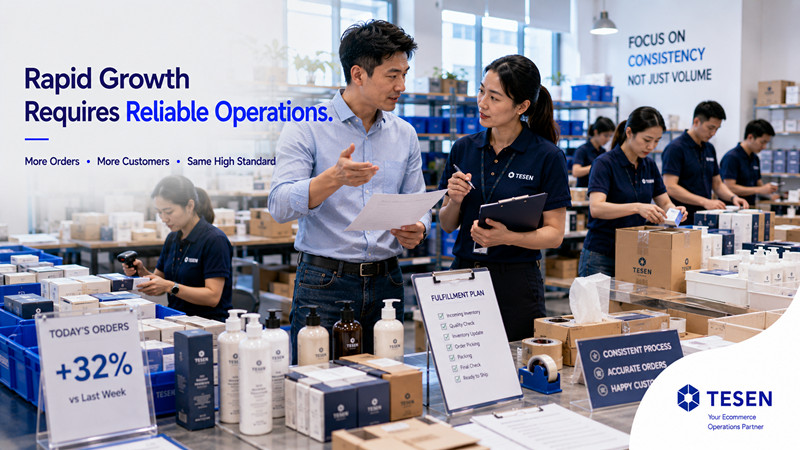
Fast growth gets attention.
A sudden increase in sales.
More website traffic.
More customers.
For ecommerce founders, these are exciting signs.
But rapid growth alone does not create a strong Shopify brand.
Growth creates demand.
Operations determine whether the business can consistently fulfill that demand.
At TESEN, we've observed that growing ecommerce brands often become more vulnerable—not less—when sales increase faster than their operational systems can support.
Supplier communication becomes harder.
Inventory becomes less predictable.
Quality problems affect more customers.
Fulfillment pressure increases.
The strongest brands are therefore not simply the ones that grow fastest.
They are the ones that can continue delivering a reliable customer experience while they grow.
Operational consistency means being able to deliver reliable performance across the systems that support customer orders.
For Shopify and DTC brands, this may include:
Consistency does not mean that nothing ever goes wrong.
Every ecommerce operation will experience exceptions.
The important difference is whether the business has systems capable of identifying problems, responding effectively, and maintaining predictable performance over time.
Operational weaknesses are often difficult to notice at low order volume.
Consider a store processing 20 orders per day.
One inventory error affects only a small number of customers.
A supplier delay may be manageable.
A few quality problems can be handled individually.
Now imagine the same business processing 200 orders per day.
The same operational weaknesses become much more expensive.
A small inventory discrepancy may affect dozens of orders.
A production delay may cause a major stockout.
A quality problem in one batch may reach many customers.
Growth therefore does not necessarily create operational problems.
It amplifies the ones that already exist.
Customers rarely understand what happens behind an ecommerce operation.
They do not see:
They simply experience the final outcome.
Was the product available?
Was the correct item shipped?
Did the order leave on time?
Was tracking clear?
Did the product arrive as expected?
For customers, these outcomes define fulfillment quality.
This makes fulfillment consistency one of the most visible results of strong ecommerce operations.
Reliable fulfillment is rarely created by the warehouse alone.
Several upstream systems determine whether orders can be processed consistently.
Suppliers influence when inventory becomes available.
Late production updates can create:
Better communication gives brands more time to respond before customer orders are affected.
Fulfillment depends on having the correct SKU available when an order arrives.
Brands need visibility into:
Consistent fulfillment becomes difficult when inventory decisions are reactive.
Physical inventory is not always sellable inventory.
Products may contain:
If quality problems are discovered only after fulfillment, the result can be refunds, replacement shipments, and customer complaints.
Once inventory is ready, warehouse operations must remain consistent.
This includes:
Accuracy becomes increasingly important as daily order volume grows.
Brands also need to understand where problems are happening.
Is production delayed?
Is inventory low?
Is stock waiting for QC?
Is an order waiting for processing?
Visibility allows teams to identify exceptions before they become larger fulfillment problems.
| Rapid Growth Without Operational Consistency | Growth Supported by Consistent Fulfillment |
|---|---|
| Frequent stockouts | Better inventory availability |
| Reactive supplier communication | More predictable production |
| Inconsistent product quality | Clear QC standards |
| Increasing fulfillment exceptions | Stable processing workflows |
| Higher customer support workload | More predictable customer experience |
| Teams constantly solving emergencies | Teams able to plan ahead |
The goal is not to slow growth.
It is to ensure operations are capable of supporting it.
Shipping speed matters.
But speed without consistency creates uncertainty.
Imagine two customer experiences.
Delivery usually takes 5–6 days.
Tracking updates consistently.
Orders are accurate.
Products arrive in good condition.
Delivery sometimes takes 3 days.
Sometimes 9 days.
Tracking is inconsistent.
Occasional stockouts delay orders.
Which experience is easier for customers to trust?
For many ecommerce brands, predictability becomes just as important as pure speed.
Customers want confidence that the brand will deliver what it promised.
Consider a Shopify brand that experiences rapid sales growth after a successful marketing campaign.
Demand rises quickly.
But supplier communication and inventory planning remain largely unchanged.
Soon:
The brand may initially believe the problem is warehouse capacity.
But the root cause may be broader operational inconsistency.
Once supplier coordination, replenishment planning, quality control, and fulfillment workflows become more structured:
The marketing campaign did not need to change.
The operational foundation did.
TESEN works with Shopify and DTC brands that source products from China and fulfill orders internationally.
Our fulfillment-led model can connect:
The objective is not simply to process more parcels.
It is to reduce the operational gaps between suppliers, inventory, warehouse execution, and customer fulfillment.
For brands managing multiple suppliers or growing SKU complexity, this coordination can become increasingly important.
Brands should not wait until fulfillment problems become serious.
Useful warning signs include:
These signals suggest that growth is beginning to place pressure on the existing system.
Improving operational consistency before order volume increases further is generally easier than repairing customer experience after problems become widespread.
Operational inconsistency does not only affect customers.
It also creates hidden costs.
Examples include:
These costs may not appear in a simple fulfillment quotation.
But they influence the real economics of an ecommerce business.
More consistent operations can therefore protect both customer experience and operational efficiency.
Marketing strategies can be copied.
Products can be copied.
Competitors can often use similar advertising platforms and shipping providers.
Operational consistency is harder to replicate.
It is built through:
These capabilities develop over time.
And customers experience the result as reliability.
That reliability can become an important part of brand trust.
Rapid growth creates opportunity.
Operational consistency determines whether a Shopify brand can turn that opportunity into sustainable growth.
Reliable supplier coordination helps keep production predictable.
Better inventory planning protects product availability.
Quality control protects sellable inventory.
Fulfillment operations turn those preparations into customer orders.
At TESEN, we help Shopify and DTC brands connect these China-side operations around ecommerce fulfillment.
Because customers do not experience your growth strategy.
They experience whether your business delivers consistently every time they order.
First identify where the problem begins. Review supplier production, inventory availability, QC, warehouse processing, tracking, and shipping performance rather than assuming every issue is caused by the warehouse.
A fulfillment partner can help standardize receiving, inventory management, picking, packing, tracking, and shipping. Partners that also support supplier coordination, QC, and inventory planning may provide additional visibility into upstream issues that affect fulfillment.
Both matter, but faster transit does not solve stockouts, quality problems, order errors, or inconsistent processing. A predictable end-to-end fulfillment experience is often more valuable than optimizing transit speed alone.
Warning signs include recurring stockouts, delayed processing, increasing customer inquiries, inventory discrepancies, supplier coordination problems, or difficulty managing increasing SKU and order volume.
Reliable product availability, accurate orders, stable delivery expectations, and clear tracking can strengthen customer confidence, which can support repeat purchasing and long-term brand trust.
TESEN supports supplier management, QC, inventory planning, warehousing, custom packaging, order fulfillment, and international shipping, helping Shopify and DTC brands coordinate the China-side operations that affect fulfillment reliability.
TESEN is a China-based Ecommerce Supply Chain & Fulfillment Partner for Shopify and DTC brands.
We support product sourcing, supplier management, quality control, inventory planning, warehousing, custom packaging, Shopify order fulfillment, and international shipping.
Our commercial focus is ecommerce fulfillment, supported by the upstream supplier, quality, and inventory operations that help brands maintain more predictable fulfillment as they scale.
Source Your Products and Start Dropshipping
 IPv6 network supported