When Shopify brands experience fulfillment problems, the warehouse often receives the blame.
Orders ship late.
Products become unavailable.
Inventory runs short.
Customers start asking when their orders will arrive.
But not every fulfillment problem begins inside the fulfillment center.
For brands sourcing products from China, some of the most important factors affecting fulfillment performance occur much earlier—during supplier production, replenishment, quality control, and inventory planning.
At TESEN, we often see a simple operational connection:
Supplier reliability affects inventory availability. Inventory availability affects fulfillment reliability.
This is why supplier management should not be treated as completely separate from ecommerce fulfillment.
Fulfillment is commonly described as the process of receiving, storing, picking, packing, and shipping customer orders.
That definition is correct from a warehouse perspective.
But from an ecommerce operations perspective, successful fulfillment depends on what happens before inventory reaches the warehouse.
A fulfillment center needs:
Suppliers influence every one of these conditions.
A highly efficient warehouse cannot fulfill an SKU that has not been produced.
It cannot prevent a stockout caused by late replenishment.
And it cannot fully compensate for recurring production defects that were not identified upstream.
The warehouse executes fulfillment.
But suppliers help determine whether the inventory required for fulfillment is actually ready.
The connection becomes clearer when we look at specific operational problems.
Suppose a supplier normally requires 15 days to complete production.
A Shopify brand plans replenishment around that lead time.
But production unexpectedly requires another seven days, and the supplier communicates the delay too late.
Existing inventory continues selling.
Stock falls below the required level.
Eventually:
Production delay → Late replenishment → Stockout → Unfulfilled orders
To the customer, this looks like a fulfillment problem.
The warehouse has no inventory to ship.
But the original problem began during production.
Better supplier communication gives brands more time to adjust purchasing, inventory, or fulfillment decisions before the problem reaches customers.
Inventory planning should not be based only on sales data.
Supplier lead times matter just as much.
A brand needs to understand:
For example, 500 units may look like healthy inventory.
But if the product sells 30 units per day and replenishment requires several weeks, the brand may already be approaching a stockout risk.
This is why supplier management and inventory planning need to work together.
The earlier a brand understands production status, the earlier it can make replenishment decisions.
A supplier does not need to communicate only when production is complete.
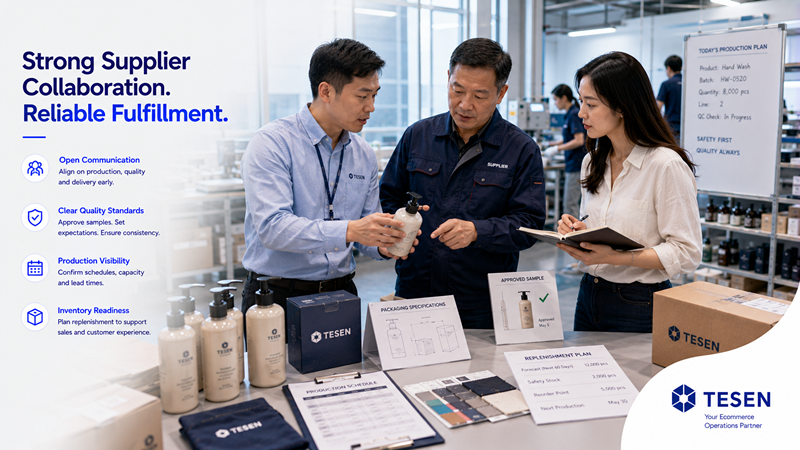
Useful production visibility may include:
Without these updates, ecommerce teams are often forced to plan inventory based on assumptions.
That creates reactive operations.
When supplier communication is structured, brands gain a clearer picture of incoming inventory and can coordinate fulfillment more effectively.
Another important connection between suppliers and fulfillment is product quality.
Imagine that 1,000 units arrive at a warehouse.
The inventory record initially shows:
1,000 units received.
But after inspection, some units have unacceptable defects.
The amount of physical inventory and sellable inventory is therefore different.
This matters for fulfillment.
If quality problems are not identified early, defective products can enter available stock and eventually reach customers.
The result may include:
Supplier quality management therefore directly affects the reliability of the inventory entering fulfillment.
For DTC brands, fulfillment involves more than the product itself.
Products may require:
If these requirements are not communicated clearly during production, the warehouse may receive products that are not ready for fulfillment.
This creates additional handling, repacking, relabeling, or delays.
Clear coordination between the brand, supplier, and fulfillment partner helps ensure products arrive in a format that can move efficiently into inventory and fulfillment.
Supplier communication can be relatively informal when a brand has:
Scaling changes the equation.
A growing Shopify brand may eventually manage:
5 suppliers × 30 SKUs × different lead times × different packaging × changing demand
At that point, supplier management becomes a system rather than a series of individual conversations.
Small communication failures become more expensive because they affect larger order volumes.
A two-day production delay matters much more when hundreds of customer orders depend on that inventory.
This is why supplier relationships become increasingly important as ecommerce operations scale.
There is also an important distinction between having a good supplier relationship and having a structured supplier management process.
A good relationship creates trust.
Supplier management turns that relationship into operational consistency.
Effective supplier management may include:
Brands need both.
Good relationships make communication easier.
Good processes make the results more predictable.
Consider a growing Shopify brand working with several suppliers in China.
The fulfillment warehouse is processing available orders accurately, but stockouts continue occurring.
The initial assumption might be that inventory management at the warehouse is the problem.
A closer review may show something different.
Supplier production dates frequently change.
Production updates arrive late.
Replenishment decisions are therefore made using incomplete information.
By creating clearer production follow-up and connecting supplier updates with inventory planning, the brand gains earlier visibility into incoming stock.
This allows the team to identify potential shortages before available inventory is exhausted.
The warehouse itself does not need to become faster.
The information reaching the warehouse and inventory team becomes better.
That is the operational value of stronger supplier management.
For brands sourcing from China, managing suppliers and fulfillment through completely separate providers can create communication gaps.
The supplier knows production.
The warehouse knows inventory.
The brand sits between them trying to connect the information.
TESEN's model is designed to reduce that fragmentation.
Depending on the brand's requirements, we can support:
The purpose is not simply to add more services around fulfillment.
It is to connect the upstream operations that determine whether fulfillment has the right inventory available at the right time.
No.
This is an important point for Shopify brands evaluating a China-based fulfillment partner.
Working with a fulfillment and supply chain partner does not necessarily mean replacing suppliers that already work well.
A brand may already have:
In this situation, the fulfillment partner can potentially work with those existing suppliers instead.
The objective is coordination—not unnecessary supplier replacement.
This can include receiving products from multiple factories, coordinating production information, conducting agreed QC, consolidating inventory, and fulfilling customer orders from one operation.
For growing brands, this is often more practical than rebuilding an established supplier network.
When evaluating a fulfillment partner that also offers supplier management, brands should ask practical questions.
A partner should not require sourcing everything through its own supplier network if the brand already has reliable factories.
Production visibility becomes important when inventory planning depends on incoming stock.
Brands should understand how quality requirements are communicated and how inspections are performed.
Production updates become much more valuable when they help inform replenishment decisions.
This can simplify inventory and fulfillment for brands with increasingly complex supplier networks.
The brand should know how delays, quality issues, packaging problems, or other exceptions will be reported.
These capabilities help distinguish simple purchasing assistance from genuine supplier management.
A fulfillment center is an important part of ecommerce operations.
But it cannot operate independently from everything upstream.
Supplier performance affects production.
Production affects replenishment.
Replenishment affects inventory.
Inventory affects fulfillment.
Fulfillment affects customer experience.
For Shopify brands sourcing from China, stronger supplier relationships can therefore create a meaningful operational advantage.
Not because relationships eliminate every problem.
They don't.
But better communication and coordination give brands more time and better information to manage problems before customers experience them.
Reliable Shopify fulfillment begins before an order reaches the warehouse.
It begins with suppliers that understand requirements, communicate production status, maintain quality standards, and coordinate replenishment effectively.
As brands scale, managing these relationships becomes increasingly connected with inventory and fulfillment performance.
At TESEN, we help Shopify and DTC brands connect supplier management, quality control, inventory planning, warehousing, and ecommerce fulfillment through one China-based operational workflow.
Because reliable fulfillment requires more than an efficient warehouse.
It requires reliable inventory—and reliable inventory begins upstream.
Supplier management affects production schedules, replenishment timing, product quality, packaging readiness, and inventory availability. Problems in these areas can eventually create stockouts or fulfillment delays.
It can reduce the risk. Earlier production updates give brands more time to adjust replenishment and inventory decisions before available stock runs out. However, stockouts also depend on demand forecasting, lead times, and inventory strategy.
Yes, depending on the provider. TESEN can coordinate with existing Chinese suppliers rather than requiring brands to replace established factories, including production follow-up, receiving, QC, inventory, and fulfillment.
Ask whether they can work with existing suppliers, follow production schedules, coordinate QC, manage incoming inventory from multiple factories, support replenishment, and report supplier delays or quality problems clearly.
Traditional fulfillment normally focuses on receiving, storage, pick-and-pack, and shipping. Supplier management occurs upstream, but connecting it with fulfillment can improve inventory availability and operational visibility for brands sourcing internationally.
TESEN can support supplier communication, production follow-up, quality control, inventory coordination, warehousing, custom packaging, order fulfillment, and international shipping as part of a connected China-based ecommerce supply chain.
TESEN is a China-based Ecommerce Supply Chain & Fulfillment Partner for Shopify and DTC brands.
We support product sourcing, existing supplier management, quality control, inventory planning, warehousing, custom packaging, ecommerce fulfillment, and international shipping.
Our fulfillment-led approach connects the upstream China-side operations that determine product availability and fulfillment reliability, helping brands manage suppliers, inventory, and order fulfillment through a more coordinated workflow.
Source Your Products and Start Dropshipping
 IPv6 network supported