Many ecommerce brands treat quality control as a defensive activity.
Something to use when defects appear.
Something to strengthen after return rates increase.
Something to review when customers start complaining.
But growing Shopify brands eventually learn that quality control serves a much bigger purpose.
It protects the consistency required for sustainable growth.
At TESEN, we've found that quality control is not simply about identifying defective products.
It is about preventing operational problems before they damage customer trust, fulfillment efficiency, and brand reputation.
For growing ecommerce businesses, quality control is not only an inspection cost.
It is part of the growth infrastructure behind the brand.
A small quality problem can appear manageable at low order volume.
One defective product.
One customer complaint.
One replacement shipment.
But scale changes the impact.
Suppose a product has a 2% defect issue.
At 50 orders per month, the problem may affect only a small number of customers.
At 5,000 orders per month, the same quality inconsistency can affect many more buyers.
The problem has not necessarily become technically worse.
The business impact has.
Quality issues can create:
This is why growing brands need stronger quality systems before higher order volume makes small inconsistencies expensive.
Customers do not see production lines, supplier discussions, or inspection reports.
They experience the product.
That product becomes part of how they judge the brand.
A customer who orders the same SKU twice expects the experience to remain consistent.
They expect:
When production quality varies between batches, customers may experience the same SKU as two different products.
That inconsistency is especially damaging for DTC brands trying to build recognition and repeat purchasing.
Quality control therefore protects more than individual units.
It helps protect brand consistency across production cycles.
Fulfillment is often judged by warehouse execution:
Was the correct SKU picked?
Was the parcel packed correctly?
Did the order ship on time?
These remain important.
But fulfillment quality also depends on the inventory entering the warehouse.
A fulfillment team can accurately pick and pack a defective product.
Operationally, the order may have been processed correctly.
From the customer's perspective, the fulfillment experience still failed.
This is why quality control needs to happen before defective products become available inventory.
The operational chain looks like this:
Supplier → Quality Control → Sellable Inventory → Fulfillment → Customer
When QC fails upstream, the problem eventually reaches fulfillment and customer service.
A defective item has a product cost.
But that is rarely the complete business cost.
Consider what may happen after a quality issue reaches a customer:
Customer complaint → Support review → Refund or replacement → New fulfillment order → Additional shipping
A single quality issue can create multiple downstream expenses.
Depending on the situation, there may also be:
This is why comparing quality-control expense only with product cost can be misleading.
The more useful comparison is:
Prevention Cost vs Total Failure Cost
For growing ecommerce brands, preventing avoidable defects before fulfillment can often be more efficient than solving them after delivery.
Early-stage brands can sometimes manage quality informally.
The founder approves a sample.
The supplier receives feedback.
Problems are discussed through messages.
This can work while the business has:
Growth creates complexity.
A larger Shopify brand may manage:
At this point, verbal expectations are no longer enough.
The business needs clearer quality standards.
These may include:
Structured quality standards reduce interpretation between the brand, supplier, and fulfillment team.
One of the biggest mistakes in ecommerce QC is treating inspection as the entire quality system.
Inspection is important.
But inspection happens after decisions have already been made.
A stronger quality process may begin earlier.
Does the factory have appropriate production capability?
Can it maintain stable quality across repeat orders?
Does the approved sample clearly define what production should match?
Have materials, colors, specifications, packaging, and labels been confirmed?
Does the received production batch meet the agreed requirements?
Is the product ready to enter sellable inventory?
The earlier quality expectations are clarified, the less pressure there is on final inspection to catch every possible problem.
Inventory planning usually focuses on quantities.
But quantity alone does not tell the whole story.
Suppose a warehouse receives 2,000 units.
The physical stock count is 2,000.
After QC, 120 units are found to have unacceptable defects.
The actual fulfillment-ready stock is:
1,880 units
This difference affects:
If defective inventory is not separated clearly, the brand may believe it has more sellable stock than it actually does.
Quality control therefore supports inventory accuracy as well as customer experience.
Quality problems create work throughout the fulfillment system.
Examples include:
When products arrive consistently and meet agreed requirements, fulfillment becomes easier to standardize.
The warehouse can process inventory with fewer exceptions.
This is important as order volume grows.
Scalable fulfillment depends not only on faster picking and packing.
It also depends on receiving inventory that is consistent enough to move through standardized workflows.
Customer acquisition is expensive for many ecommerce brands.
That makes repeat purchasing increasingly important.
A customer may buy once because of:
But repeat purchases usually require trust.
Product consistency contributes directly to that trust.
If customers repeatedly receive what they expected, the brand becomes more predictable.
If quality varies significantly between orders, trust weakens.
This is why quality control should not be viewed only as a production activity.
It can support customer retention by protecting product consistency over time.
Growth often leads brands to diversify manufacturing.
They may add suppliers because of:
This can improve supply flexibility.
But it also increases quality complexity.
Different suppliers may interpret the same requirements differently.
One factory may use slightly different materials.
Another may package the product differently.
A third may apply different tolerance standards.
Without centralized quality expectations, the customer may experience these differences as inconsistency.
This is why multi-supplier brands need stronger QC coordination.
The objective is not simply to inspect more.
It is to make different suppliers produce toward the same brand standard.
Consider a Shopify brand expanding from several core products into a larger product range.
Sales remain strong.
Marketing continues performing.
But customer complaints begin increasing.
The business investigates and discovers that different suppliers are applying different quality standards.
Some differences are minor.
But customers notice:
No single issue appears catastrophic.
Together, they weaken brand consistency.
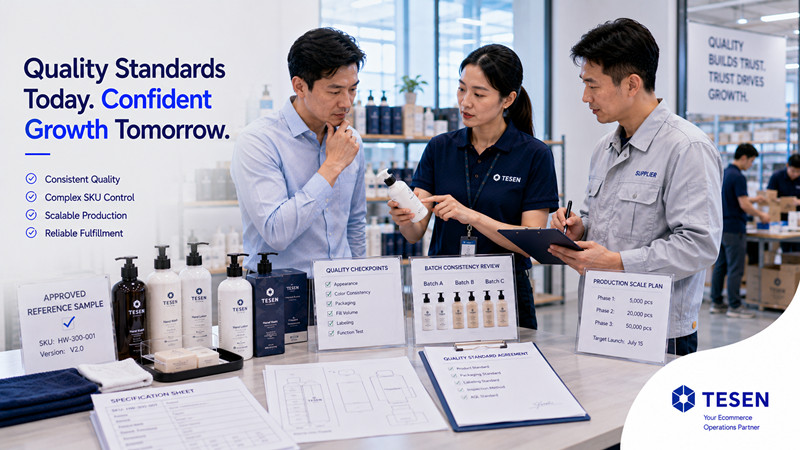
By establishing clearer product standards, approved reference samples, supplier quality communication, and more structured inspection procedures:
The brand does not need to slow growth.
It needs a quality system capable of supporting that growth.
TESEN connects quality control with our broader China-based fulfillment workflow.
Depending on the product and agreed requirements, support can include:
When issues are identified, the objective is not simply to remove defective products.
Where appropriate, the information can also be communicated back to suppliers so future production can improve.
This creates a stronger connection between supplier management, quality control, inventory, and fulfillment.
Not every product requires the same level of inspection.
The appropriate QC approach depends on:
Some lower-risk products may only require agreed sampling and visual checks.
Other products may require:
The goal is not maximum inspection for every SKU.
The goal is an inspection strategy appropriate to the business risk.
Shopify brands often ask whether every unit should be inspected.
There is no universal answer.
Sampling inspection can be suitable when supplier quality is stable and product risk is relatively low.
It can reduce inspection time and cost while still providing visibility into batch quality.
100% inspection may be more appropriate when:
Inspection scope should therefore be based on risk rather than habit.
When comparing fulfillment partners that offer quality-control services, brands should ask:
Generic “QC included” language is not enough.
Different products may require different checks.
Timing matters.
Brands should understand how defective units are separated and reported.
This may be useful depending on the product and inspection scope.
This helps connect inspection with longer-term supplier improvement.
These questions reveal whether QC is a real operational capability or simply a basic visual check.
Growth increases volume.
Quality control protects consistency while that volume increases.
The strategic value comes from protecting several things at once:
Customer trust
Fewer defective products reach customers.
Brand consistency
Different batches remain closer to the agreed standard.
Inventory reliability
Sellable stock is clearer.
Fulfillment efficiency
Fewer product-related exceptions enter the warehouse workflow.
Customer retention
Repeat customers receive a more predictable product experience.
This is why quality control becomes more valuable as Shopify brands scale.
It helps the business increase volume without allowing product consistency to deteriorate at the same pace.
Quality control is not simply about finding defective products.
It is about protecting the consistency that allows a Shopify brand to grow without weakening customer trust.
For brands sourcing products from China, quality decisions connect directly with suppliers, inventory, fulfillment, and customer experience.
At TESEN, we help Shopify and DTC brands integrate supplier management, quality control, inventory, warehousing, and ecommerce fulfillment through one China-based workflow.
Because growth creates more orders.
Quality control helps ensure those additional orders continue delivering the product experience the brand promised.
Brands should review QC when production volume increases, new suppliers are added, SKU count grows, return rates rise, customer complaints become more frequent, or product consistency begins to vary between batches.
Yes, especially when returns are caused by manufacturing defects, missing components, incorrect labels, packaging issues, or other problems that can be identified before fulfillment. It cannot prevent returns caused by every reason, such as customer preference or incorrect sizing choices.
Not necessarily. Inspection scope should depend on product risk, value, supplier performance, defect history, and brand requirements. Sampling may be sufficient for some SKUs, while others may justify 100% inspection.
Some can. TESEN can support customized inspection requirements depending on the product, including appearance checks, quantity verification, packaging inspection, label and barcode checks, sampling, and other agreed QC criteria.
QC helps prevent defective or incorrectly prepared products from entering sellable inventory. This reduces fulfillment exceptions, replacement orders, and the risk of poor-quality products reaching customers.
TESEN can coordinate agreed quality requirements with suppliers, inspect incoming inventory, separate defective products, and communicate identified issues back to suppliers where appropriate, connecting QC with supplier management and fulfillment.
TESEN is a China-based Ecommerce Supply Chain & Fulfillment Partner for Shopify and DTC brands.
We support product sourcing, supplier management, quality control, inventory planning, warehousing, custom packaging, Shopify order fulfillment, and international shipping.
Our fulfillment-led model connects product quality with supplier coordination and inventory management so brands can build more reliable operations as they scale.
Source Your Products and Start Dropshipping
 IPv6 network supported