
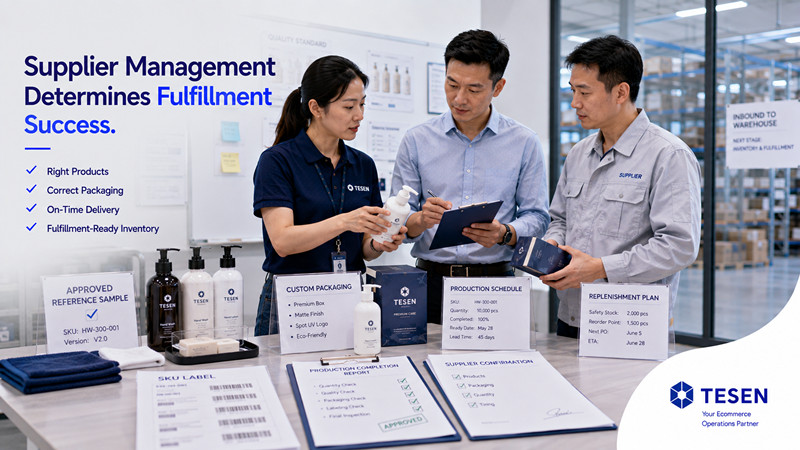
Many ecommerce brands think fulfillment begins when a customer places an order.
The customer completes checkout.
The warehouse receives the order.
The product is picked, packed, and shipped.
From the customer's perspective, that is where fulfillment begins.
Operationally, however, reliable fulfillment starts much earlier.
Before a product ever reaches the warehouse, suppliers have already influenced:
At TESEN, we've found that many Shopify fulfillment problems that appear inside the warehouse actually begin upstream.
The warehouse sees the symptom.
Supplier management often determines the cause.
Supplier management is the process of coordinating and maintaining the manufacturers and suppliers that produce products for an ecommerce business.
It goes beyond finding a factory or negotiating product prices.
Effective supplier management can include:
For growing Shopify brands, supplier management becomes increasingly connected with fulfillment performance.
That is because fulfillment depends on having the correct inventory available when customer orders arrive.
A fulfillment warehouse can process orders efficiently only when several upstream conditions have already been met.
The correct product must exist.
Production must be completed.
The product must meet quality requirements.
Inventory must arrive at the warehouse.
The correct SKU information must be available.
If one of these stages fails, fulfillment becomes more difficult regardless of warehouse efficiency.
The relationship can be summarized simply:
Supplier Performance → Inventory Availability → Fulfillment Performance
This is why supplier management should not be treated as a completely separate purchasing function.
One of the most important supplier-management variables is production lead time.
Suppose a Shopify brand sells 30 units of a product per day.
The warehouse currently holds 600 units.
At first glance, inventory may appear healthy.
But if the supplier requires 25 days to produce replenishment inventory, the brand is already exposed to a potential stockout.
The calculation is not simply:
How much stock do we have?
It also needs to include:
How quickly can our supplier replace it?
If production lead times change unexpectedly, replenishment decisions can become inaccurate.
This is why reliable supplier updates are critical.
Supplier delays are not always avoidable.
Factories may experience:
The critical factor is often when the brand learns about the problem.
If the supplier communicates a delay early, the brand may still have options.
It can:
If the supplier communicates only after the original completion date has passed, those options become much more limited.
This is the difference between proactive and reactive supplier management.
A warehouse may have excellent inventory management.
But it cannot create inventory.
When suppliers deliver late, fulfillment inventory can fall below required levels.
The operational chain often looks like this:
Production delay → Replenishment delay → Inventory shortage → Fulfillment delay → Customer complaint
By the time the customer sees the problem, several earlier stages have already failed.
This is why a stockout should not always be treated as a warehouse problem.
Brands should trace the issue backward.
Was replenishment ordered too late?
Did production take longer than expected?
Did the supplier communicate the delay?
Was incoming inventory visible?
Finding the root cause is more useful than simply increasing stock.
Another important supplier-management issue is product quality.
Suppose a factory delivers 1,000 units.
Physically, 1,000 units exist.
But after quality inspection, 50 units are found to have unacceptable defects.
The actual fulfillment-ready inventory is therefore:
950 units
not 1,000.
This distinction matters.
Poor supplier quality can create:
Supplier management therefore needs to include clear quality expectations before production is complete.
Quality control should identify problems.
Supplier management should help reduce the likelihood that the same problems keep recurring.
For Shopify and DTC brands, products may need more than basic factory packaging.
Requirements can include:
If these requirements are communicated incorrectly, the warehouse may receive inventory that is not ready for fulfillment.
The warehouse then has to:
This increases handling and can delay order processing.
Clear supplier coordination reduces these downstream problems.
Supplier management can be relatively straightforward when a Shopify brand sells:
Growth changes this.
A brand may eventually manage:
At this stage, supplier management becomes an operational system rather than a series of WhatsApp messages.
Without structure, information becomes fragmented.
One supplier is late.
Another has completed production.
A third has a quality issue.
Meanwhile, warehouse inventory continues changing every day.
Connecting this information becomes increasingly important for reliable fulfillment.
Good supplier management is not simply contacting factories more frequently.
The quality of the information matters.
Growing ecommerce brands benefit from having clear visibility into:
Has production started?
What percentage is complete?
Is the expected completion date still realistic?
What is the actual production time?
Has it changed from previous orders?
Have any production problems been identified?
Will corrective action affect completion dates?
Are labels, boxes, inserts, and accessories ready?
When will the inventory actually become available for fulfillment?
These answers allow brands to connect production with inventory planning instead of managing them independently.
Strong supplier relationships are valuable.
But a good relationship alone does not guarantee reliable operations.
A brand may have worked with the same factory for years and still experience:
Supplier relationships create trust.
Supplier management creates structure.
The strongest operations combine both.
Good supplier relationships make difficult conversations easier.
Good supplier-management processes make performance more predictable.
Consider a Shopify brand sourcing several products from multiple factories in China.
The brand uses an experienced fulfillment warehouse.
Orders are processed efficiently when inventory is available.
However, popular SKUs repeatedly run out of stock.
Initially, the business may believe it simply needs to hold more inventory.
A deeper review could reveal a different problem.
Supplier completion dates frequently change.
Production updates arrive late.
Replenishment planning is therefore based on estimated rather than confirmed information.
The warehouse is functioning correctly.
But inventory is arriving too late.
After introducing more structured production follow-up and linking supplier updates with replenishment planning:
The main improvement does not happen inside the warehouse.
It happens upstream.
TESEN's commercial focus is ecommerce fulfillment.
But for brands sourcing from China, reliable fulfillment often depends on what happens before products reach our warehouse.
Depending on the brand's requirements, TESEN can support:
This allows supplier information to connect more directly with inventory and fulfillment.
For example:
If a supplier reports a production delay, that information can affect replenishment planning.
If QC identifies defective inventory, available stock can be adjusted before fulfillment.
If multiple suppliers are delivering products, inventory can be consolidated into one fulfillment operation.
The goal is not to replace every supplier.
It is to reduce the operational gaps between suppliers and fulfillment.
Yes, depending on the provider.
A growing Shopify brand may already have reliable factories and negotiated supplier relationships.
Changing those suppliers simply because the brand changes fulfillment partners may not make sense.
A China-based fulfillment partner can instead work with the existing supplier network.
This may include:
For many brands, this creates a more practical transition than rebuilding the sourcing operation from the beginning.
When comparing fulfillment partners, Shopify brands should ask specific questions.
This matters if the brand already has established factories.
Supplier updates help support better inventory planning.
Brands should understand how QC expectations are communicated and inspected.
This is important for brands with growing SKU complexity.
Inventory visibility and supplier lead times should ideally inform each other.
Brands should know how production delays, quality issues, or packaging problems will be communicated.
These questions reveal whether supplier management is a real operational capability or simply a sourcing add-on.
Customers never communicate with your factory.
They do not know which supplier manufactured their product.
But they experience supplier performance indirectly.
Reliable suppliers help create:
Poor supplier performance creates the opposite.
This is why supplier management ultimately becomes part of customer experience.
The customer does not see the supplier.
They see the result.
Reliable Shopify fulfillment does not begin when a customer clicks “Buy.”
It begins much earlier.
Supplier production determines when inventory becomes available.
Supplier communication affects whether replenishment decisions are made early enough.
Supplier quality affects how much inventory is actually sellable.
Packaging coordination affects whether products are ready for fulfillment.
For Shopify and DTC brands sourcing from China, supplier management therefore becomes one of the foundations of reliable fulfillment.
At TESEN, we connect supplier coordination, quality control, inventory, warehousing, and order fulfillment through one China-based operational workflow.
Because the warehouse can only fulfill the inventory it receives.
And reliable inventory begins with reliable supplier management.
It can reduce the risk. Better supplier communication and production visibility give brands more time to adjust replenishment decisions before inventory runs out. Stockouts also depend on sales velocity, forecasting, safety stock, and supplier lead times.
Useful information includes production status, expected completion dates, production lead times, quality issues, packaging readiness, quantities, and expected delivery dates to the fulfillment warehouse.
Some can. TESEN can work with a brand's existing suppliers for production follow-up, receiving, agreed QC, inventory coordination, custom packaging, and fulfillment rather than requiring the brand to replace established factories.
Products that fail agreed quality requirements may not be suitable for customer fulfillment. This means physical warehouse inventory can be higher than actual sellable inventory.
Supplier management becomes increasingly important when brands work with multiple factories, have growing SKU complexity, replenish frequently, experience repeated stockouts, or need closer coordination between production and fulfillment.
Look for direct supplier communication, production follow-up, existing-supplier support, QC coordination, inventory visibility, multi-supplier receiving, replenishment support, and clear exception reporting.
TESEN is a China-based Ecommerce Supply Chain & Fulfillment Partner for Shopify and DTC brands.
Our commercial focus is ecommerce fulfillment, supported by product sourcing, supplier management, quality control, inventory planning, warehousing, custom packaging, and international shipping.
By connecting supplier operations with inventory and fulfillment, TESEN helps growing brands build more predictable China-side ecommerce operations.
Source Your Products and Start Dropshipping
 IPv6 network supported