A customer who receives a defective product does not think about where the problem started.
They do not know whether the issue came from the factory, packaging, inventory handling, or fulfillment.
They simply know that the product did not meet their expectations.
For ecommerce brands, this is why quality control should not be viewed only as an inspection process.
Effective ecommerce quality control creates a protective layer between supply chain problems and the customer experience.
The earlier a quality problem is identified, the more options a brand has to solve it.
Once that same problem reaches the customer, it can become a refund, replacement shipment, negative review, or loss of trust.
For Shopify and DTC brands sourcing products from China, quality control is therefore closely connected with supplier management, inventory, and fulfillment — not simply factory inspection.
Ecommerce quality control is the process of managing and checking product quality before products reach customers.
Depending on the product and business model, this can include:
Product inspection is one part of this process.
A stronger quality-control system also asks what caused the problem, which inventory may be affected, and how the same issue can be prevented in future production.
Product quality and fulfillment are sometimes treated as separate operations.
In practice, they are closely connected.
Imagine a production batch containing a small percentage of defective products.
If those defects are identified before inventory becomes available for fulfillment, the affected units can potentially be:
If they are not identified, those products can enter normal inventory.
They are then picked, packed, shipped, and eventually delivered to customers.
At that point, a supplier quality problem has become a fulfillment and customer experience problem.
The customer does not see that operational chain.
The brand experiences all of its consequences.
Good ecommerce quality control begins before products arrive at a fulfillment warehouse.
It begins with suppliers.
An approved sample does not guarantee that every future production batch will remain identical.
Materials may change.
Production teams can change.
Manufacturing tolerances can drift.
Packaging specifications can be misunderstood.
This is why supplier quality management matters.
Brands need suppliers capable of maintaining agreed standards across repeated production cycles — not simply producing one acceptable sample.
Clear quality requirements and regular supplier communication also make problems easier to identify and resolve.
For brands sourcing from China, connecting supplier management with QC can be especially valuable because quality issues can sometimes be addressed before inventory enters normal fulfillment.
Quality may be relatively manageable when a brand has:
Growth changes the equation.
A scaling Shopify brand may introduce more SKUs, larger production runs, additional factories, customized packaging, and higher fulfillment volumes.
Even when the defect percentage remains unchanged, the number of customers potentially affected increases.
For example, a 2% defect rate across 100 units affects two products.
The same rate across 10,000 units potentially affects 200.
Scale amplifies both strong systems and weak ones.
Growing brands therefore eventually need to move from informal product checking toward a more structured, risk-based quality-control approach.
One of the most important questions in quality control in ecommerce is not simply:
Can we identify the defect?
It is:
When will we identify it?
A product issue is identified before inventory becomes available for customer orders.
The brand can investigate the batch, communicate with the supplier, isolate affected inventory, and decide what corrective action is appropriate.
Customers may never know the problem existed.
The same defect passes through inventory and fulfillment.
Now the business may need to manage:
The physical defect may be exactly the same.
The business cost is not.
This is one of the strongest reasons for connecting ecommerce product inspection with fulfillment operations.
More inspection does not automatically mean better operations.
Checking every product in exactly the same way can add unnecessary cost and complexity.
A better question is:
Where is the quality risk highest?
Brands should consider factors such as:
A new supplier producing a technically complex product may require a different QC approach from a long-term supplier producing a simple and stable SKU.
The objective should be appropriate quality control based on actual risk — not inspection simply for the sake of inspection.
There is no universal daily-order threshold.
A Shopify or DTC brand should consider strengthening its quality-control process when:
At that stage, solving customer complaints individually addresses the symptoms.
A stronger approach is identifying where those problems can be prevented earlier.
A fulfillment partner does not replace the manufacturer’s responsibility to produce products correctly.
However, a fulfillment partner can provide an important checkpoint before inventory reaches customers.
Depending on the product and agreed QC requirements, this may include:
More importantly, quality information should not remain isolated inside the warehouse.
If the same problem repeatedly appears in incoming inventory, that information should feed back into supplier management and future production decisions.
This creates a stronger operational loop:
Supplier Management → Quality Control → Inventory → Fulfillment → Customer Experience
And when a problem occurs:
Quality Issue → Supplier Feedback → Corrective Action → Future Production
The value is not simply finding defective products.
It is reducing the chance that the same problems continue entering fulfillment.
TESEN is a China-based Ecommerce Supply Chain & Fulfillment Partner for Shopify and DTC brands.
Our core focus is ecommerce fulfillment, supported by upstream operational capabilities including supplier management, quality control, inventory management, customized packaging, and international shipping.
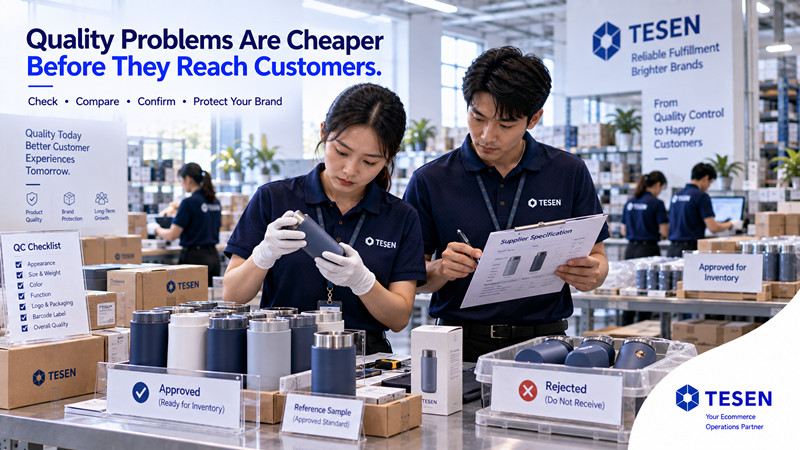
Depending on a brand's product and requirements, our quality-control support may include:
When a problem is identified, we look beyond the defective unit itself.
Important operational questions include:
This connects QC with supplier management and fulfillment instead of treating inspection as a standalone service.
Customer service is important.
Brands need effective systems for resolving problems when they occur.
But prevention is usually more efficient than recovery.
If a defective product is identified before fulfillment, there may be:
The customer simply receives the product they expected.
That is the less visible value of ecommerce quality control.
Customers may never know the inspection happened.
They experience its result.
Ecommerce quality control should not operate independently from supplier management and fulfillment.
For growing Shopify and DTC brands:
Quality control is not only about detecting defective products.
It is about preventing upstream supply chain problems from becoming fulfillment and customer problems.
For growing Shopify brands, that requires connecting supplier management, product quality, inventory, and fulfillment instead of managing each function separately.
At TESEN, we help Shopify and DTC brands connect these operational stages so quality issues can be identified and addressed earlier.
Because once a defective product reaches the customer, quality control has already missed its best opportunity to protect the brand.
Ecommerce quality control is the process of managing and checking product quality before products reach customers. It may include supplier quality requirements, product inspection, packaging verification, incoming inventory checks, sampling, and corrective feedback to suppliers.
A fulfillment partner can provide an additional quality checkpoint when inventory arrives from suppliers. The appropriate inspection level depends on the product, supplier history, defect risk, and agreed QC requirements.
Product inspection is one activity within quality control. A broader ecommerce QC strategy can also include supplier quality management, agreed standards, packaging requirements, recurring issue analysis, and corrective actions.
There is no single standard. QC should generally reflect the product's complexity, supplier history, previous defects, production changes, order volume, and potential impact of a quality problem.
Yes, when supplier coordination is included in the service scope. A China-based fulfillment partner can communicate identified issues to suppliers, isolate affected inventory, and help coordinate corrective action before questionable products enter fulfillment.
More structured QC becomes increasingly valuable when production volumes grow, SKU counts increase, additional suppliers are introduced, custom packaging becomes more complex, or recurring quality problems begin affecting returns and customer complaints.
TESEN is a China-based Ecommerce Supply Chain & Fulfillment Partner for Shopify and DTC brands.
Our core focus is ecommerce fulfillment, supported by product sourcing, supplier management, quality control, inventory planning and storage, custom packaging, and international shipping.
By connecting upstream supplier and quality operations with fulfillment execution, TESEN helps growing ecommerce brands identify problems earlier and build more reliable operations.
Source Your Products and Start Dropshipping
 IPv6 network supported