For many ecommerce brands, product sourcing and fulfillment begin as separate decisions.
A sourcing agent or factory helps find and manufacture the product.
A warehouse stores inventory and ships customer orders.
At a small scale, this can work.
But as Shopify and DTC brands grow, the gap between sourcing and fulfillment often becomes an operational weakness.
Production timelines change.
Supplier updates arrive late.
Quality issues are discovered after inventory reaches the warehouse.
Replenishment decisions happen too slowly.
Fulfillment teams do not have enough visibility into incoming stock.
The problem is not necessarily that either provider is doing a poor job.
The problem is that the information between them is disconnected.
For growing ecommerce brands, product sourcing and fulfillment should increasingly be treated as connected parts of the same operating system.
Because reliable fulfillment begins long before a customer places an order.
Product sourcing is the process of identifying, evaluating, and coordinating suppliers that can manufacture or provide products for an ecommerce brand.
It may include:
Many brands initially evaluate sourcing mainly through price.
They ask:
These are important questions.
But for a growing ecommerce business, sourcing decisions also influence what happens much later.
The supplier you choose affects production reliability.
Production reliability affects inventory availability.
Product quality affects fulfillment readiness.
Lead times affect replenishment.
And all of these eventually affect the customer.
A warehouse can only fulfill products that are:
This means fulfillment performance depends on upstream sourcing decisions.
Consider a simple example.
A brand selects a supplier offering the lowest product cost.
But the supplier has:
The initial purchase price may be attractive.
But downstream operations may experience:
The lowest product cost does not always create the lowest operational cost.
This is why sourcing should be evaluated as part of the fulfillment system.
When different partners manage sourcing and fulfillment without strong coordination, information often becomes fragmented.
The supplier knows what is happening in production.
The sourcing agent knows what has been ordered.
The warehouse knows what has physically arrived.
The ecommerce team knows what customers are buying.
But no one has the complete picture.
That creates operational gaps.
A supplier delays production by one week.
If the fulfillment team does not know this early enough, current inventory may run out before replenishment arrives.
The customer sees:
Product unavailable or order delayed.
The brand sees:
Fulfillment problem.
But the root cause was actually:
Supplier production and communication.
Connecting sourcing information with fulfillment helps identify these problems earlier.
Finding a supplier is only the first step.
Once a product enters regular production, supplier management becomes more important than supplier discovery.
Growing brands need answers to questions such as:
These are not purely sourcing questions.
They are fulfillment questions.
Supplier management connects what is happening at the factory with what needs to happen inside inventory and fulfillment.
Quality control is another reason sourcing and fulfillment should not operate in isolation.
If quality problems are discovered only after inventory enters the warehouse, the business has fewer options.
Inventory may need to be:
This creates additional handling and can affect fulfillment availability.
A stronger process is:
Supplier → Quality Control → Sellable Inventory → Fulfillment → Customer
Quality standards should ideally be agreed during sourcing and supplier coordination—not created only after defects appear.
At low volume, product expectations may be communicated informally.
A founder sends photos.
The supplier confirms details.
A sample is approved.
But as order volume grows, product specifications become more important.
Brands may need clearer standards for:
These specifications help reduce variation between production batches.
They also help fulfillment teams understand what inventory should look like before it becomes available for customer orders.
Inventory planning sits directly between sourcing and fulfillment.
To make a good replenishment decision, brands need information from both sides.
Looking at only one side creates an incomplete picture.
Imagine a product selling 100 units per week.
The warehouse reports 300 units remaining.
That appears to equal approximately three weeks of inventory.
But if the supplier requires five weeks to produce and deliver replenishment, the stockout risk already exists.
The inventory number alone is not enough.
Supplier lead time changes the decision.
The need for coordination increases as brands add products.
A small ecommerce business may have:
A scaling Shopify brand may eventually manage:
At this stage, every new supplier creates another production timeline.
Every new SKU creates another replenishment decision.
Every packaging variation creates another fulfillment requirement.
This is why operational complexity can grow faster than order volume.
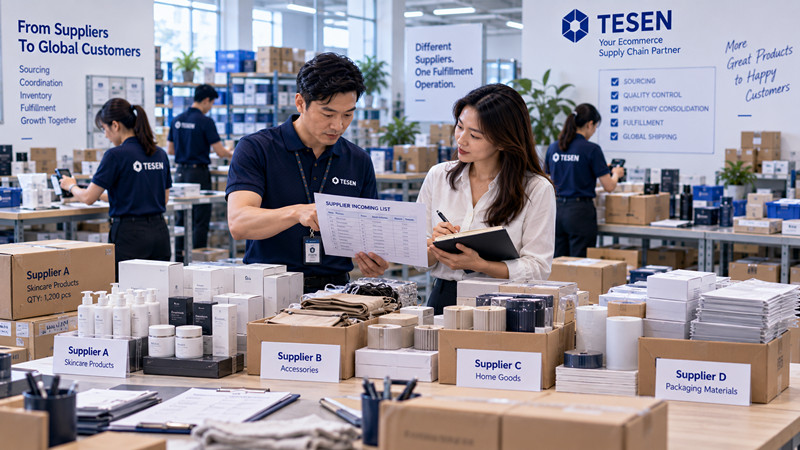
Many ecommerce brands source from more than one factory.
For example:
If each supplier ships independently, the brand may need to coordinate multiple incoming deliveries.
A China-based sourcing and fulfillment partner can help consolidate these flows.
Products can potentially be:
This reduces the number of handoffs between factories and the final fulfillment operation.
Custom packaging is often treated as a branding decision.
Operationally, it also affects fulfillment.
Brands may need:
These materials may come from different suppliers.
If packaging arrives late, customer orders may be delayed even when the product itself is in stock.
This is another example of why fulfillment readiness depends on upstream coordination.
A product is not always fulfillment-ready simply because manufacturing is complete.
Managing sourcing and fulfillment together does not mean every activity must happen inside one physical building.
It means the information and decisions are connected.
A more integrated model looks like this:
Suppliers are evaluated based on price, capability, quality, reliability, and lead time.
↓
Production timelines, changes, and issues are monitored.
↓
Products are checked against agreed standards.
↓
Available stock, sales velocity, and supplier lead times guide replenishment.
↓
Products are received, organized, and prepared for fulfillment.
↓
Inventory is picked, packed, and shipped when customer orders arrive.
The important element is not simply having fewer vendors.
It is reducing information gaps between each stage.
Not necessarily.
A brand may already have:
There may be no reason to replace them.
An integrated fulfillment partner can instead work with the existing supplier network.
The important question is not:
Do we use one company for everything?
It is:
Are sourcing, supplier, inventory, and fulfillment decisions connected?
A brand can keep existing suppliers while improving coordination between them and the fulfillment operation.
Connecting sourcing and fulfillment becomes particularly valuable when a brand experiences:
These conditions create more dependencies between upstream production and downstream fulfillment.
Consider a Shopify brand selling several products from different Chinese suppliers.
One bestseller begins growing faster than expected.
The fulfillment warehouse notices inventory becoming low.
The brand contacts its sourcing agent.
The sourcing agent contacts the factory.
The supplier reports that production requires four weeks.
By that point, avoiding a stockout may be difficult.
The same increase in sales velocity triggers an earlier inventory review.
The brand checks:
Replenishment begins earlier.
The difference is not faster warehouse processing.
It is earlier information.
Some brands assume that recurring fulfillment problems mean they need a new warehouse.
Sometimes that is true.
But not always.
Problems may originate from:
Changing the warehouse does not automatically solve these problems.
The more useful approach is to identify where the fulfillment issue actually starts.
TESEN's core commercial focus is ecommerce fulfillment.
For Shopify and DTC brands sourcing from China, we can also support upstream activities that affect fulfillment readiness.
Depending on the project, this can include:
The purpose is not simply convenience.
It is operational continuity.
If production is delayed, inventory planning can be reviewed.
If QC identifies a problem, defective stock can be separated before fulfillment.
If sales velocity increases, supplier lead time can be considered earlier.
This helps brands manage sourcing and fulfillment as connected decisions rather than isolated services.
Yes.
Brands do not need to change reliable factories simply because they start working with TESEN for fulfillment.
TESEN can coordinate with existing Chinese suppliers for areas such as:
This is particularly useful for brands that already have established supplier relationships but need better coordination between factories and fulfillment.
Before selecting a partner, growing ecommerce brands should ask:
This avoids unnecessary supplier changes.
This helps connect supplier lead time with inventory planning.
This reduces the risk of defective inventory entering customer orders.
This matters for multi-SKU brands.
This is useful when packaging comes from another factory.
This reveals whether sourcing and fulfillment are truly connected.
Fulfillment integration depends on inventory visibility.
These questions help determine whether a provider offers a genuinely integrated service or simply two unrelated services under one company name.
Customers never see sourcing operations.
They do not know which supplier produced the product.
They do not see production updates.
They do not see replenishment spreadsheets.
But they experience the outcome.
They notice when:
The customer experience is therefore influenced by sourcing decisions long before fulfillment begins.
Reliable ecommerce fulfillment does not begin at checkout.
It begins with the decisions that determine whether the correct product will be available, quality-approved, and ready when the customer orders.
For growing Shopify and DTC brands, product sourcing, supplier management, quality control, inventory planning, and fulfillment should increasingly operate as one connected system.
At TESEN, we help brands connect these China-side operations around ecommerce fulfillment.
Because better fulfillment does not always require faster shipping.
Sometimes it requires better coordination before fulfillment begins.
Product sourcing is technically an upstream supply-chain activity, but sourcing decisions strongly affect fulfillment. Supplier reliability, production lead times, product quality, and packaging all influence whether inventory is ready when customer orders arrive.
Not necessarily. What matters is whether sourcing information and fulfillment operations are properly connected. Brands can keep existing suppliers while using a fulfillment partner to coordinate inventory, QC, packaging, and order fulfillment.
Yes, depending on the provider. TESEN can work with existing Chinese suppliers rather than requiring brands to replace established factories.
Supplier lead times, MOQs, production capacity, quality, and production timing determine when inventory becomes available and how much stock a brand may need to hold.
It becomes more useful when a brand manages multiple suppliers, growing SKU counts, frequent replenishment, custom packaging, quality issues, or increasing Shopify order volume.
It can reduce the risk by connecting sales velocity and current stock with supplier lead times and production status. It cannot eliminate all stockouts, but it can support earlier replenishment decisions.
TESEN supports Shopify and DTC brands with product sourcing, existing supplier coordination, production follow-up, QC, inventory management, storage, custom packaging, fulfillment, and international shipping through a China-based fulfillment workflow.
TESEN is a China-based Ecommerce Supply Chain & Fulfillment Partner for Shopify and DTC brands.
Our core commercial service is ecommerce fulfillment, supported by product sourcing, supplier management, quality control, inventory planning, warehousing, custom packaging, and international shipping.
This fulfillment-led model helps brands connect upstream supplier activity with downstream inventory and customer orders.
Source Your Products and Start Dropshipping
 IPv6 network supported