When ecommerce brands think about quality control, they often picture an inspector checking products before shipment.
Is the product damaged?
Is the quantity correct?
Does the packaging meet requirements?
These checks are important.
But quality control serves a much larger purpose.
For growing Shopify and DTC brands, quality control helps protect the experience customers have when a product finally reaches them.
At TESEN, we've found that many customer experience problems that appear after delivery actually begin much earlier—during production, supplier coordination, receiving, or product inspection.
Because every product that reaches a customer represents the brand that sold it.
Customers never see the inspection process.
They only see the result.
Ecommerce quality control is the process of verifying that products meet agreed requirements before they reach customers.
Depending on the product and brand requirements, this may include:
But effective quality control should not begin only when products are ready to ship.
It starts with defining what an acceptable product actually looks like.
That requires coordination between the brand, supplier, and fulfillment operation.
Customers expect the product they receive to match what they purchased.
They expect:
When these expectations are consistently met, customers rarely think about quality control.
When they are not, quality becomes immediately visible.
A small manufacturing defect can become:
This is why quality control should be viewed as part of customer experience—not simply as an internal warehouse procedure.
The terms are often used interchangeably, but there is an important difference.
Product inspection is a specific activity.
Quality control is the broader system used to prevent unacceptable products from reaching customers.
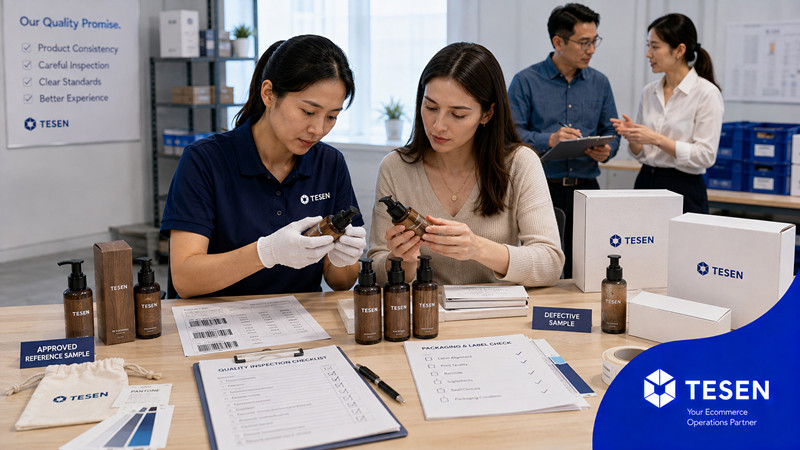
For example, an ecommerce quality control workflow may include:
Before production begins, brands and suppliers should establish clear expectations around product specifications, materials, appearance, packaging, and acceptable defects.
Samples can be checked before larger production runs to confirm that the supplier understands the required standard.
Changes in materials, components, packaging, or manufacturing should be communicated before they create larger quality problems.
Products arriving at the fulfillment warehouse can be checked for visible damage, quantity discrepancies, packaging issues, or other agreed requirements.
Depending on the product and inspection plan, random sampling or additional verification can be performed before inventory is shipped to customers.
Inspection is therefore one part of quality control—not the entire strategy.
Factories naturally play an important role in product quality.
But Shopify brands should understand that a factory's internal QC process may not always match the brand's own requirements.
For example, a supplier may consider a small cosmetic difference acceptable.
The brand may not.
A factory may focus primarily on product functionality.
The customer may also care about:
This is why brands should define their own quality expectations rather than relying entirely on a supplier's general inspection standards.
The more clearly those expectations are documented, the easier it becomes to inspect products consistently.
Quality problems do not end with the defective product.
Once an unacceptable item enters fulfillment inventory and reaches a customer, the cost can spread across the operation.
A single defect may require:
Customer complaint → Support review → Refund or replacement → Additional fulfillment → Additional shipping
If the same production issue affects an entire batch, the impact becomes much larger.
This may create:
Preventing defects before fulfillment can therefore be significantly more efficient than solving them after delivery.
Not every product requires the same inspection process.
A simple textile product and an electronic device should not necessarily follow identical QC procedures.
The appropriate inspection plan may depend on:
For some products, visual inspection and quantity verification may be sufficient.
Others may require functional testing, measurement, assembly checks, or customized inspection criteria.
This is why quality control should be based on agreed requirements rather than a generic checklist applied to every SKU.
Another important decision is how much inventory should be inspected.
There are generally two practical approaches.
Sampling inspection checks a portion of a production batch.
This can be suitable when:
100% inspection checks every unit.
This may be more appropriate when:
There is no single inspection method that is right for every ecommerce business.
The goal is to choose an inspection level appropriate to the product and risk.
Quality control and inventory management are closely connected.
Imagine 1,000 units arriving at a fulfillment warehouse.
The inventory system may show:
1,000 units available.
But if 80 units have unacceptable defects, the true sellable inventory is lower.
Without identifying those defects early, inventory data can create a false sense of availability.
Quality control therefore helps brands understand not only:
How much inventory do we have?
but also:
How much sellable inventory do we actually have?
That distinction becomes increasingly important as order volume grows.
At TESEN, quality control can be integrated with supplier management and fulfillment rather than treated as an isolated final step.
Depending on the brand, product, and agreed inspection requirements, this may include:
Connecting QC with supplier communication also helps problems move upstream.
If repeated defects are discovered, the objective should not simply be to keep finding the same problem at the warehouse.
The better outcome is to communicate the issue back to the supplier and reduce the chance of it occurring in future production.
That is where quality control becomes part of supply chain improvement.
One Shopify brand maintained reliable order processing and shipping performance but experienced increasing product returns.
At first, the fulfillment operation appeared to be working properly.
Orders were processed correctly.
Shipments left on schedule.
The problem was upstream.
Small manufacturing inconsistencies were reaching customers because the existing inspection process focused mainly on packaging and order accuracy.
After strengthening product-specific quality requirements and inspection procedures:
Shipping did not become faster.
Fulfillment did not fundamentally change.
The quality of the inventory entering fulfillment improved.
And customers experienced the difference.
For a growing DTC brand, quality consistency matters just as much as detecting obvious defects.
Customers expect the second product they purchase to feel like the first.
They expect different production batches to maintain similar:
This becomes increasingly difficult when brands work with multiple suppliers or expand their product range.
Clear quality standards and consistent inspection help reduce variation between production batches.
Over time, this protects something more valuable than an individual order:
brand trust.
At low order volume, a few quality issues may appear manageable.
At higher volume, the same defect rate affects many more customers.
For example, even a relatively small quality issue becomes significant when thousands of units are shipped.
This is why quality control should evolve as an ecommerce business grows.
Brands may need:
Scaling sales without scaling quality management increases operational risk.
Quality control is not simply about finding defective products.
It is about preventing avoidable customer disappointment.
For Shopify and DTC brands, effective quality control connects:
Supplier expectations → Product quality → Sellable inventory → Fulfillment → Customer experience
When these stages work together, brands can reduce unnecessary returns, improve product consistency, and create a more reliable customer experience.
At TESEN, we help ecommerce brands connect supplier management, quality control, inventory, and fulfillment rather than treating them as isolated operations.
Because customers will never see the inspection process behind their order.
But they will always experience its result.
The appropriate checks depend on the product, but they may include appearance, functionality, quantity, dimensions, variants, accessories, packaging, labels, barcodes, and visible defects. Brands should define inspection requirements according to their product and quality expectations.
Factory QC is valuable, but it may not always reflect a brand's specific standards. Growing brands often benefit from defining their own inspection requirements and verifying products independently before fulfillment when appropriate.
It depends on the product, supplier history, batch size, defect risk, and brand requirements. Sampling may be appropriate for stable, lower-risk products, while higher-risk or higher-value products may require more extensive inspection.
Some fulfillment partners offer QC services alongside warehousing and order fulfillment. Brands should confirm what is inspected, the sampling method, inspection criteria, reporting process, and whether customized QC requirements are supported.
Identifying defects before shipment can reduce replacement orders, additional shipping, returns, customer support workload, and the risk of defective inventory reaching multiple customers.
Depending on agreed requirements, TESEN can support supplier quality coordination, sample verification, incoming inspection, quantity and appearance checks, packaging and label verification, random sampling, and customized quality inspection before fulfillment.
TESEN is a China-based ecommerce fulfillment and supply chain partner supporting Shopify and DTC brands with product sourcing, supplier management, quality control, inventory planning, warehousing, private labeling, order fulfillment, and international shipping.
By connecting quality control with supplier coordination and fulfillment, TESEN helps growing ecommerce brands improve product consistency and reduce avoidable customer-facing problems.
Source Your Products and Start Dropshipping
 IPv6 network supported