Most ecommerce brands understand the customer-facing side of a return.
A customer requests a return.
The brand approves it.
A refund or replacement is processed.
From the customer-service perspective, the case may appear to be finished.
Operationally, however, another process has just started.
The product comes back.
Now someone needs to decide:
This is why ecommerce returns management should not be treated only as a customer-service process.
A return is also an inventory and fulfillment event.
A return shouldn't only trigger a refund. It should trigger an operational decision.
For growing Shopify and DTC brands, what happens after the product comes back can affect inventory accuracy, quality control, supplier management, packaging, and future fulfillment performance.
Ecommerce returns management is the process of handling returned customer orders from the initial return request through receiving, inspection, inventory classification, refund or replacement, and any required operational follow-up.
The customer-facing process may include:
Return Request → Authorization → Refund / Replacement
But the physical product follows another workflow:
Returned Product → Receiving → Inspection → Classification → Inventory Decision
These two processes need to connect.
Otherwise, the customer may receive a refund while the returned product becomes unclear or inaccurate inventory inside the warehouse.
One of the most important principles in returns management is simple:
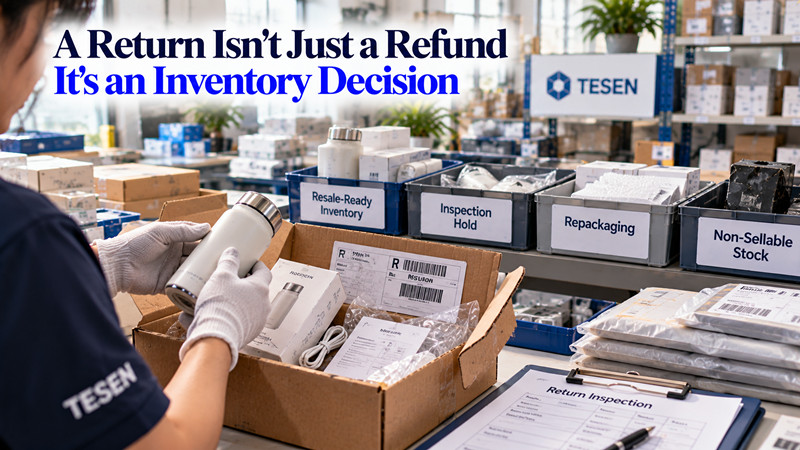
Every returned product needs a defined inventory status.
A returned item should not automatically be placed back onto normal inventory shelves.
Depending on its condition, there are several possible outcomes.
If the product is unused, complete, and still meets the brand's standards, it may be returned to sellable inventory.
But that decision should be deliberate.
Some products need inspection before their condition can be confirmed.
This is particularly important when the return reason involves:
The product itself may still be suitable for resale, but the original packaging may no longer be acceptable.
In that case, new packaging may be required before the product becomes fulfillment-ready again.
Some returned products can be corrected.
For example:
After rework, the product may be inspected again before returning to available inventory.
If the condition is uncertain, the safest inventory status may be Hold.
The item remains physically in the warehouse but unavailable for normal fulfillment until a decision is made.
Some products should not return to fulfillment.
This may apply to items that are:
The important principle is not which status is used.
It is that returned inventory should never become normal available inventory by default.
This is where returns management connects directly with inventory accuracy.
Imagine a Shopify brand has:
800 units of normal sellable inventory
plus:
50 returned units awaiting inspection
Physically, the warehouse contains:
850 units
But the business does not necessarily have 850 units available for customer orders.
Until those 50 returned units have been inspected and approved, fulfillment-ready inventory remains:
800 units
This distinction is critical:
Physical Inventory ≠ Available Inventory ≠ Fulfillment-Ready Inventory
Returned products may require inventory statuses such as:
Without these distinctions, growing return volume can gradually reduce inventory accuracy.
At low order volume, a few unprocessed returns may not appear significant.
At scale, the situation changes.
Imagine an ecommerce brand processing:
10,000 orders per month
with a:
5% return rate
That produces:
500 returned orders per month
If returned units are not consistently inspected and classified, the brand may gradually lose visibility into how much inventory is actually available.
That can affect:
This is why returned inventory should be visible in the same way that incoming supplier inventory is visible.
The relevant question is not simply:
How many units came back?
It is:
How many returned units can actually be used again?
A return is not only an inventory event.
It can also provide information about what went wrong.
Common return reasons include:
From a customer-service perspective, these may look like categories used to process a refund.
From an operational perspective, repeated patterns can reveal deeper problems.
Repeated size-related returns could indicate:
Repeated damage could indicate:
Repeated packaging complaints could indicate:
Repeated defects could indicate:
Wrong-item returns could indicate:
A return reason is therefore more than a customer complaint.
It can be operational evidence.
A mature ecommerce returns process should not stop after the refund and returned-product decision.
Return information should feed back into the operation.
A useful feedback loop is:
Return Reason
↓
Operational Diagnosis
↓
Supplier / QC / Packaging / Fulfillment Review
↓
Corrective Action
↓
Better Future Fulfillment
For example:
Repeated damaged products
↓
Review packaging condition
↓
Compare supplier packaging and fulfillment packaging
↓
Identify where protection is failing
↓
Improve future packaging
Or:
Repeated wrong-SKU returns
↓
Review affected orders
↓
Check SKU labels and picking process
↓
Identify the source of confusion
↓
Correct inventory identification or picking procedures
This is how returns become operational data instead of remaining only a cost.
The original Medium article already establishes this feedback-loop logic clearly. 粘贴的文本 (1)
Some customer returns originate long before the product reaches the fulfillment warehouse.
If customers repeatedly report:
the root cause may be upstream.
Brands should investigate:
This is particularly important for ecommerce brands sourcing products from China.
A customer return may be the first time a pattern becomes visible at scale.
That information should therefore be able to flow back into supplier management.
Returns can also show whether existing QC processes are sufficient.
Suppose customers repeatedly return a product because of the same visible defect.
If that defect could reasonably have been identified before fulfillment, the brand may need to review:
This does not mean every customer return represents a QC failure.
Some product problems become visible only during actual customer use.
But repeated defect patterns should be investigated.
Returns therefore provide a valuable downstream quality signal:
QC tries to identify problems before fulfillment. Returns can reveal problems QC did not identify.
That creates a feedback relationship:
QC → Fulfillment → Customer Experience → Returns → QC Improvement
Packaging problems can originate at different stages.
A product may leave the fulfillment warehouse in good condition but arrive damaged.
If the same type of damage occurs repeatedly, the operation should investigate:
The important question is not simply:
Should we refund this customer?
The operational question is:
Why are customers experiencing the same damage repeatedly?
If the root cause can be identified, future returns may be reduced.
Some return reasons originate directly inside fulfillment.
Examples include:
When these patterns appear, the fulfillment operation should be able to identify:
This is where returns management becomes connected to fulfillment performance.
A strong returns process should not only process what came back.
It should help reduce avoidable returns in the future.
At low order volume, returns can often be managed manually.
Someone checks the product.
Someone decides whether it can be restocked.
The team remembers why the customer returned it.
This may work when there are only a few returns each week.
As the brand grows, informal decisions become inconsistent.
Two warehouse employees may classify identical returned products differently.
One unit may immediately return to sellable inventory.
Another may remain on hold.
Return reasons may be recorded differently.
Repeated issues may not be recognized as a pattern.
Over time, this creates operational noise.
Growing ecommerce brands therefore need a standardized process that defines:
Standardization supports both:
Inventory Accuracy
and
Operational Learning
The term reverse fulfillment describes products moving back through the operation after a customer return.
Forward fulfillment asks:
Which products can be sent to customers?
Reverse fulfillment asks:
Which returned products can safely re-enter inventory?
The direction changes.
The operational principles do not.
Both depend on:
This is why returns should not be treated as a completely separate operational system.
Reverse fulfillment is still fulfillment—just moving in the opposite direction.
For each returned product, brands can use a six-step process.
Confirm:
Record the customer's reported reason.
Where possible, use consistent return categories instead of relying entirely on free-text notes.
Consistent categories make patterns easier to identify.
Check:
Assign an appropriate status:
Resell / Inspect / Repackage / Rework / Hold / Dispose
Consider whether the return may relate to:
One isolated return may not justify a major operational change.
Repeated patterns deserve closer investigation.
This is how returns management becomes a decision system, rather than simply a refund process.
A fulfillment partner cannot eliminate ecommerce returns.
The more relevant question is whether it can make returned inventory understandable.
A brand should be able to determine:
What came back?
Why did it come back?
What condition is it in?
What should happen next?
Depending on the operating model, useful return information may include:
This creates a clearer bridge between:
Customer Service → Returns → Inventory → Fulfillment
The source article specifically identifies these visibility requirements for a fulfillment partner. 粘贴的文本 (1)
TESEN's core commercial focus is ecommerce fulfillment for Shopify and DTC brands.
Where the agreed fulfillment workflow includes returned products, those products may require operational handling before they can re-enter inventory.
Depending on the brand's requirements, returned inventory may need to be:
The important part is making the inventory status clear.
If return patterns reveal a broader problem, that information may also be relevant to:
The objective is not simply to move returned products back into warehouse storage.
It is to understand:
What happened?
What should happen to the inventory?
Does anything need to change upstream?
That creates a stronger operational feedback loop.
Ecommerce returns management covers the process from customer return authorization through receiving, inspection, inventory classification, refund or replacement, and any operational follow-up required after the product comes back.
Returned products may be approved for resale, inspected, repackaged, reworked, held, or removed from sellable inventory depending on their condition and the brand's requirements.
No. A returned product may physically be inside the warehouse but still require inspection, repackaging, rework, or another decision before it becomes fulfillment-ready.
Reverse fulfillment is the operational process of handling products moving back from customers into the fulfillment or inventory system. It can include receiving, inspection, classification, rework, repackaging, and inventory disposition.
Yes. Repeated return patterns involving defects, dimensions, materials, packaging, or missing components may indicate supplier or QC issues that deserve investigation.
Ask how returned products are received, identified, inspected, classified, and recorded; whether returned inventory is separated from sellable inventory; what information is provided about condition; and how rework, repackaging, or disposal decisions are handled.
Yes. Repeated wrong-item, damaged-product, missing-component, packaging, or labeling returns can reveal operational patterns that can be used to improve future fulfillment.
A customer return creates a cost.
But it also creates information.
The brand learns:
The value depends on what happens to that information.
If every return is treated as an isolated customer-service case, the same problems can continue.
If return information feeds back into inventory, suppliers, quality control, packaging, and fulfillment, it can support better future decisions.
The more useful operating model is:
Customer Return → Inventory Decision → Operational Insight → Corrective Action → Better Future Fulfillment
Because a return should not only close one customer-service case.
It should help the operation make the next decision better.
TESEN is a China-based Ecommerce Supply Chain & Fulfillment Partner for Shopify and DTC brands.
Our core commercial focus is ecommerce fulfillment, supported by product sourcing, supplier management, quality control, inventory planning and storage, custom packaging, returns handling where applicable, and international shipping.
By connecting inventory status and fulfillment operations with upstream supplier, quality, and packaging information, TESEN helps growing ecommerce brands build more coordinated operations.
Source Your Products and Start Dropshipping
 IPv6 network supported