As ecommerce brands grow, many operational issues appear to be fulfillment problems.
Orders are delayed.
Inventory runs out unexpectedly.
Customers ask where their packages are.
Support tickets increase.
However, in many cases, fulfillment is not where these problems begin.
They start much earlier in the supply chain.
At TESEN, we've observed that many growing Shopify brands initially focus on improving warehouse operations or shipping speed.
The brands that scale successfully take a different approach.
They solve supply chain problems before they become fulfillment problems.
Because reliable fulfillment is the result of a well-managed supply chain—not the starting point.
An ecommerce supply chain is the complete system that moves products from manufacturers to customers.
For Shopify and DTC brands, this typically includes:
Fulfillment is one important stage within the supply chain.
It is not the entire system.
When one stage becomes unstable, every stage that follows is affected.
Many ecommerce businesses assume delayed shipments are caused by warehouses or logistics providers.
In reality, the original cause often occurs much earlier.
Common supply chain issues include:
By the time products arrive at the warehouse, fulfillment teams are often managing the consequences—not the cause.
This is why solving upstream issues creates stronger downstream performance.
Every stage of the supply chain influences fulfillment performance.
| Supply Chain Stage | Impact on Fulfillment |
|---|---|
| Product sourcing | Determines supplier reliability and lead times |
| Supplier management | Improves production consistency |
| Quality control | Reduces defective products and returns |
| Inventory planning | Prevents stock shortages and overselling |
| Warehousing | Supports accurate inventory management |
| Order fulfillment | Processes customer orders efficiently |
| International shipping | Delivers products to customers |
A stronger supply chain creates a stronger fulfillment operation.
One Shopify brand selling throughout Europe experienced increasing delivery delays during a period of rapid growth.
Initially, the business believed its warehouse operation required improvement.
However, after reviewing the complete supply chain, several underlying issues became clear.
These issues affected fulfillment long before products reached the warehouse.
After improving supplier coordination, inventory planning, and production visibility:
The warehouse itself had not fundamentally changed.
The supply chain had.
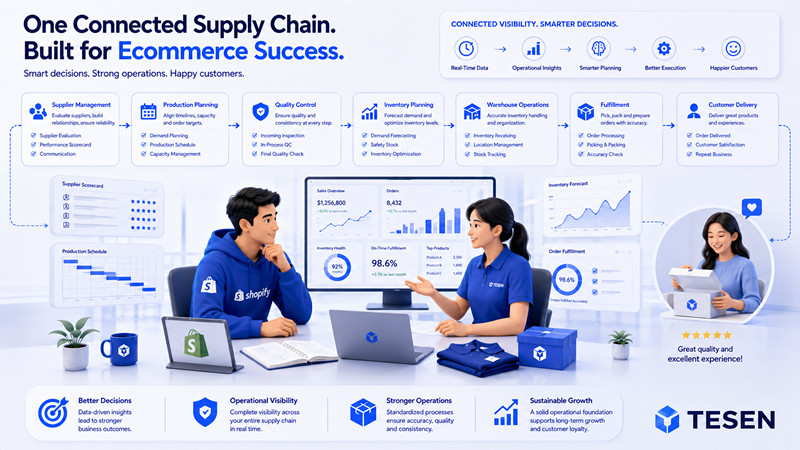
At TESEN, we believe fulfillment performs best when the entire supply chain operates as one connected system.
Our ecommerce supply chain services include:
Rather than treating sourcing and fulfillment as separate services, we help Shopify brands build integrated operational workflows.
This creates greater visibility, stronger supplier relationships, and more predictable fulfillment performance.
As daily order volume increases, operational complexity grows rapidly.
Brands that only optimize fulfillment often continue experiencing recurring issues because the root causes remain unresolved.
Brands that strengthen their entire supply chain typically achieve:
In other words, fulfillment becomes more reliable because the supply chain becomes stronger.
Successful Shopify brands eventually stop asking:
"How can we ship faster?"
Instead, they ask:
This shift in thinking helps create scalable ecommerce operations that support long-term growth.
Great ecommerce brands understand that fulfillment is only one part of a much larger operational system.
By improving sourcing, supplier coordination, production planning, inventory management, and quality control before products reach the warehouse, businesses create a stronger foundation for reliable fulfillment.
At TESEN, we help Shopify and DTC brands build connected supply chain systems that support predictable fulfillment rather than constantly reacting to operational problems.
Because the strongest fulfillment systems begin long before the first order is packed.
An ecommerce supply chain is the complete process of sourcing, producing, storing, fulfilling, and delivering products to customers.
Fulfillment focuses on warehousing, picking, packing, and shipping orders. Supply chain management includes fulfillment as well as sourcing, supplier management, production planning, quality control, and inventory management.
When sourcing, production, inventory planning, or supplier communication become unstable, fulfillment teams often experience delays, stock shortages, and inconsistent operations.
Yes. Some fulfillment partners, including TESEN, provide sourcing support, supplier coordination, quality control, inventory planning, and fulfillment services as part of an integrated supply chain solution.
Reliable supply chain operations lead to more consistent product quality, stable inventory, predictable fulfillment, and on-time deliveries, all of which improve customer satisfaction.
Brands should begin strengthening their supply chain before rapid growth creates operational bottlenecks. Proactive planning is usually more effective than reacting to fulfillment problems after they occur.
TESEN is a China-based ecommerce supply chain partner helping Shopify and DTC brands build reliable operations through product sourcing, supplier management, quality control, inventory planning, warehousing, order fulfillment, private labeling, and global shipping.
By integrating every stage of the supply chain into one connected workflow, TESEN helps growing brands scale with greater visibility, operational stability, and long-term confidence.
Source Your Products and Start Dropshipping
 IPv6 network supported