Many ecommerce brands believe fulfillment begins when products arrive at a warehouse.
In reality, successful fulfillment starts much earlier.
It starts with quality control.
Before products are packed, shipped, or delivered to customers, they should first be inspected to ensure they meet agreed quality standards.
Skipping this step may save time initially, but it often leads to expensive operational problems later.
At TESEN, we've seen many fulfillment challenges that were actually caused by quality issues during production rather than shipping itself.
For growing Shopify brands, quality control is one of the most important foundations of a reliable fulfillment system.
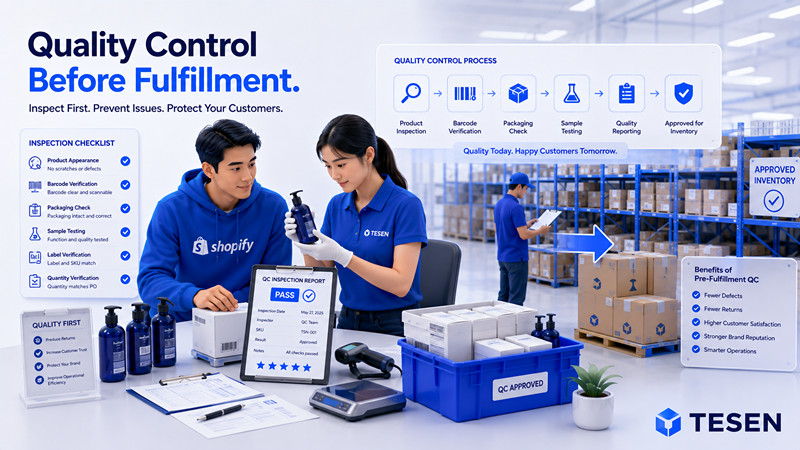
Quality Control (QC) is the process of inspecting products before they are stored in inventory or shipped to customers.
The goal is simple:
Identify problems before customers do.
For ecommerce brands, quality control commonly includes:
A structured QC process helps ensure products entering the fulfillment workflow meet agreed quality standards.
Customer experience doesn't begin when a package is delivered.
It begins when a customer opens the package.
Even if shipping is fast, defective or damaged products create a poor customer experience.
Without proper quality control, ecommerce brands often face:
These issues frequently lead to:
Quality control protects both your customers and your business.
Many fulfillment problems are actually quality problems in disguise.
For example:
If defective products enter warehouse inventory, they may be shipped to dozens of customers before anyone discovers the issue.
The result is a chain reaction of:
By identifying defects before products enter inventory, quality control creates a smoother and more predictable fulfillment process.
As Shopify brands grow, they often make quality control mistakes such as:
These shortcuts may reduce short-term costs.
However, they usually increase long-term operational expenses.
| With Quality Control | Without Quality Control |
|---|---|
| Defects identified before shipment | Customers discover defects first |
| More consistent product quality | Quality varies between batches |
| Fewer returns and reshipments | Higher return rates |
| Lower customer support workload | More support tickets |
| Better customer satisfaction | Increased negative reviews |
| More predictable fulfillment | Operational disruptions |
This comparison shows why quality control should be viewed as an investment rather than an additional cost.
At TESEN, quality control is integrated into the fulfillment workflow instead of being treated as a separate service.
Depending on the product and customer requirements, our QC process may include:
By combining sourcing, quality control, and fulfillment into one operational process, we help Shopify brands reduce fulfillment risks before products ever leave the warehouse.
One Shopify brand sourcing products from multiple factories experienced increasing customer complaints despite maintaining fast shipping times.
After reviewing the issue, the problem was not logistics.
Several production batches contained cosmetic defects that had not been identified before fulfillment.
After implementing a structured quality control process through TESEN:
The shipping process remained unchanged.
The quality control process made the difference.
Many businesses treat quality control as an optional inspection step.
Successful ecommerce brands treat it as part of their operational strategy.
Strong quality control supports:
Reliable fulfillment begins with reliable products.
Quality control is one of the most overlooked parts of ecommerce fulfillment.
Reliable fulfillment depends not only on shipping speed but also on product consistency.
By identifying defects before products enter inventory, Shopify brands reduce unnecessary costs while protecting customer trust.
At TESEN, we believe quality control is not simply an inspection step.
It is an essential part of building a reliable fulfillment system that supports sustainable ecommerce growth.
Quality control is the process of inspecting products before they are stored or shipped to ensure they meet agreed quality standards.
Inspecting products before fulfillment prevents defective items from entering inventory, reducing returns, reshipments, and customer complaints.
Most ecommerce products benefit from quality inspections, especially private label products, customized items, electronics, apparel, beauty products, and products sourced from multiple suppliers.
Yes. Many fulfillment partners, including TESEN, provide product inspections, quantity verification, packaging checks, barcode verification, random sampling, and customized QC procedures.
Finding problems before shipment is generally far less expensive than handling returns, replacement shipments, refunds, and customer support after delivery.
Quality control ensures that only products meeting agreed standards enter the fulfillment process, making fulfillment more reliable and predictable.
TESEN is a China-based fulfillment and supply chain partner helping Shopify and DTC brands streamline product sourcing, supplier management, quality control, inventory planning, warehousing, order fulfillment, private labeling, and global shipping.
By integrating sourcing, quality control, and fulfillment into one operational workflow, TESEN helps growing ecommerce brands build reliable supply chains that support sustainable long-term growth.
Source Your Products and Start Dropshipping
 IPv6 network supported