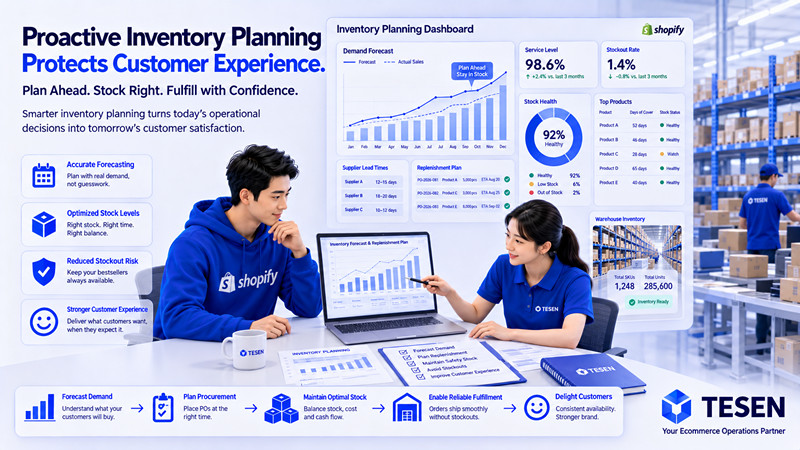
When ecommerce brands discuss inventory planning, the conversation usually focuses on forecasting sales.
Questions like these often dominate the discussion:
These are important questions.
But they are only part of the picture.
At TESEN, we've found that successful inventory planning isn't simply about predicting demand.
It's about ensuring customers receive the products they expect, when they expect them.
Every inventory decision eventually influences fulfillment performance and, ultimately, customer experience.
Inventory planning is the process of deciding how much inventory to purchase, when to replenish stock, and how to maintain product availability while controlling inventory costs.
For Shopify and ecommerce brands, inventory planning typically includes:
The objective isn't simply to keep products on shelves.
It's to create stable, predictable operations that support reliable fulfillment.
Inventory planning directly influences fulfillment performance.
When inventory is planned effectively, warehouses can fulfill orders efficiently and customers receive products on time.
When planning is weak, fulfillment teams often face problems such as:
Although these appear to be fulfillment issues, many actually begin with inventory planning.
Reliable fulfillment depends on reliable inventory.
Sales forecasting is an important part of inventory planning.
However, forecasting alone rarely provides enough information to support growing ecommerce businesses.
Successful Shopify brands also consider:
At TESEN, we've observed that businesses relying only on historical sales data often struggle when market demand changes unexpectedly.
Effective inventory planning requires visibility across both suppliers and fulfillment operations.
Customers rarely know why an order is delayed.
They simply know their expectations weren't met.
Strong inventory planning helps protect customer experience by improving:
Every improvement in inventory planning creates a better purchasing experience.
| Effective Inventory Planning | Poor Inventory Planning |
|---|---|
| Stable product availability | Frequent stock shortages |
| Predictable replenishment | Emergency purchasing |
| Reliable fulfillment | Delayed order processing |
| Better customer satisfaction | Higher support workload |
| Stronger operational visibility | Reactive decision-making |
| Improved cash flow control | Inventory inefficiencies |
Inventory planning is not just about inventory.
It influences every stage of fulfillment.
At TESEN, inventory planning is integrated into our Shopify fulfillment workflow.
Our team supports brands through:
Rather than reacting to stock shortages, we help brands identify inventory risks before they impact fulfillment or customer experience.
One Shopify brand selling throughout Europe experienced increasing stock shortages despite maintaining strong sales forecasts.
The issue wasn't inaccurate demand prediction.
Production lead times varied between suppliers, and replenishment planning failed to account for those differences.
As a result:
After improving inventory planning and supplier coordination through TESEN:
Demand remained stable.
The inventory strategy changed.
And fulfillment performance improved as a result.
Many ecommerce businesses view inventory planning as an internal operational activity.
Customers experience its results every day.
Strong inventory planning helps brands achieve:
Over time, these operational improvements become competitive advantages.
Inventory planning is about much more than forecasting demand.
It creates the operational stability required to deliver a consistent customer experience.
At TESEN, we believe inventory planning works best when it's closely connected with product sourcing, supplier management, quality control, warehousing, and fulfillment.
Because protecting customer experience begins long before an order is packed.
Reliable fulfillment starts with reliable inventory planning.
Inventory planning is the process of determining inventory levels, replenishment timing, and stock allocation to ensure products remain available while controlling inventory costs.
Effective inventory planning helps prevent stock shortages, improves replenishment, and allows fulfillment operations to process customer orders more consistently.
Yes. A fulfillment partner can provide inventory visibility, replenishment planning, supplier coordination, warehouse management, and operational reporting to support better inventory decisions.
Growing Shopify brands should also evaluate supplier lead times, production capacity, safety stock, seasonal demand, shipping schedules, and inventory visibility when planning inventory.
Reliable inventory planning keeps products available, reduces fulfillment delays, improves delivery consistency, and builds customer confidence.
Yes. TESEN helps Shopify brands improve inventory visibility, supplier coordination, replenishment planning, warehousing, and fulfillment to build more predictable ecommerce operations.
TESEN is a China-based Shopify fulfillment partner helping ecommerce brands simplify product sourcing, supplier coordination, inventory planning, quality control, warehousing, order fulfillment, private labeling, and global shipping.
By integrating inventory planning with fulfillment operations, TESEN helps growing brands build reliable systems that support long-term ecommerce growth.
Source Your Products and Start Dropshipping
 IPv6 network supported